A surprising diagnosis of metastatic breast cancer in December left my nerves frayed and my capacity to see the positive challenged. That is not quite accurate. Anybody who knows me well knows that my capacity to see the negatives in a situation is formidable. I like to refer to myself as a troubleshooter who can sniff out DANGER with remarkable neurotic accuracy, a source of endless frustration to a husband, who is a natural optimist.
My first consult after a series of scans taken 3 months into treatment was tense (you think!). Theresa, my oncologist’s right-hand nurse practitioner, read me the radiologist’s report which sounded alarmingly ambivalent to my ears and apparently my facial expression exposed my alarm.
“Dona, what is going on? I’m not encouraging you. I can tell by looking at you. “
All I was hearing was something like this little tune, “Cancer here, cancer there, a little cancer sprinkled everywhere.”
She tried again to give me the report’s findings with more color commentary and positive caveats. No dice, I just couldn’t hear what was good in the report.
Finally, Theresa looked at David, “David, help me out, why am I not able to encourage Dona?”
They started talking about the way I process new information as if I wasn’t in the room. I finally said, “OK, Theresa, bottom line – should I be happy from what I’m hearing? It sounds confusing and unconvincing.”
Theresa’s response helped, “Dona, you should be ecstatic!”
I breathed my first deep breath. But as David explained, I still needed to process (David, gets me and most of the time he is supernaturally patient. Bless him). I hounded him the next few days with a ton of questions. I wanted to understand and emotionally experience the good news of this first 3 months of treatment on a new drug. Since that day I’ve wondered about my reactions and wondered whether there were spiritual parallels.
Life and death information takes serious processing
I, like most people, want straight forward explanations. If people are like me, they want a simple dopamine rush of good news; end of story, no caveats and no qualifiers.
I was confronted with a report about life or death. If ever there was a time to seek clarification and interpretation wasn’t that the moment? I can be forgiven for not being easily placated considering the gravity of my health situation. There was another problem. I was mentally and emotionally dense to the language, descriptions and vocabulary of this serious diagnostic report. I needed help to figure this out. Where was the good news? I kept asking until it finally seeped in, but it was a struggle.
There was another time long ago when good news didn’t sound immediately like good news. When I was an undergraduate, I was walking a dorm hall and was roped in to a bible study in a dorm room. By the time I left I was handed my first New Testament. I read and read and read. The good news that these dorm Christians were talking about was escaping me. The more I read the worst I felt about my spiritual condition and how little my life reflected the teachings of Jesus. I wasn’t getting this good news thing. In retrospect, I was feeling the bad news of being a sinner. The good news – relief from disappointment and guilt – was only a whisper at that point. I entertained chucking it for something spiritually benign, mellow and nonjudgmental. I tried transcendental meditation but continued private reading of the New Testament. Jesus was compelling, but he said some things that I didn’t understand or even like. Some of what was written provoked an angst that was akin to despair. I wanted to read something that made me feel good and accepting of where I was with no changes required. Where was this good news? This New Testament document was serious. There was an alarming truth that intuitively felt like I was being confronted with life and death. I got that far but I was stuck.
Clarification and interpretation are needed
I needed help with the vocabulary and concepts of the New Testament. I had questions, tons of questions, with no one to go to but books that I read while sitting on floors of book stores and libraries. Eventually I found smarter, wiser and older people than me to throw all my questions. I was a dog on a bone; stubbornly holding on but growling along the way, refusing to be distracted or relaxed. Accepting this Good News about Jesus without fully understanding would not stand the test of time. Giving up on the whole thing was a viable option – too much cognitive dissonance. But in hindsight that ‘dog on a bone’ compulsion was a gift of the Holy Spirit. I had to face and humbly accept the bad news about myself to get to the good news: that through believing in Christ, his sacrifice and resurrection, I could be forgiven and receive the peace I had been longing for. Ultimately, I received the good news, ended the growling and began to enjoy and relax within the joy of my “bone”.
Final parallel: Discipleship can feel like medical treatment
Long term Christian discipleship, all those moments of your life after you receive the Good News, many times is like reviewing the reports of full body scans and looking for malignancies. The news can be bad. We may realize there is more work to be done. Questions and doubts will come up. A treatment plan may need to be developed and rigorously implemented in ways that are not comfortable. However, we will have the Great Physician treating and encouraging us to “fight the good fight” for knowledge of the truth and then persevering (2 Timothy 4:7) until that one day when we rest in the presence of God forever.

 call the New Testament that awakens something in me that feels alive, organic, true and full of conviction, promise and hope. The scriptures give me comfort in my grief but also the scriptures give me needed chastisement from time to time that feels oddly hopeful, too. The scriptures challenge me to think outside my pre-occupation with self – the mandate to serve and pray for the poor and others brings comfort. The scriptures prompt me to think about the cosmos (I’m binge watching Netflix’s the “Fabric of the Universe”). The big bang of our big God excites and reassures. Genesis 1: “In the beginning God created the heavens and the earth.” I like contemplating the bigness and mysteries of God and His creation and I imagine his delight as humans are driven to discover and explore the grandeur of it all.
 Weird back story: when my first child was a toddler a good family friend died of lymphoma. I became obsessed with the fear of cancer. My neck was bruised from searching, prodding and poking for swollen lymph nodes. I went to the doctor pointing out some swollen bits. The doctor was annoyingly unimpressed. I went to another doctor. No satisfaction there either. I drove my poor husband crazy with the “what ifs.” (David lovingly refers to that period of our lives as the neurotic imaginary cancer scare of the 80’s). So, what was going on? The therapist in me analyzes that period of my life as a sort of coming of age process. Motherhood, with its great love for a vulnerable dependent human being, also came with great anxiety, realizing that life held little control. A little toddler needed her mother and I developed a neurotic need to reassure myself that we could never be separated. Time passed and more life happened (another child was born) there was less time to focus on the scary “what ifs” of this life. My neurosis took a rest. But I am not apologizing nor thinking its neurotic to hold to the view that there is something terribly wrong with a world that takes loving mothers or fathers from their vulnerable young children.
 Bowler is living out my younger self’s worst fear. Now, I have stage 4 metastatic breast cancer but I am long past being that young mother of a small child who lived in dreaded fear of cancer. I’m saddened and anxious about an unknown future but grateful that I saw my little children grow up to be amazing women. But before I come across as too ready to cross the finish line of motherhood, clarity is needed. I am pursuing the best medical treatment, staying as positive as possible, and praying for miraculous healing. I love my adult children and long to see them grow into their 40’s with all the self-awareness and maturity that awaits them. I adore my grandsons and long to live long enough for them to have memories of their Nona. I fret about my 93 year old mother being without her only child. I love, love my best friend and husband of almost 40 years and grieve as I think of his loneliness and aging beyond his 65 years without me. But the utter panic of leaving small children behind has thankfully been replaced with a swipe of my brow that a bullet has been dodged.
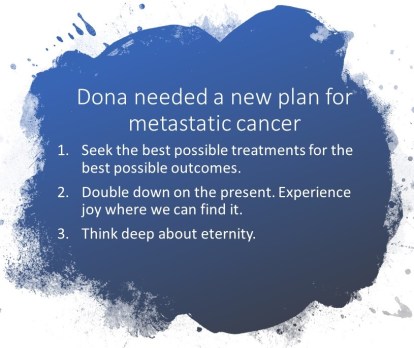

 We were waiting our turn. This was one of several high anxiety medical appointments. We would be told the extent of the metastasis. Our daughter had offered to come with us and we gratefully accepted. To tap down the tension she was telling us the most recent knucklehead antic of one of our grandsons. We were laughing.
 Hardly shocking are the numerous studies showing loneliness as adverse to physical health. More than depression or anxiety, loneliness predicts a lower mortality rate. People live longer who don’t report chronic feelings of loneliness. Consider the Roseto Effect; a 50-year study of the residents of Roseto, Pennsylvania, a community of Italian immigrants who lived sedentary lifestyles, were overweight, had high alcohol consumption, smoked stogies (whatever those are) and were exposed to toxic particles through their work at the quarries. Bottom line: they lived way longer than the average person in the US during the 1950’s. Being a descendent of Italian immigrants I was happily prepared to read that it was genetics that brought their good fortune of longevity. However, family members of the Roseto residents who lived in neighboring towns were not beneficiaries of the same great health. So, what was it? As it turned out no one in Roseto owned a TV and nightly group dinners were a common occurrence. Researchers, after controlling for about everything, concluded that these folks were dodging the bullets of loneliness’s bad health effects because they did use technology to entertain themselves in isolation. They just had each other and consequently lived longer for it.
 But here is the catch, what is there to be grateful for if I don’t have someone to say, ‘thank you’ to? Thank you to my husband for the endless times as he serves me selflessly and generously. Thank you to medical scientists and doctors who show compassion within their expertise. Thank you to my daughters and their spouses for their support and love. Thank you to my many friends who show me extraordinary kindness and love. But unless there is a cosmic creator whose thumbprint is behind all the small and great wonders of existence then the thankfulness loses its mystery, awe and lifegiving power. I feel more alive when I am thanking God. God is eternal and somehow my thankfulness is linked to eternity and therefore takes on a more powerful life-giving meaning:
 I have not written a blog post since the summer of 2015. Apparently, the absence of cancer in the following years anesthetized deep thinking. That was fine by me. I like to write but what I really like to do is talk and anybody who has met me can attest within 5 minutes that I like to talk and I can do so in a variety of formats: teaching, storytelling (my favorite), presenting sermons, sale pitches, chitchatting , joking, and just generally yucking it up. I’m an extrovert, obviously, so talking is not just fun; it’s a blood transfusion that keeps me feeling alive, energetic and vibrant.
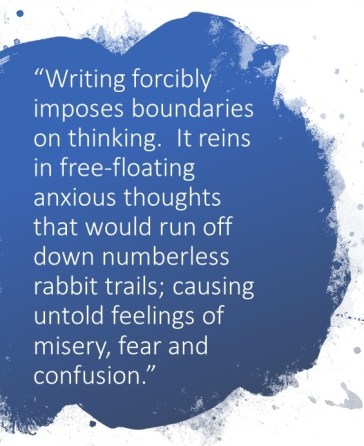 reins in free-floating anxious thoughts that tend to run off into numberless rabbit trails causing untold feelings of misery, fear and confusion.
 , I posted a blog titled, “Fear of Dying.” It described my anxiety while undergoing a CT scan to determine whether my breast cancer had metastasized. It had not. My worst fear was not realized. The “horse was still in the barn,” to use my surgeon’s phrase.
 Dona's Blog