What a dead rat on a grill taught me about caring for people

Since being diagnosed with breast cancer in February David and I have been living in Buffalo, NY. Daughters, grandchildren and a cancer institute two miles from the apartment we rent year around made the decision to settle in for the duration of treatment. Adding to those blessings has been the small urban Buffalo Vineyard Church that we attend.

A debriefing session was held after church today about the Friday evening barbecues that the church hosts in Buffalo’s urban west side during the summer months. This urban church is small in number but its members, mostly younger than 35, have big hearts and active mission to the people in their urban community.

We sat outside after church eating snacks while discussing the usual questions posed during a debrief of a major church initiative:  “What went well, what needs to be improved upon, what lessons did we learn for next year, and how did anyone see God at work?”

I shared my story and Maryanne said, “Dona that can be the title of your next blog post.”  I have taken her up on it because among other things rats can be great ice breakers of which I will explain shortly, but first I will share another time when a rat played an important role in a social setting.

Senegal World Vision trip 2005

Eight of us were eating in a restaurant in a small town near villages we were visiting.  Our church in Juneau Alaska was partnering with World Vision and village elders to bring clean water to an impoverished area serving a couple thousand people.  As we were eating our meal a huge rat darted past the door keeper.  Women screamed, maybe some men, too.  Some folks jumped on chairs and others like me were in denial saying ridiculous things like, “That’s not a rat. It’s too big. It’s probably a gopher.”  The rat was frantically running underneath tables and chairs trying to avoid the door keeper whose powerful legs finally won the day when he soccer- kicked the “gopher” rat across the room, through the door into the dusty dirt road from where he came.  The room erupted with applause, cheers and high fives as we witnessed this great athletic feat by our door man.  We laughed, told our versions, commiserated with the other patrons of the restaurant about their versions. Met new people. It was one of the highlights of the trip.

West Side Buffalo, June 2014

The grills were being prepared as adults from the community were coming and sitting on folding chairs and children were running around waiting for the food to be cooked and offered.  Many folks from the church had their barbecuing tasks to prepare for and others like me were sitting around trying to get to know some people who were coming to this weekly event.  I set my sights on a group of three women who seemed to know each other well as they talked about things in the community of which I knew nothing about.  But being the talker that I am (not even chemo can take that away from me) I ventured into their space and introduced myself and they did likewise.  They asked me if I went to the church that was putting on the barbecue.  I no sooner said yes, then they told me that they had seen a dead rat on one of the five grills that was getting ready to be fired up. In fact, they emphatically told me that the grill had been leaning on the side of the church for two days with the dead rat on it for both days; and someone needed to do something about that grill.  I had the distinct feeling that that someone was meant to be me.  Two reactions came up immediately. The first was laziness.  I didn’t want to do anything about it because I figured a grill heated up to over a 1000 degrees would kill any left-over dead rat-ness. I said as much but they were not impressed and seemed annoyed.  “Someone needs to wash that grill with hot soapy water,” the women said again and again. I knew that someone was meant to be me.  My second reaction was disgust.  I didn’t want to get that close and personal with a grill that had been the resting place for a dead rat for two days. I wanted to shoot back by using my cancer card, “You do it, I’m in cancer treatment and don’t need this”. But I knew that this was not the way to make new friends.

After cleaning the grill with hot soapy water, the women invited me back over to their circle with a, “You did good, girl!”  We all warmed up to each other.  Finding out I had cancer they told me encouraging stories about family members who got cancer and were treated wonderfully at Roswell Cancer Institute before they died ( hmm…..not the most encouraging of outcomes) but I knew for them the question of life or death was not the point  of the experience.  It was that their loved ones and they by virtue of proximity to their loved ones were treated respectfully and lovingly at Roswell Park Cancer Institute. They wanted me to be encouraged by such an important truth: how we are treated by strangers whose job is to care about us is the point.  I was so glad for hot soapy water and the presence of mind to finally show that I cared for what they cared about. This was my story of how God was at work, even through a dead rat.

Galatians 6:9 “Let us not become weary in doing good, for at the proper time we will reap a harvest if we don’t give up.”

The Waiting Room

I have a friend who was quoting an elderly relative to me once. The relative lived in a nursing home. The quote went something like this: “Sometimes I imagine that while I am living here I am in one of heaven’s waiting rooms.” I think we would all have to admit that she had to be one of the most positive and optimistic women we have ever heard. There are a lot of ways that this post could thematically be approached based on that one comment but I want to talk about waiting rooms.

The nature of waiting rooms
I usually do not mind waiting rooms if I am not hurry to be somewhere else after the appointment. Being a people watcher and communicator waiting rooms afford me many possibilities of entertainment. Admitting however that cell phones have changed the human interaction potential in waiting rooms, I still find the scene unusual enough to be interesting. I imagine myself sitting like an obedient dog with tail wagging and tongue hanging out hoping some human will pay attention to me and rub me behind my ear. I don’t just start talking to anyone. I look around, size up the mood of the waiting room crowd and wait for an opening and then off to the races I go. It is amazing what you can learn from people’s stories or opinions. And if you know me, you know that I am not short of my own.

The Phlebotomy waiting room
Last week I walked into the Phlebotomy waiting room to have blood drawn. It was crowded. Every seat was taken but there was one left for me. I sized up the mood. It was grim and motivated me to send up a quick prayer on behalf of my fellow cancer patients who needed what I needed – encouragement – before seeing their oncologist, surgeon, or oncology radiologist. All ages were represented but everyone looked old. You know how not smiling or talking makes the lines around our mouth droop down so we either look sad or mad? Well, if you did not know that – you know it now. If you are over 50 and don’t want to look 70 then smile more often. It makes everyone look younger. I ought to know. I have had deep laugh lines since realizing I wasn’t going to be young forever. My children and even my husband would say at times, “What are you mad about?” This was not fair as my only fault was that I was not smiling and not smiling apparently made me look like I was mad when I was just feeling and looking neutral, or so I thought. I have defended myself enough that I no longer get those comments.

Well, anyway, back to the scene in the phlebotomy waiting room where I was among the most isolated looking and silent group of individuals I had seen yet in a waiting room since my cancer diagnosis. 15 minutes into my silent wait something changed and it happened so quickly and dramatically that I had to ask a woman later on in the day who had been there whether she noticed what I noticed. She didn’t hesitate to agree that something odd was at work. Here is what happened: A woman walked into the waiting room and the man next to me noticed that there was nowhere for her to sit. He got up out of his seat and said for her to sit down in his seat. She was several feet from him so the interaction was heard and witnessed by all of us. She said, “That is alright, I have been traveling in a car to get here for two hours and don’t mind standing”. This older gentleman was having none of it. He insisted and she capitulated. The moment she sat down, the gentleman’s name was called to have his blood drawn. And it was at that moment that the entire waiting room burst into laughter. Why? I am not sure. Maybe these folks and I included were unsuspectingly waiting for an uplifting moment to bring us out of ourselves. The sweet irony of this man’s good deed seemed to earn him a surprising reward or a dispensation of grace- He no longer had to wait. He was called and in!  Ok, that was cool enough for this sad looking group but it wasn’t the end of the story. As soon as the laughter died out, strangers started talking to each other. I mean everyone was talking except for one cell phone engrossed person. People were talking to those next to them and to those across from them and the conversations were animated and prolonged. The buzz in the room solicited a comment from the receptionist: “Hey, is there a party going on in there?” she yelled from a room close by. I remained detached for a short while as I tried to understand this phenomena objectively. Questions of psychological and spiritual nature were being raised but before long I, too, wanted to be a part of these human connections.

What to make of the waiting room transformation
“And God said, Let us make humanity in our image. God made man and then announced that it was not good for man to be alone, so he made a helper suited to the man and he made them male and female; both made in the image of God.” God, Himself, is community, Father, Son and the Holy Spirit and apparently does not want us to be alone. We are wired to belong to each other. A spark of the Holy Spirit is what I believed happened in that waiting room. Isolation gave way to community and we were all better off for it. Encouraged, uplifted and hopeful is what we experienced and all of that without one of us having yet to see or hear from our doctors. God bless our doctors and what they do but at that moment we didn’t need them.

Forgetting Cancer

For 6 months my invasive breast cancer was always before me. First, there was the diagnosis and the anxiety of waiting for various test results.  Then there was the mastectomy with the pain of the surgery and the discomfort of the lymph node drains.  Four months of chemo beset me with nausea, fatigue, and a compromised autoimmune system that at one point landed me in the hospital for three days.

Grim Realities Helped Me Forget Cancer

But when chemo was over I got a 3-week reprieve before radiation therapy. I was feeling pretty well; almost normal aside from the fact that I was missing a breast and had to decide each day which wig or scarf to wear to cover my hairless palette.  So I used the break to visit elderly parents in another state. David, my husband, had to return to Alaska for over a week to keep his business going so I was on my own as I scrambled frantically to “fix” my parents’ needs before I left to go back to Buffalo for radiation.    A combination of guilt, sadness and frustration with my limitations in fixing their limitations would begin the process of cancer-forgetfulness.

My parents, being house bound, watch a lot of TV……CNN, Dr. Phil, Judge Judy.   I normally keep up with news through radio and the web.  I was not used to seeing the CNN images of conflict, terror and extreme hardship from around the world.  As I tried to process the suffering of the Gaza and Israeli conflict, the ISIS reign of terror, and Ebola crisis in West Africa I was unconsciously strengthening the process of cancer-forgetfulness.  Even watching Dr. Phil and Judge Judy every weekday with my folks provided distractions from my current health despite of my temptation to be critical of media exploitation of these human messes.

Now all this might sound a bit grim.  There I was dealing with cancer treatment yet distracting myself with morbidity and tragedy. But I could not allow my situation to keep my head in the sand about the tremendous suffering happening in this world.  If I did I was at risk.  My situation with its potential for corrosive self-absorption would end up robbing me of empathy for others. Now, I am not speaking to those who suffer severe pain or those in late stages of a terminal illness.   Nor am I writing about those in the midst of anguished grief for the recent loss of a loved one. What I am addressing is the threat of self-absorption that can come from dealing with a serious health challenge, robbing of an identity other than the illness, itself.

Taking time to think helped me to forget cancer

There was  something else that was going on that aided my cancer-forgetfulness for those weeks; something upbeat and something I will need to continue whether I am  busy with obligations or not.  I took time to think in the midst of parent care.  Each morning before I hit the ground running I would find a quiet place in the home of my gracious hosts to read, pray, write and think. My thoughts were being reoriented to life’s meaning and purpose. The essential Christian doctrines of faith I held had to be thought through deeply if I was going to find the peace I was looking for.  God, Jesus, sin, human nature, salvation, the world and God’s plan for the world, hope, faith, love, and service to others were the grist for the mill of my soul’s peace. It always came down to, “Do I really believe what I believe?” and if so, “What’s the big sweat?”  God is in control and I can trust Him.   And eventually gratitude found its way into my thinking as I thought of family and friends that spanned the world who were not just blessing my life but blessing the lives of so many others.

(Tim Keller talks about this in his book, “Walking with God in Pain and Suffering”).

Being in awe of the sacrificial service of others helped me forget cancer

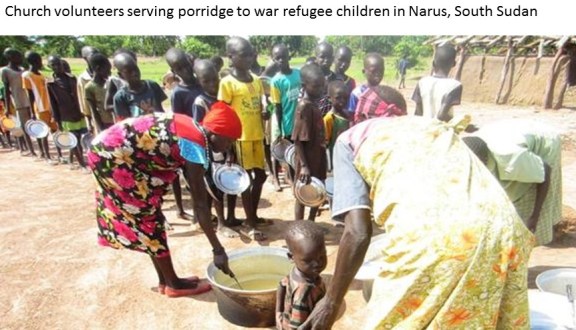
AsIDP CHILDREN IN NARUS_cropped I spent time thinking something else happened. I would read or hear stories about people who were doing extraordinary acts of service because of their compulsion to serve Christ.  Some of these people I knew through my Juneau church’s partnership with ministries abroad.   Pastor Saphano, the Sudanese pastor of a poor struggling church in southern Sudan, who manages to house and feed over 250 orphans and refugee children from the civil war.   Hannah who currently pastors a church in Amman, Jordan for Syrian and Iraqi refugees but once was the pastor of the Baptist church in Gaza.  He continues his ministry in Gaza (see an interview with Hanna here) by providing aid to hundreds of Gazans as well as most recently opening his home in Gaza to 100 frightened refugees of the Israeli/Hamas conflict.  David and I have stayed in that home and it is hard to imagine 100 people staying there. There are thousands of people like them who are servicing in lands of great conflict and suffering with sacrifice and love.  When I take the time to reflect on such things I begin to forget cancer.

Thinking more, not less, helped me forget cancer

I read or heard once that perhaps God commanded a day of rest (Sabbath) in the Ten Commandments because he knew that if humans were left to themselves they would never stop in their frenetic work to eke out an existence in order to think through the big questions of life. Taking time to reflect on the meaning and purpose of life will bring many back around to Him with a growing awareness of how life is meant to be understood and experienced.  This reflection cannot always be done perfectly, that is for sure, but nonetheless, this type of reflection builds an appreciation that this life is not all there is.  It is a reminder of the promise that He is with us through the tough and good stuff whether we feel it or not.

I am back in Buffalo now.  I’ll be reminded of my cancer every week day morning for the next 6 ½ weeks of radiation therapy.  But I can still practice the discipline of thinking about the big picture; making sure I find the time to remember who God is and who I am supposed to be with cancer or without.


No skimping on kindness during cancer treatment

I looked up and there she was. I was waiting for my big breakfast egg scramble at an outdoor café, excited that I was feeling energetic and had an appetite. I had walked from my apartment to my favorite breakfast place to eat and work on my latest blog.

I was finishing my blog post on body image as I waited to be served my breakfast.  As she sat at an empty table I could feel her eyes on me. My initial knee jerk response was not to make eye contact.  I sensed she would approach me for something maybe just conversation but I had my own agenda and it didn’t include a long conversation with anyone. I couldn’t resist so I quickly looked up and then returned my focus back to the lap top faster than I could say egg scramble. Not sure but I thought we had actually met before in front of a laundry mat (a real talker – it takes one to know one) but I doubted she remembered me. She hangs out a lot on the street looking for approachable faces. Now, if this wasn’t bad enough on my part here’s where it gets really down and low. How I was behaving was a violation of one of my own recently acquired rules since becoming a city dweller. The rule: make sure eye contact is made and at least a few words are spoken to someone pan handling when responding to their request.  Why?  A few years ago while walking the streets of Jerusalem I was  reminded out of nowhere that people who panhandler or those sitting  against walls with blankets and change cups in tow were human beings, made in God’s image and deserving of dignity.  Furthermore, they were once children who didn’t have the ambition to become homeless or a pan handler when they grew up.  Like me and you and all 6 year olds they couldn’t conceive a future, regardless of how bad their childhood was, that excluded a dream of being a firefighter, teacher, nurse, shopkeeper, or professional basketball player.  I doubt that any of these adults on the street said to themselves at 6-years old, “When I grow up I hope to wear tattered clothes, be alone and ask people for money as my daily routine.”  So, from that time on I determined that I wouldn’t just place money in a bag or hand without making eye contact and saying something. It’s not as easy as you would think. Folks experiencing homelessness are accustomed to thinking of themselves as nobodies. They know we are uncomfortable with their circumstances and they are counting on us to relieve a little of our own guilt.  Just drop it in or hand it out and keep moving; that’s all that is expected in this street drama of the haves and the have not’s.

Well, back to me – My breakfast came and I don’t know if was the size of it or the presentation of it; but staring at it I was immediately overwhelmed by my privilege and plenty.  I then knew what I wanted to do and it wasn’t out of guilt. I wanted to invite her to join me and share my breakfast or order her own. I looked up. She was gone. I waited hoping she would return but she didn’t.  I finally ate disappointed and a little dejected for a missed opportunity for both of us.  Interesting that I felt disappointed and dejected; emotions that are likely standard fare for my would-be eating partner.

For parents, grandparents or anyone who have opportunity to influence children for goodness and kindness please read the following article: A Mom’s Hope for a Better World.  Full of interesting statistics, good insights and practical suggestions, this mom does a great job of looking at the world and ‘bringing it home.’

The New 60?

Last week I read a thoughtful, insightful on-line article by Sharon Hodde Miller entitled, ‘Why pastors should preach on body image.’ As it turns out I am not the only one commenting or blogging about this article. By and large the comments have been supportbrinkleyive but for some it hit a raw nerve with angry criticism towards the author and the church. The following thoughts expressed in this blog and the ones in the article tend to be slanted towards the younger generation.  But there is something for us oldsters to take home as well.  After all, aging creates its own image issues. We are certainly not helped by the recent People magazine cover photo of Christie Brinkley at 60 years old.
From what I can ascertain the angry comments about Miller’s article come from women who have struggled with eating disorders and feel the article is judgmental and damaging. Furthermore, they have been hurt by a church whom they believe has misunderstood the complexities and difficulties of an eating disorder. The perception that they are meant to fix themselves haunts them and adds to an already in place self-loathing.

Even though eating disorders are mentioned in the article (please read this article – very provocative) my sense is that Miller addressed primarily the preoccupation and obsession to improve ones physical appearance to the exclusion of interests worthy of our nature as God image-bearers. By the way, this is not just a female issue.  As the article points out more and more young men are succumbing to the pressures of body perfection.

Personal Background:

Our culture has done a good job of selling us a self-worth based on others acceptance of us. If you were born female that acceptance was conveyed to you by a media culture that said that appearance was your only ticket for that acceptance.

Thirty-three years ago when I was pregnant with my first child I heard a pastor describe our culture’s message in this way, “If you are a boy you will hear the message that there are three ways to have self-worth: good looks, athleticism or intelligence. If you are born female the message will be: good looks, good looks or good looks.”  This was true for me growing up and I figured my child, if a girl would be fed the same message.  Right after my daughter was born a friend asked me if I would like a signature bible verse carved on a wood plaque as a baby gift. I chose the following verse and still have the plaque as a reminder of an important truth. It comes from the next to last verse of Proverbs: “Beauty is vain (fleeting) and charm is deceitful but a woman who fears the Lord will be praised.”  I honestly believe I had the verse written more for myself than for my baby girl.

I read that verse now and try to understand it from the most recent assault on my body. I’m missing a breast.  I am not really sure I want breast reconstruction in spite of the fact that recent research shows an increase of self-esteem and positive mood for women who choose to do so. Then again I’m 63 years old.  If I was 33 or 43 I might know for sure that I wanted a body that conformed with the bodies of my gender. But then I go online and see younger women modeling their one breasted selves in bathing suits called monokinis; exposing the surgical side of their mastectomies.  I’m amazed at their confidence; but I am still sitting on the fence about the whole thing. Is my ambivalence reflecting something amiss in my body image? Again, I am not sure. After all if you know me, you know I am certainly not against wearing makeup, especially lipstick (read blog post: ‘The Upside (I mean it) of being Bald’).

Theological considerations:

Body perfection is a natural longing. I believe that as human beings we naturally yearn for perfection and beauty.  Maybe it comes from an innate primal look-back to the perfection we had as sinless God-image bearers or perhaps it’s a subconscious looking forward to a time when all things will be made right through the promise of a new created order with God’s beauty and perfection being the mirror reflecting our perfected selves.  Many of you have heard the following before but I think it’s relevant to the issue: “There is a God shaped vacuum in the heart of every man (and woman) which cannot be filled by a created thing, but only God, the Creator, made known through Jesus” (Blaise Pascal, 17th century Christian philosopher and writer). We walk around yearning for something to fulfill us; something beautiful, awesome and perfect.   We are wired to be filled with Him, the only all perfect One.  If we chose to go it alone then we are at risk to seek perfection and fulfillment in ways that deliver for a while (maybe) and then let us down with their lack of permanence.  I agree with Miller’s main point.  We are in need of pastors and anyone else who has a platform to tell us the truth about ourselves.  The truth is that the relentless pursuit of perfection in ourselves is futile and speaks of something broken in us and our world. We need to be reminded often that we are loved and of immense value to the one who made us, died for us, forgives us for our many imperfections(imperfect bodies is not one of them) and promises to return and set everything anew with beauty, glory and perfection.  Meanwhile I will let my far from perfect body be a reminder of a needful medical procedure that saves lives and of a self-worth that is really God’s worth being allowed to overshadow me with his message of love and acceptance.

Some asides:

I am so sympathetic with those who have eating disorders. I have treated people with this condition in my practice and I know their struggle and pain. Seeking help and keeping hope lend to healing and restoration. There is always hope.

For the rest of us let us be mindful of being drawn in by a culture that gives us no breaks.  On one hand we are castigated for being overweight and putting a burden on our health and our health care system and at the same time castigated for being too thin and self-obsessed about our bodies (hopefully my blog posting isn’t adding fuel to that fire).  And don’t forget that we are also being fed a steady diet of images meant to cause us to emulate or at least envy the beautiful so we can feed a greedy appearance industry.  Be aware and forewarned that our culture gives us mixed and contradictory messages.

Watch out for comparisons when it comes to caring about physical appearances.  “Pride gets no pleasure out of having something, only out of having more of it than the next man (or woman)… It is the comparison that makes you proud: the pleasure of being above the rest. Once the element of competition is gone, pride is gone.” (C.S. Lewis, Mere Christianity).  In a different way, feelings of inferiority in comparison to others about appearance diminish us and them in our eyes thus interfering with our ability to get to really know and love them.

I’ll stop with one practical suggestion.

Try breaking the stranglehold of damaging comparisons by intentionally looking for attractive qualities in a person that are not appearance-based.  Look for something about their character, their personality, how they treat someone else, how willing they are  to be helpful, friendly, listening, accommodating, generous, their parenting style, cooking, whatever!  Look intentionally for anything, make a mental note about it and tell that person, or tell someone else about your positive observation about that person.  This is not superficial and inauthentic.  The Lord knows we need help to think less of ourselves and more of others.  It doesn’t come easy but let’s not give up.  I suspect that if we do this regularly we really will break the stranglehold. Our positive view of others and healthier views of ourselves will become second nature, our thoughts deepened and our lives enriched.


Steroid Side Effects: New BFF’s’

‘Tis’ the privilege of friendship to talk nonsense, and have her nonsense respected.’     – Charles Lamb, 17th century poet and essayist


The last couple of infusions have required a total of 10 steroid pills to be taken during the 18 hours before the infusion. This only happens the day before the infusion and David is so thankful.  Here’s why.

After the first episode of steroid glut David asked if he could give me a signal while I was in the clinic that would indicate that I needed to take my enthusiasm and gregariousness down a notch. The signal would be a wink. I was all for this.  I certainly didn’t want to add embarrassment to him or myself due to a steroid over-exuberance. I agreed to the signal and thought that we had worked out something very appropriate.

Then came the day of my second infusion.  My system was flooded with steroids.  Yippee!  I knew I was walking the knife edge between friendly and inappropriate but I was having way too much fun yucking it up with everybody…….and I mean everybody.  Pity the stranger who just happened to look my way as I wanted them to become my new best friend.  I knew if I looked at David’s face it would be winking away so I made a conscious decision to not look at him.  What did he know?

Perhaps you are curious what my opening liners were to try to engage my new best friends?

“Hi there (lady sitting in waiting room), you have a really nice tan. I mean it; a really pretty tan.  But are you supposed to?  Aren’t we instructed to avoid the sun while on chemo?  Tip: start with a complement but end with a friendly helpful admonition or criticism.

Our conversation ended up being shorter than I would have liked.

Next attempt to make new best friends.

“Hi, I remember you guys from two weeks ago. You are the friendly volunteers who carry around the goody cart.”  (So far so good).

Then David said hi, too, but called one of them by the wrong name, or so I thought. Apparently steroids make one’s thoughts the rule of the land. I drew attention to the fact that David had called the woman by her wrong name. We argued about that in front of the volunteers.  I tried to enlist the volunteers to take my side.  They said they were instructed not to get in the middle of family disagreements.

The goodie cart rolled away sooner than I would have liked.

The infusion center at the cancer institute is huge with 36 infusion chairs or beds.  I decided I would visit all 35 of my chemo brothers and sisters.  I told David I was going to the bathroom and would take my IV pole with me and wouldn’t need his help getting there. I wandered the aisles to see if there was anybody I recognized from my previous visits.  Bingo! I quickly engaged a friendly and talkative 80 year old something patient that I had met the previous week.  Cruising and talking was great.  Eventually David and my infusion nurse found me and semi-dragged me back to my cubicle.

Friendly 80-year-old and I could have talked longer. She was probably on steroids too.

Back home and coming down from steroid exuberance I began to think about the awkward side of friendliness amongst strangers.  I searched the Net to read what not to say to people while seated next to them on a plane, clinic, or any other waiting area.  Here are some ‘pick-up or hi-ya’ questions I hope to avoid asking at my next infusion:

“What do you do about rectal itch?”

“Does this look malignant to you?”

“Want to see something really weird?”

All steroid frolics aside:

A little bit of steroids are great.  We all know of their anti-inflammability benefits.  A one-time mega dose of steroids is one thing but I hope that those of you that must take steroids long-term and experience the adverse side-effects read this blog post for what it is.

There is good research touting the health benefits of connecting with strangers “appropriately” (benefits for you and benefits for them). We just need to be willing to take a risk.  It is both spiritual (God created community), emotional/mental and organic. New human connections boost oxytocin and serotonin, which are biochemicals that build our immune system, improve mood and bond us with others.

So, I’ll see you out there making new best friends.  And don’t forget to smile (see blog post entitled, ‘Duchennes Smiles Only, Please’).


Uprisings of grief and anger in the Middle East

As many of you who read this blog know, David and I have been volunteers with the Palestinian Bible Society (PBS) since 2004.  Since 2007 we have spent two months a year in Jerusalem working for PBS. This year was an unexpected exception as I was diagnosed with cancer shortly before we were due to travel to the Middle East to assist the staff in the good work of peace and love that they do in the name of Christ.  One of the greatest disappointments of the diagnosis and treatment is not being able to be with people we love, doing a work of shared purpose and commitment.  Of course some may think our trip cancellation is a hidden blessing, given the recent tragedies which have sparked the uprisings of tension, rage and fear.   But as many of you would agree, when your loved ones are in crisis there is no other place you’d rather be than with them.   That is how we feel about our friends of PBS. Please take the time to read the following communication to supporters of PBS (prayer for peace in Jerusalem) forwarded by the director, Nashat Fellemon.  I think you will agree with us that the voice of reason, love and hope that is the vision and hallmark of the Bible Society is what is desperately needed in times like this.

_____________________________________________________

Dear Dave and Dona:

Thanks for your email, I hope you and Donna are well. We miss you guys here and we pray that the hand of the Lord be with you for healing and for full recovery.

I am attaching a PBS_Prayer Call Alert we did during the weekend, this expresses the heart of PBS in this conflict and a call for peace and prayer for this troubled land.

I feel that what happened to the 4 teens was terrible, the brutal killing of 3 Israelis and in retaliation 1 Palestinian  has caused tension in the land that I have never witnessed before. It’s sad to see that the walls are only getting higher in the hearts of the people and hatred and animosity is the common language in the streets. We pray may your kingdom come, may your will be done on earth.

We pray every morning for the Muslims during this month of Ramadan and also for the situation, we will be praying for you too this morning.

Peace,

Nashat

Credit Deficit Despondency

There can be something about being on the receiving end of much kindness that is unsettling.

All of us have heard something to the effect of, “I am more comfortable giving to people than I am receiving from people.”  It is a good, nice, healthy (mostly) sentiment.  After all, Paul quotes Jesus as saying, ‘It is more blessed to give than to receive.’  (Acts 20:35)

Ah, but within the full context of the verse lies the rub:  “In everything I did, showed you that by this kind of hard work we must help the weak, remembering the words of the Lord Christ himself said: ‘It is more blessed to give than receive.’”

credit_croppedSo, at this point in time I am ‘the weak.’  Moreover, I suspect that my hard work to help the weak when I was healthy had some dubious motivations.

I heard a pastor once say in a sermon that human beings ultimately want three things: credit, control and choice. But our lives are not guaranteed any one of these. In fact when we think we can master, manage or possess any one of the three we are living an illusion.

During this time of cancer treatment I understand and accept my lack of control and choice.   But I was surprised to realize how strong that desire for credit was operating within me.

I’m aware that I am not contributing that much to others at this point in my life and I don’t like it. I never thought before that serving others was for any kind if credit but of late I am beginning to wonder. The way that has been exposed in me was not in ways I would have imagined. Let me explain.  There are not too many days that have gone by since my cancer diagnosis that I have not received a card, email, text, gift ,flowers, an inspirational book or some other token of love. In the beginning each outpouring of encouragement was met with joy and appreciation. My self-worth and self-esteem were not only intact but also bolstered by the kindnesses shown to me by others. But as time and the protracted treatment process marched on something began to change.  It only became apparent recently and I didn’t like what I was seeing.  I had descended into something I will call “credit deficit despondency.”   At the beginning of this treatment journey the memory of my service to others was still fresh as it had not been very long ago that I was that person who enjoyed and drew a lot of purpose and satisfaction from busily assisting others. I sensed God’s call on my life and I felt equipped to do what he had called me to do. I felt special in what I was doing.  Along came cancer.  I was not prepared for the long treatment and its many compromises and preoccupations.

The days, weeks and months were now dimming the memory of my time as a useful service-oriented person.  But still the faithful encouragement of others was coming my way.  How unbelievable that people were not bored with me and my progress because I was certainly bored with myself.  Credit deficits were mounting.

Emotional application:

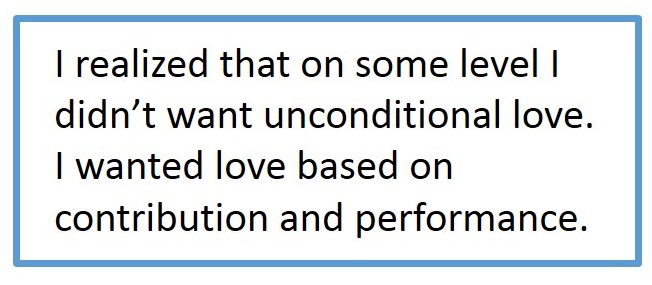
I realized that on some level I didn’t want unconditional love.  I wanted love based on contribution and performance.  I had been spoon fed this since a baby.  Haven’t we all? It is the way of our culture.  We say we want unconditional love but really we want to be loved for a reason.  And we believe we deserve it. We’ve earned the credits for it to happen. We either have some gift, talent, virtue, service, sacrifice, personality or special something that earns us the affection and love of those who mean something to us.   And we control it.  Of course this is not a fully conscious understanding of ourselves or certainly it wasn’t of me until I was put in a position of not being able to do much to effect any kind of positive change. It began as a slow creep accompanying the snail mail of cards painstakingly picked out, handwritten, addressed, stamped and sent out. Ouch! The credit deficit was mounting.  I could not control it and I had no choice in it.

So, what was I to do about this? It didn’t feel good or right.  After all my many years as a Christian I had to go back to Christianity 101 – the basics.   I am a sinner who received God’s grace (undeserved mercy and love through his death on the cross to secure my forgiveness now and forever). I had and have no good deed credits to offer him that influences his unconditional offer of love and forgiveness.  I have the promise of being with him now and forever.

The psalmist says that, “God’s loving kindnesses are new each morning.” Unconditionally, they are offered to us. Christ is not interested in credit surplus or deficit. He’s interested in us “getting Him.”  He knows “we are but dust” but he loves us and offers Himself unconditionally. When we get that – more personally when I get it – my heart breaks.  The worthless attempts to validate myself empty out and then there is room to be “built up and rooted in Christ’s love” and “to be still and know that He is God.”  And somehow I am changed by that in a good way. I can receive and I can give. And His love is never impressed one way or the other and that is good news.

So, back to Acts 20:36 and the bottom line:  I have freedom to be weak whether emotionally, physically or spiritually.  When I am strong I have freedom to work hard to help the weak (as so many of you have done for me in recent months)…..not for credit but for the simple reason that God loves the weak and it feels good to help when we can.  That is truly good news.

We saw the sunrise (in Mosul) and we said, ‘Oh God you are good!’

I believe in Christianity as I believe that the sun has risen: not only because I see it, but because by it I see everything else.”

― C.S. Lewis

This post will not be a cancer-related one unless cancer is used here metaphorically as we take time to consider the malignancy of some suffering in this world.

Have you ever heard a story that left you in awe or perhaps confused as to how to make sense of it?  You knew that what you were hearing was swelling with profound meaning but because you had never experienced anything close to such a thing you felt inadequate to try to give words of meaning to what you heard; as if you might risk exposing a small-mindedness or an arrogant superfluous-ness.

I am about to share a story with you but it will be the last thing I will write for fear that I will be tempted to comment or explain. Some stories are stand alone and they work their meaning for each individual in unique emotional or spiritual ways. And that meaning can be transformative in some way. Offering a commentary can perhaps rob the story of its mystery of inspiration for a particular individual in a particular way.

I have been a subscriber to two different websites that track and follow the persecution of Christians in areas of government repression or radical Islamic insurgency.  Release International (a UK-based organization) and World Monitor Watch (a ministry of Open Doors) inform of persecution of individuals or whole communities. Their information is based on sources that are close to the situation and are supported by a few secular media organizations.  These stories of persecution have become so numerous, common place and seemingly intractable that unless you are looking for them they are not reaching your typical news source.

Recent news coverage of the fall of Mosul, Iraq to radical Islamist insurgency forces has made all the major news sources. What may or may not be explained in the telling of the takeover of the city by ISIS (the Islamist insurgents ) is the terror that 3000 Christians are experiencing as they desperately try to escape a possible death, abduction, or worse as they become a target of hostilities. We are aware that this is happening in Syria as thousands upon thousands of refugees flee to Jordan, Lebanon or any place that they can get to. And yes, these terrorized refugees are Muslim as well as Christian. Civil war is no respecter of religion, age or defenselessness. However, in both countries (Syria and now Iraq) thousand year old enclaves of Christians are being targeted for extinction, extortion or forced conversion.  Entire communities, towns and cities of Christians who have lived peacefully for centuries as minorities in Syria and now in Iraq, have fled.

Typically the web sites I go to for updates don’t share personal human interest stories. They typically tell the facts and ask for prayer or some form of advocacy.  I pay special attention, however, when a personal story is reported.  The following is part of the full story of the Christian flight from Mosul as reported in World Monitor Watch and it left me so humbled and in awe of God’s work in the hearts of Christians in the midst of great adversity.

“A family with four small children, three to nine-years-old, living in the most dangerous area of Mosul – similar to the Green Zone in Baghdad – said after ISIS reached Mosul on June 6 they planned to leave early Tuesday morning around 7 am. But on Monday evening – while they ate dinner – two homes next to them were hit with RPGs and set on fire.

“We left the food and ran,” the wife said. “We didn’t even stop for our shoes, we fled in our sandals! We just made sure to take our I.D.s and important papers. The children were very scared.”

An older woman spoke of the long trip leaving Mosul:  “We saw many people crying, and very angry. But we were singing praise songs in our car. We saw the sunrise, and we were saying, ‘O God, You are good.  Thank you for this peace we have, we didn’t sleep all night, and still until now, but we are not angry. When we are rich in God, it is very special in these kinds of hard times.”

At one place where they were stopped waiting to pass, she saw some young men who were very angry. She went over and said to them, “Do you believe in God?” When they said yes, she asked, “Can I pray for you?” So they said ‘yes, please pray for us’. So she prayed with them there. “And I’m still praying for them now,” she added.

The church leader joined in: “Pray that we can return quickly to Mosul, because the future is unknown for us all. What kind of jobs we can get here is limited, and of course students missed their final exams, which are now postponed. How can we live, find work for an income? The church is helping us temporarily with living expenses, but we can’t stay here forever.  If we cannot return, we will apply for residency here in Ankawa. We believe God will care for us, as Jesus said He does for the birds of the air!”

“God is good, all the time!” he added, with a big smile, gesturing to the children tumbling over each other and playing in the tiny hallway. “We pray things will get better, so we can go back to Mosul.”

Upon leaving, the church leader gave a final plea: “Pray for peace in Iraq.  We have had enough of wars. Nowhere is safe here.”

Lord we join our fellow believers as we pray for peace for everyone and the end of terror.  (Psalm 10:17-18)  Amen

(Sorry dear readers, I did just leave a commentary.  I couldn’t help it.)


The upside (I mean it!) of being bald


In this post I want to  speak to the pluses and minuses of being bald. I’m serious….not tongue-in-cheek, or just funny or sarcastic. I have come to see some real advantages about being bald.

The positives:

1. You feel squeaky clean after a quick shower.

2. Your head dries within seconds – no blow drying, no nothing – just you and your natural born head.

3. You never have a bad hair day.

4. If you ever get head lice it will be easy to get rid of.

5. You get to reinvent yourself with the many wigs that you have conned from the American Cancer Society.  (Not really a con; it is just a matter of going to all the different ACS sites and asking for your one free wig.  They don’t care that you got one at another location.  Thank you, ACS.)

6. Friends give you gifts.  Some are beautiful scarves that you can wrap your head in different styles: African, Gypsy, Egyptian.   Again you’re reinventing yourself.

Aside:

You know how our mothers always told us to make sure we had clean underwear on in case we were in an accident and had to be taken to the hospital?   Well I’ve got another one for you ladies:  always make sure you have on 24-hour stay lipstick and earrings..

True story: In an earlier post I mentioned that I passed out at the oncology clinic due to fever and infection; an episode that required the hospital’s  rapid response team to be summoned.  Once they were reassured  I was no longer in crisis  they started talking to me.  Let me rephrase that. They started talking about me.  At that point I was slowing regaining consciousness.  I could hear and understand but I just could not summon the strength to open my eyes.. I heard one responder say, “Look at her she still has her lipstick on!”  At that moment I knew something critical had to be said whether my eyes were open or not. So I said, “By the time I have my eyes open I expect all of you that are surrounding me to have your lipstick on.”  (I desrved that.)  They laughed and said that Ralph only wore his at night.  (Ralph had to have been a medical student.) See ladies, clean underwear won’t generate admiration or laughs.  Wearing clean underwear is just doing your duty.  Wearing 24-hour lipstick is above and beyond.

Positives of baldness continued……

6. When you want your husband to feel sorrier for you than you deserve you can  walk around the house bald or with an unflattering scalp cap; looking very pitiful without your lipstick or earrings. It might get you a back rub or yet another glass of lemonade. But don’t overdo  this, it will backfire. One time after being particularly demanding my husband looked at me in my scalp cap and said, “You look and act like you are in the mujahedeen!”

7. When you finally decide to spruce it up a bit you get more than your share of compliments from your husband. He really means it because he’s really relieved!

The downside:

Did you notice that I didn’t mention a single negative? There is one big one:

You cannot ride in a convertible.  If you ride in a convertible you wig will invariably fly off once the car attains a speed of 45 miles an hour. It is likely your friends will be videotaping you when this happens. The video will be uploaded and go viral within minutes. This is subject to YouTube embarrassment and notoriety worldwide. I know this to be true because I know of it happening to at least one other woman.

So I’ll close with a link to the  Church Lady’s Wig Flies Off. I have watched this YouTube a dozen times.  I love this woman and I love her family and you’ll see why.  Listen carefully for some few  keywords. She explains what a “Treacher” is.  Listen for the word, “road kill”.  Watch the  the expression on her daughter’s (the driver’s) face.  Listen to the teasing of the other daughters that are on and off-camera.   And finally listen for the expression that I could have said, “at least you wearing your lip stick!”


Please weigh in on this topic of plusses of baldness in the comment section. No negatives please.

Some illustrations from my own creative hand to amuse and educate: remember you are reinventing yourself.

Lipstick, earrings, wig and looking twelve


Egyptian scarf with lipstick and cool earrings
No lipstick, no nothing but grumpiness
Short curly wig. Too much lipstick but cool earrings.
Gypsy scarf with lipstick and earrings but looking 10-years old.
African turban, lipstick, earrings