The Storyteller

It is gratifying to tell a story to a sensitive 4-year old. The stories don’t have to be particularly interesting with complicated plots, characters or climaxes. They sometimes don’t even have to be stories at all – just mere observations told with some real or feigned flair. But nonetheless they are received with appreciation and interest.
“Oh, look Marlon (my grandson), there’s a guy smoking a pipe. You don’t see that much anymore.” “Why,” said Marlon. “I don’t know. But my dad used to smoke a pipe but then he stopped smoking it when he learned from the doctor that it was bad for his health.” Health and/or moral lessons can be sneakily introduced this way. That story got retold to his parents later on when I wasn’t there. Too bad, because Marlon got the story understandably mixed up as he thought that I said his dad had smoked a pipe. My son-in-law had to tell him that ” Nonna was mistaken”. Shucks! I had to retell the story with emphasis on my dad, not his. By that time, Marlon was hardly interested in the retelling of a story that only included a change in proper names.

Sometimes my stories generate sympathy and compassion for almost nothing. “Hey Marlon, yesterday, I saw a guy carelessly throw trash out of his car onto the street. Boy, that wasn’t nice, was it?” “Why”, said Marlon. “Well, because we all need to work together to make our roads and communities clean and nice places to live.” Later, Marlon said, “Nonna, I’m sorry that you had to see someone litter from their car.” I was impressed that my non-story had such an impact even while feeling a tad guilty that my litter story had not nearly the emotional impact on me as my grandson assumed it had. Shame on me.

Storytelling is hot at the moment
There are books, seminars and workshops on Storytelling. It appears that we are all desperately in need of hearing a good story or, better yet, to be able to tell one. The goal is to create stories that are interesting, arresting, and even life changing. Libraries, clubs and shows advertise upcoming storytelling events. Good communication and sermons must include stories to hold the interests of its audience. That audience can sometimes be just one person like your spouse or child. This current trend has a way of making Storytelling sound like it’s the newest tool for good communication. It is almost as if before now, we were only communicating in treatises and legalese or worst yet, in grunts, texts and tweets. But Storytelling is hardly new. We have been telling stories ever since we humans have been sitting around camp fires rotisseriz-ing our wild drumsticks. We are hardwired for stories. Oral storytelling has been the ancient way of entertaining and efficiently teaching the younger generation of what was important for group cohesiveness and how to stay alive in a world rife with dangers.

We still do it.

I unfortunately got the “tell scary life stories gene” in spades as my daughters can testify. They are able to retell every, “once there was this person, and they did something and then something really horrible happened to them so watch out” story I ever told them. I am working on suppressing this anxious gene expression for the sake of my grandchildren. In fact, I am hoping to be able to tell them some of Jesus’ stories in winsome and engaging ways. And hopefully, like Jesus, I won’t do my Aesop’s fable-lesson- type-thing at the end of the story to make sure they get the point. Rather I hope to let Jesus’ parables do their own mysterious workings in my grandchildren’s hearts and minds; informing their understanding of God’s love and what He wants of them.

I have been attending to the parables of Jesus for several decades. I am often surprised how freshly they communicate God’s ways and wisdom. ” The prodigal son” (Luke 15) is a personal  favorite  when I am tempted to feel that God  doles out love and acceptance based on performance rather than faith in His love and sacrifice. My latest appreciation of this parable follows, thanks to Kenneth Bailey.

A very incomplete recap of Jesus’ story of the “Prodigal Son”
The story begins with a young adult son or teen who asks for his share of the family inheritance – a request that was unheard of in first century Palestine. The request amounts to a “you are taking too long to die so give me my inheritance now.” Jesus’ audience would have perked up immediately with this story’s beginning as it would have belied the cultural norms right from the get- go. A son behaving in such a way would have been punished but surprisingly the father grants his request and off the son goes to a “faraway place where he proceeds to squander his inheritance on wild riotous living.” Jesus then describes the son’s descent into self-inflicted poverty. Alone and starving the son remembers the stability and comforts of home and decides to take a chance and return. He, too, knows his culture’s expectations of how to treat such a flagrantly disobedient son. But he is desperate.

Jesus’ first century listeners would have assumed the ending to this morality drama. The father who is also a wealthy landowner and by implication a leader and one of the guardians of the community’s stability  would have the son killed, banished or, if inclined to show mercy, treated as an hired servant with no claim to a son’s status or affection. The latter is what the son is hoping for as we listen to his internal dialogue being practiced on his journey back home.: “Father, I have sinned against heaven and against you. I am no longer worthy to be called your son: make me like one of your hired servants.” (Luke 15:18-19)

And why not? There needed to be an ending that would help keep the community intact. After all, youth listening to a story like this would need to know that if you break the community’s rules , you could expect to be an outcast. How else would the long held traditions of elder respect and compliance be upheld? How else was a community going to be protected from chaos, corruption, and possible extinction unless the father or community elder did not exact the rules of tribal community survival?  Bringing the erring son to justice was certainly what the Jesus-listeners would have expected.. But no, this is not how this story would end. Jesus, no doubt, surprised his listeners with an ending of unimaginable love, forgiveness, and humility. “But while the son was still a long way off, his father saw him and was filled with compassion for him. He ran to his son, threw his arms around him and kissed him.” (Luke 15:20)

I like imagining the father hiking up his long robe to run ( older men in the Middle East don’t run. it is beneath them and invites shame) all the while thinking, “Who cares what the village thinks of me. Let the community be disgusted with my disregard to the village’s rules and let them think I am no longer worthy of their esteemed opinion and respect. I only care that I have my son back and I am going to throw a party!” To add more intrigue to this story, Jesus introduces a third character. The self-righteous follow-the-rules older brother who upon hearing of his loser brother returning and being thrown a party by their father is abhorred and resentful. He complains bitterly to his father for what he sees as an injustice of indulgence and favoritism. The father tries to woo the older son with love, as well. “Don’t you see? You had the benefit of always being with me and enjoying the comforts of home, while your brother was playing the fool and ended up almost starving to death, you had a stable life with friends and beef steak anytime you wanted it.”

Bailey, a theologian and Middle Eastern scholar who I credit for elucidating Jesus’ parables with exciting insights, calls this parable and other parables, metaphoric and deeply theological representations of God’s, “costly demonstration of extravagant and unexpected love.” He states says that this kind of love that only God can offer is for “the law breaker (younger son) as well as for the law keeper (older son in the story).” They both need it and so do we regardless of which brother we identify with.

Read, ”Jesus through Middle Eastern Eyes,” by Kenneth Bailey.

Personal application
Is a story told to first century Palestine relevant for us? Well, it depends if you feel a need to be accepted and loved beyond your capacity to be deserving of such love. And it depends on whether or not you believe in a God whom you have let down no matter how little or hard you have tried to be good and self-justified. If you feel such a need as I do then this parable is a tear jerk-er of good news. And for sure it is much better and has more emotional impact than stories of people smoking pipes or even of litter bugs.

What a dead rat on a grill taught me about caring for people

Since being diagnosed with breast cancer in February David and I have been living in Buffalo, NY. Daughters, grandchildren and a cancer institute two miles from the apartment we rent year around made the decision to settle in for the duration of treatment. Adding to those blessings has been the small urban Buffalo Vineyard Church that we attend.

A debriefing session was held after church today about the Friday evening barbecues that the church hosts in Buffalo’s urban west side during the summer months. This urban church is small in number but its members, mostly younger than 35, have big hearts and active mission to the people in their urban community.

We sat outside after church eating snacks while discussing the usual questions posed during a debrief of a major church initiative:  “What went well, what needs to be improved upon, what lessons did we learn for next year, and how did anyone see God at work?”

I shared my story and Maryanne said, “Dona that can be the title of your next blog post.”  I have taken her up on it because among other things rats can be great ice breakers of which I will explain shortly, but first I will share another time when a rat played an important role in a social setting.

Senegal World Vision trip 2005

Eight of us were eating in a restaurant in a small town near villages we were visiting.  Our church in Juneau Alaska was partnering with World Vision and village elders to bring clean water to an impoverished area serving a couple thousand people.  As we were eating our meal a huge rat darted past the door keeper.  Women screamed, maybe some men, too.  Some folks jumped on chairs and others like me were in denial saying ridiculous things like, “That’s not a rat. It’s too big. It’s probably a gopher.”  The rat was frantically running underneath tables and chairs trying to avoid the door keeper whose powerful legs finally won the day when he soccer- kicked the “gopher” rat across the room, through the door into the dusty dirt road from where he came.  The room erupted with applause, cheers and high fives as we witnessed this great athletic feat by our door man.  We laughed, told our versions, commiserated with the other patrons of the restaurant about their versions. Met new people. It was one of the highlights of the trip.

West Side Buffalo, June 2014

The grills were being prepared as adults from the community were coming and sitting on folding chairs and children were running around waiting for the food to be cooked and offered.  Many folks from the church had their barbecuing tasks to prepare for and others like me were sitting around trying to get to know some people who were coming to this weekly event.  I set my sights on a group of three women who seemed to know each other well as they talked about things in the community of which I knew nothing about.  But being the talker that I am (not even chemo can take that away from me) I ventured into their space and introduced myself and they did likewise.  They asked me if I went to the church that was putting on the barbecue.  I no sooner said yes, then they told me that they had seen a dead rat on one of the five grills that was getting ready to be fired up. In fact, they emphatically told me that the grill had been leaning on the side of the church for two days with the dead rat on it for both days; and someone needed to do something about that grill.  I had the distinct feeling that that someone was meant to be me.  Two reactions came up immediately. The first was laziness.  I didn’t want to do anything about it because I figured a grill heated up to over a 1000 degrees would kill any left-over dead rat-ness. I said as much but they were not impressed and seemed annoyed.  “Someone needs to wash that grill with hot soapy water,” the women said again and again. I knew that someone was meant to be me.  My second reaction was disgust.  I didn’t want to get that close and personal with a grill that had been the resting place for a dead rat for two days. I wanted to shoot back by using my cancer card, “You do it, I’m in cancer treatment and don’t need this”. But I knew that this was not the way to make new friends.

After cleaning the grill with hot soapy water, the women invited me back over to their circle with a, “You did good, girl!”  We all warmed up to each other.  Finding out I had cancer they told me encouraging stories about family members who got cancer and were treated wonderfully at Roswell Cancer Institute before they died ( hmm…..not the most encouraging of outcomes) but I knew for them the question of life or death was not the point  of the experience.  It was that their loved ones and they by virtue of proximity to their loved ones were treated respectfully and lovingly at Roswell Park Cancer Institute. They wanted me to be encouraged by such an important truth: how we are treated by strangers whose job is to care about us is the point.  I was so glad for hot soapy water and the presence of mind to finally show that I cared for what they cared about. This was my story of how God was at work, even through a dead rat.

Galatians 6:9 “Let us not become weary in doing good, for at the proper time we will reap a harvest if we don’t give up.”

The Waiting Room

I have a friend who was quoting an elderly relative to me once. The relative lived in a nursing home. The quote went something like this: “Sometimes I imagine that while I am living here I am in one of heaven’s waiting rooms.” I think we would all have to admit that she had to be one of the most positive and optimistic women we have ever heard. There are a lot of ways that this post could thematically be approached based on that one comment but I want to talk about waiting rooms.

The nature of waiting rooms
I usually do not mind waiting rooms if I am not hurry to be somewhere else after the appointment. Being a people watcher and communicator waiting rooms afford me many possibilities of entertainment. Admitting however that cell phones have changed the human interaction potential in waiting rooms, I still find the scene unusual enough to be interesting. I imagine myself sitting like an obedient dog with tail wagging and tongue hanging out hoping some human will pay attention to me and rub me behind my ear. I don’t just start talking to anyone. I look around, size up the mood of the waiting room crowd and wait for an opening and then off to the races I go. It is amazing what you can learn from people’s stories or opinions. And if you know me, you know that I am not short of my own.

The Phlebotomy waiting room
Last week I walked into the Phlebotomy waiting room to have blood drawn. It was crowded. Every seat was taken but there was one left for me. I sized up the mood. It was grim and motivated me to send up a quick prayer on behalf of my fellow cancer patients who needed what I needed – encouragement – before seeing their oncologist, surgeon, or oncology radiologist. All ages were represented but everyone looked old. You know how not smiling or talking makes the lines around our mouth droop down so we either look sad or mad? Well, if you did not know that – you know it now. If you are over 50 and don’t want to look 70 then smile more often. It makes everyone look younger. I ought to know. I have had deep laugh lines since realizing I wasn’t going to be young forever. My children and even my husband would say at times, “What are you mad about?” This was not fair as my only fault was that I was not smiling and not smiling apparently made me look like I was mad when I was just feeling and looking neutral, or so I thought. I have defended myself enough that I no longer get those comments.

Well, anyway, back to the scene in the phlebotomy waiting room where I was among the most isolated looking and silent group of individuals I had seen yet in a waiting room since my cancer diagnosis. 15 minutes into my silent wait something changed and it happened so quickly and dramatically that I had to ask a woman later on in the day who had been there whether she noticed what I noticed. She didn’t hesitate to agree that something odd was at work. Here is what happened: A woman walked into the waiting room and the man next to me noticed that there was nowhere for her to sit. He got up out of his seat and said for her to sit down in his seat. She was several feet from him so the interaction was heard and witnessed by all of us. She said, “That is alright, I have been traveling in a car to get here for two hours and don’t mind standing”. This older gentleman was having none of it. He insisted and she capitulated. The moment she sat down, the gentleman’s name was called to have his blood drawn. And it was at that moment that the entire waiting room burst into laughter. Why? I am not sure. Maybe these folks and I included were unsuspectingly waiting for an uplifting moment to bring us out of ourselves. The sweet irony of this man’s good deed seemed to earn him a surprising reward or a dispensation of grace- He no longer had to wait. He was called and in!  Ok, that was cool enough for this sad looking group but it wasn’t the end of the story. As soon as the laughter died out, strangers started talking to each other. I mean everyone was talking except for one cell phone engrossed person. People were talking to those next to them and to those across from them and the conversations were animated and prolonged. The buzz in the room solicited a comment from the receptionist: “Hey, is there a party going on in there?” she yelled from a room close by. I remained detached for a short while as I tried to understand this phenomena objectively. Questions of psychological and spiritual nature were being raised but before long I, too, wanted to be a part of these human connections.

What to make of the waiting room transformation
“And God said, Let us make humanity in our image. God made man and then announced that it was not good for man to be alone, so he made a helper suited to the man and he made them male and female; both made in the image of God.” God, Himself, is community, Father, Son and the Holy Spirit and apparently does not want us to be alone. We are wired to belong to each other. A spark of the Holy Spirit is what I believed happened in that waiting room. Isolation gave way to community and we were all better off for it. Encouraged, uplifted and hopeful is what we experienced and all of that without one of us having yet to see or hear from our doctors. God bless our doctors and what they do but at that moment we didn’t need them.

Forgetting Cancer

For 6 months my invasive breast cancer was always before me. First, there was the diagnosis and the anxiety of waiting for various test results.  Then there was the mastectomy with the pain of the surgery and the discomfort of the lymph node drains.  Four months of chemo beset me with nausea, fatigue, and a compromised autoimmune system that at one point landed me in the hospital for three days.

Grim Realities Helped Me Forget Cancer

But when chemo was over I got a 3-week reprieve before radiation therapy. I was feeling pretty well; almost normal aside from the fact that I was missing a breast and had to decide each day which wig or scarf to wear to cover my hairless palette.  So I used the break to visit elderly parents in another state. David, my husband, had to return to Alaska for over a week to keep his business going so I was on my own as I scrambled frantically to “fix” my parents’ needs before I left to go back to Buffalo for radiation.    A combination of guilt, sadness and frustration with my limitations in fixing their limitations would begin the process of cancer-forgetfulness.

My parents, being house bound, watch a lot of TV……CNN, Dr. Phil, Judge Judy.   I normally keep up with news through radio and the web.  I was not used to seeing the CNN images of conflict, terror and extreme hardship from around the world.  As I tried to process the suffering of the Gaza and Israeli conflict, the ISIS reign of terror, and Ebola crisis in West Africa I was unconsciously strengthening the process of cancer-forgetfulness.  Even watching Dr. Phil and Judge Judy every weekday with my folks provided distractions from my current health despite of my temptation to be critical of media exploitation of these human messes.

Now all this might sound a bit grim.  There I was dealing with cancer treatment yet distracting myself with morbidity and tragedy. But I could not allow my situation to keep my head in the sand about the tremendous suffering happening in this world.  If I did I was at risk.  My situation with its potential for corrosive self-absorption would end up robbing me of empathy for others. Now, I am not speaking to those who suffer severe pain or those in late stages of a terminal illness.   Nor am I writing about those in the midst of anguished grief for the recent loss of a loved one. What I am addressing is the threat of self-absorption that can come from dealing with a serious health challenge, robbing of an identity other than the illness, itself.

Taking time to think helped me to forget cancer

There was  something else that was going on that aided my cancer-forgetfulness for those weeks; something upbeat and something I will need to continue whether I am  busy with obligations or not.  I took time to think in the midst of parent care.  Each morning before I hit the ground running I would find a quiet place in the home of my gracious hosts to read, pray, write and think. My thoughts were being reoriented to life’s meaning and purpose. The essential Christian doctrines of faith I held had to be thought through deeply if I was going to find the peace I was looking for.  God, Jesus, sin, human nature, salvation, the world and God’s plan for the world, hope, faith, love, and service to others were the grist for the mill of my soul’s peace. It always came down to, “Do I really believe what I believe?” and if so, “What’s the big sweat?”  God is in control and I can trust Him.   And eventually gratitude found its way into my thinking as I thought of family and friends that spanned the world who were not just blessing my life but blessing the lives of so many others.

(Tim Keller talks about this in his book, “Walking with God in Pain and Suffering”).

Being in awe of the sacrificial service of others helped me forget cancer

AsIDP CHILDREN IN NARUS_cropped I spent time thinking something else happened. I would read or hear stories about people who were doing extraordinary acts of service because of their compulsion to serve Christ.  Some of these people I knew through my Juneau church’s partnership with ministries abroad.   Pastor Saphano, the Sudanese pastor of a poor struggling church in southern Sudan, who manages to house and feed over 250 orphans and refugee children from the civil war.   Hannah who currently pastors a church in Amman, Jordan for Syrian and Iraqi refugees but once was the pastor of the Baptist church in Gaza.  He continues his ministry in Gaza (see an interview with Hanna here) by providing aid to hundreds of Gazans as well as most recently opening his home in Gaza to 100 frightened refugees of the Israeli/Hamas conflict.  David and I have stayed in that home and it is hard to imagine 100 people staying there. There are thousands of people like them who are servicing in lands of great conflict and suffering with sacrifice and love.  When I take the time to reflect on such things I begin to forget cancer.

Thinking more, not less, helped me forget cancer

I read or heard once that perhaps God commanded a day of rest (Sabbath) in the Ten Commandments because he knew that if humans were left to themselves they would never stop in their frenetic work to eke out an existence in order to think through the big questions of life. Taking time to reflect on the meaning and purpose of life will bring many back around to Him with a growing awareness of how life is meant to be understood and experienced.  This reflection cannot always be done perfectly, that is for sure, but nonetheless, this type of reflection builds an appreciation that this life is not all there is.  It is a reminder of the promise that He is with us through the tough and good stuff whether we feel it or not.

I am back in Buffalo now.  I’ll be reminded of my cancer every week day morning for the next 6 ½ weeks of radiation therapy.  But I can still practice the discipline of thinking about the big picture; making sure I find the time to remember who God is and who I am supposed to be with cancer or without.


No skimping on kindness during cancer treatment

I looked up and there she was. I was waiting for my big breakfast egg scramble at an outdoor café, excited that I was feeling energetic and had an appetite. I had walked from my apartment to my favorite breakfast place to eat and work on my latest blog.

I was finishing my blog post on body image as I waited to be served my breakfast.  As she sat at an empty table I could feel her eyes on me. My initial knee jerk response was not to make eye contact.  I sensed she would approach me for something maybe just conversation but I had my own agenda and it didn’t include a long conversation with anyone. I couldn’t resist so I quickly looked up and then returned my focus back to the lap top faster than I could say egg scramble. Not sure but I thought we had actually met before in front of a laundry mat (a real talker – it takes one to know one) but I doubted she remembered me. She hangs out a lot on the street looking for approachable faces. Now, if this wasn’t bad enough on my part here’s where it gets really down and low. How I was behaving was a violation of one of my own recently acquired rules since becoming a city dweller. The rule: make sure eye contact is made and at least a few words are spoken to someone pan handling when responding to their request.  Why?  A few years ago while walking the streets of Jerusalem I was  reminded out of nowhere that people who panhandler or those sitting  against walls with blankets and change cups in tow were human beings, made in God’s image and deserving of dignity.  Furthermore, they were once children who didn’t have the ambition to become homeless or a pan handler when they grew up.  Like me and you and all 6 year olds they couldn’t conceive a future, regardless of how bad their childhood was, that excluded a dream of being a firefighter, teacher, nurse, shopkeeper, or professional basketball player.  I doubt that any of these adults on the street said to themselves at 6-years old, “When I grow up I hope to wear tattered clothes, be alone and ask people for money as my daily routine.”  So, from that time on I determined that I wouldn’t just place money in a bag or hand without making eye contact and saying something. It’s not as easy as you would think. Folks experiencing homelessness are accustomed to thinking of themselves as nobodies. They know we are uncomfortable with their circumstances and they are counting on us to relieve a little of our own guilt.  Just drop it in or hand it out and keep moving; that’s all that is expected in this street drama of the haves and the have not’s.

Well, back to me – My breakfast came and I don’t know if was the size of it or the presentation of it; but staring at it I was immediately overwhelmed by my privilege and plenty.  I then knew what I wanted to do and it wasn’t out of guilt. I wanted to invite her to join me and share my breakfast or order her own. I looked up. She was gone. I waited hoping she would return but she didn’t.  I finally ate disappointed and a little dejected for a missed opportunity for both of us.  Interesting that I felt disappointed and dejected; emotions that are likely standard fare for my would-be eating partner.

For parents, grandparents or anyone who have opportunity to influence children for goodness and kindness please read the following article: A Mom’s Hope for a Better World.  Full of interesting statistics, good insights and practical suggestions, this mom does a great job of looking at the world and ‘bringing it home.’

The New 60?

Last week I read a thoughtful, insightful on-line article by Sharon Hodde Miller entitled, ‘Why pastors should preach on body image.’ As it turns out I am not the only one commenting or blogging about this article. By and large the comments have been supportbrinkleyive but for some it hit a raw nerve with angry criticism towards the author and the church. The following thoughts expressed in this blog and the ones in the article tend to be slanted towards the younger generation.  But there is something for us oldsters to take home as well.  After all, aging creates its own image issues. We are certainly not helped by the recent People magazine cover photo of Christie Brinkley at 60 years old.
From what I can ascertain the angry comments about Miller’s article come from women who have struggled with eating disorders and feel the article is judgmental and damaging. Furthermore, they have been hurt by a church whom they believe has misunderstood the complexities and difficulties of an eating disorder. The perception that they are meant to fix themselves haunts them and adds to an already in place self-loathing.

Even though eating disorders are mentioned in the article (please read this article – very provocative) my sense is that Miller addressed primarily the preoccupation and obsession to improve ones physical appearance to the exclusion of interests worthy of our nature as God image-bearers. By the way, this is not just a female issue.  As the article points out more and more young men are succumbing to the pressures of body perfection.

Personal Background:

Our culture has done a good job of selling us a self-worth based on others acceptance of us. If you were born female that acceptance was conveyed to you by a media culture that said that appearance was your only ticket for that acceptance.

Thirty-three years ago when I was pregnant with my first child I heard a pastor describe our culture’s message in this way, “If you are a boy you will hear the message that there are three ways to have self-worth: good looks, athleticism or intelligence. If you are born female the message will be: good looks, good looks or good looks.”  This was true for me growing up and I figured my child, if a girl would be fed the same message.  Right after my daughter was born a friend asked me if I would like a signature bible verse carved on a wood plaque as a baby gift. I chose the following verse and still have the plaque as a reminder of an important truth. It comes from the next to last verse of Proverbs: “Beauty is vain (fleeting) and charm is deceitful but a woman who fears the Lord will be praised.”  I honestly believe I had the verse written more for myself than for my baby girl.

I read that verse now and try to understand it from the most recent assault on my body. I’m missing a breast.  I am not really sure I want breast reconstruction in spite of the fact that recent research shows an increase of self-esteem and positive mood for women who choose to do so. Then again I’m 63 years old.  If I was 33 or 43 I might know for sure that I wanted a body that conformed with the bodies of my gender. But then I go online and see younger women modeling their one breasted selves in bathing suits called monokinis; exposing the surgical side of their mastectomies.  I’m amazed at their confidence; but I am still sitting on the fence about the whole thing. Is my ambivalence reflecting something amiss in my body image? Again, I am not sure. After all if you know me, you know I am certainly not against wearing makeup, especially lipstick (read blog post: ‘The Upside (I mean it) of being Bald’).

Theological considerations:

Body perfection is a natural longing. I believe that as human beings we naturally yearn for perfection and beauty.  Maybe it comes from an innate primal look-back to the perfection we had as sinless God-image bearers or perhaps it’s a subconscious looking forward to a time when all things will be made right through the promise of a new created order with God’s beauty and perfection being the mirror reflecting our perfected selves.  Many of you have heard the following before but I think it’s relevant to the issue: “There is a God shaped vacuum in the heart of every man (and woman) which cannot be filled by a created thing, but only God, the Creator, made known through Jesus” (Blaise Pascal, 17th century Christian philosopher and writer). We walk around yearning for something to fulfill us; something beautiful, awesome and perfect.   We are wired to be filled with Him, the only all perfect One.  If we chose to go it alone then we are at risk to seek perfection and fulfillment in ways that deliver for a while (maybe) and then let us down with their lack of permanence.  I agree with Miller’s main point.  We are in need of pastors and anyone else who has a platform to tell us the truth about ourselves.  The truth is that the relentless pursuit of perfection in ourselves is futile and speaks of something broken in us and our world. We need to be reminded often that we are loved and of immense value to the one who made us, died for us, forgives us for our many imperfections(imperfect bodies is not one of them) and promises to return and set everything anew with beauty, glory and perfection.  Meanwhile I will let my far from perfect body be a reminder of a needful medical procedure that saves lives and of a self-worth that is really God’s worth being allowed to overshadow me with his message of love and acceptance.

Some asides:

I am so sympathetic with those who have eating disorders. I have treated people with this condition in my practice and I know their struggle and pain. Seeking help and keeping hope lend to healing and restoration. There is always hope.

For the rest of us let us be mindful of being drawn in by a culture that gives us no breaks.  On one hand we are castigated for being overweight and putting a burden on our health and our health care system and at the same time castigated for being too thin and self-obsessed about our bodies (hopefully my blog posting isn’t adding fuel to that fire).  And don’t forget that we are also being fed a steady diet of images meant to cause us to emulate or at least envy the beautiful so we can feed a greedy appearance industry.  Be aware and forewarned that our culture gives us mixed and contradictory messages.

Watch out for comparisons when it comes to caring about physical appearances.  “Pride gets no pleasure out of having something, only out of having more of it than the next man (or woman)… It is the comparison that makes you proud: the pleasure of being above the rest. Once the element of competition is gone, pride is gone.” (C.S. Lewis, Mere Christianity).  In a different way, feelings of inferiority in comparison to others about appearance diminish us and them in our eyes thus interfering with our ability to get to really know and love them.

I’ll stop with one practical suggestion.

Try breaking the stranglehold of damaging comparisons by intentionally looking for attractive qualities in a person that are not appearance-based.  Look for something about their character, their personality, how they treat someone else, how willing they are  to be helpful, friendly, listening, accommodating, generous, their parenting style, cooking, whatever!  Look intentionally for anything, make a mental note about it and tell that person, or tell someone else about your positive observation about that person.  This is not superficial and inauthentic.  The Lord knows we need help to think less of ourselves and more of others.  It doesn’t come easy but let’s not give up.  I suspect that if we do this regularly we really will break the stranglehold. Our positive view of others and healthier views of ourselves will become second nature, our thoughts deepened and our lives enriched.


Uprisings of grief and anger in the Middle East

As many of you who read this blog know, David and I have been volunteers with the Palestinian Bible Society (PBS) since 2004.  Since 2007 we have spent two months a year in Jerusalem working for PBS. This year was an unexpected exception as I was diagnosed with cancer shortly before we were due to travel to the Middle East to assist the staff in the good work of peace and love that they do in the name of Christ.  One of the greatest disappointments of the diagnosis and treatment is not being able to be with people we love, doing a work of shared purpose and commitment.  Of course some may think our trip cancellation is a hidden blessing, given the recent tragedies which have sparked the uprisings of tension, rage and fear.   But as many of you would agree, when your loved ones are in crisis there is no other place you’d rather be than with them.   That is how we feel about our friends of PBS. Please take the time to read the following communication to supporters of PBS (prayer for peace in Jerusalem) forwarded by the director, Nashat Fellemon.  I think you will agree with us that the voice of reason, love and hope that is the vision and hallmark of the Bible Society is what is desperately needed in times like this.

_____________________________________________________

Dear Dave and Dona:

Thanks for your email, I hope you and Donna are well. We miss you guys here and we pray that the hand of the Lord be with you for healing and for full recovery.

I am attaching a PBS_Prayer Call Alert we did during the weekend, this expresses the heart of PBS in this conflict and a call for peace and prayer for this troubled land.

I feel that what happened to the 4 teens was terrible, the brutal killing of 3 Israelis and in retaliation 1 Palestinian  has caused tension in the land that I have never witnessed before. It’s sad to see that the walls are only getting higher in the hearts of the people and hatred and animosity is the common language in the streets. We pray may your kingdom come, may your will be done on earth.

We pray every morning for the Muslims during this month of Ramadan and also for the situation, we will be praying for you too this morning.

Peace,

Nashat

We saw the sunrise (in Mosul) and we said, ‘Oh God you are good!’

I believe in Christianity as I believe that the sun has risen: not only because I see it, but because by it I see everything else.”

― C.S. Lewis

This post will not be a cancer-related one unless cancer is used here metaphorically as we take time to consider the malignancy of some suffering in this world.

Have you ever heard a story that left you in awe or perhaps confused as to how to make sense of it?  You knew that what you were hearing was swelling with profound meaning but because you had never experienced anything close to such a thing you felt inadequate to try to give words of meaning to what you heard; as if you might risk exposing a small-mindedness or an arrogant superfluous-ness.

I am about to share a story with you but it will be the last thing I will write for fear that I will be tempted to comment or explain. Some stories are stand alone and they work their meaning for each individual in unique emotional or spiritual ways. And that meaning can be transformative in some way. Offering a commentary can perhaps rob the story of its mystery of inspiration for a particular individual in a particular way.

I have been a subscriber to two different websites that track and follow the persecution of Christians in areas of government repression or radical Islamic insurgency.  Release International (a UK-based organization) and World Monitor Watch (a ministry of Open Doors) inform of persecution of individuals or whole communities. Their information is based on sources that are close to the situation and are supported by a few secular media organizations.  These stories of persecution have become so numerous, common place and seemingly intractable that unless you are looking for them they are not reaching your typical news source.

Recent news coverage of the fall of Mosul, Iraq to radical Islamist insurgency forces has made all the major news sources. What may or may not be explained in the telling of the takeover of the city by ISIS (the Islamist insurgents ) is the terror that 3000 Christians are experiencing as they desperately try to escape a possible death, abduction, or worse as they become a target of hostilities. We are aware that this is happening in Syria as thousands upon thousands of refugees flee to Jordan, Lebanon or any place that they can get to. And yes, these terrorized refugees are Muslim as well as Christian. Civil war is no respecter of religion, age or defenselessness. However, in both countries (Syria and now Iraq) thousand year old enclaves of Christians are being targeted for extinction, extortion or forced conversion.  Entire communities, towns and cities of Christians who have lived peacefully for centuries as minorities in Syria and now in Iraq, have fled.

Typically the web sites I go to for updates don’t share personal human interest stories. They typically tell the facts and ask for prayer or some form of advocacy.  I pay special attention, however, when a personal story is reported.  The following is part of the full story of the Christian flight from Mosul as reported in World Monitor Watch and it left me so humbled and in awe of God’s work in the hearts of Christians in the midst of great adversity.

“A family with four small children, three to nine-years-old, living in the most dangerous area of Mosul – similar to the Green Zone in Baghdad – said after ISIS reached Mosul on June 6 they planned to leave early Tuesday morning around 7 am. But on Monday evening – while they ate dinner – two homes next to them were hit with RPGs and set on fire.

“We left the food and ran,” the wife said. “We didn’t even stop for our shoes, we fled in our sandals! We just made sure to take our I.D.s and important papers. The children were very scared.”

An older woman spoke of the long trip leaving Mosul:  “We saw many people crying, and very angry. But we were singing praise songs in our car. We saw the sunrise, and we were saying, ‘O God, You are good.  Thank you for this peace we have, we didn’t sleep all night, and still until now, but we are not angry. When we are rich in God, it is very special in these kinds of hard times.”

At one place where they were stopped waiting to pass, she saw some young men who were very angry. She went over and said to them, “Do you believe in God?” When they said yes, she asked, “Can I pray for you?” So they said ‘yes, please pray for us’. So she prayed with them there. “And I’m still praying for them now,” she added.

The church leader joined in: “Pray that we can return quickly to Mosul, because the future is unknown for us all. What kind of jobs we can get here is limited, and of course students missed their final exams, which are now postponed. How can we live, find work for an income? The church is helping us temporarily with living expenses, but we can’t stay here forever.  If we cannot return, we will apply for residency here in Ankawa. We believe God will care for us, as Jesus said He does for the birds of the air!”

“God is good, all the time!” he added, with a big smile, gesturing to the children tumbling over each other and playing in the tiny hallway. “We pray things will get better, so we can go back to Mosul.”

Upon leaving, the church leader gave a final plea: “Pray for peace in Iraq.  We have had enough of wars. Nowhere is safe here.”

Lord we join our fellow believers as we pray for peace for everyone and the end of terror.  (Psalm 10:17-18)  Amen

(Sorry dear readers, I did just leave a commentary.  I couldn’t help it.)


The Rumble of Panic beneath Everything

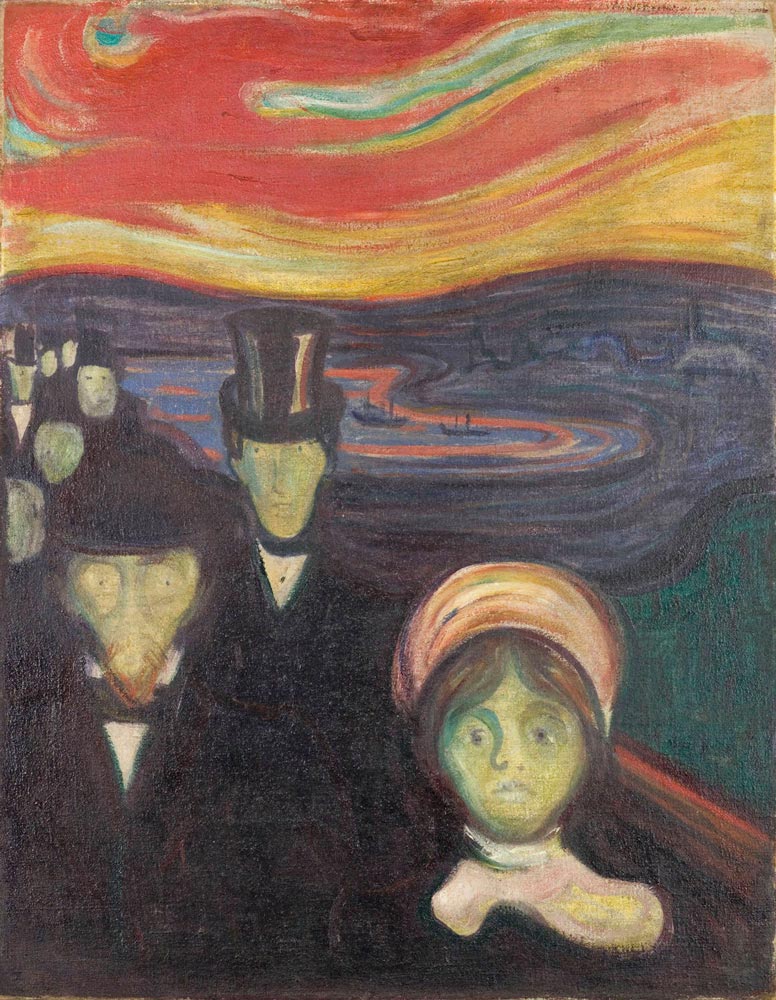
Anxiety (1894) by Edvard Munch

The counselor in me has always had a vulnerable side when the professional hat is not worn.

I’ve been an interested and emphatic listener of others’ stories since my twenties when the Jesus story first made its impact (coincidentally or consequentially, I’m not sure).  But I’ve not always been able to be a dispassionate empathetic listener. This vulnerability presents itself when I move from empathy to over-identification. The self-centered and self-protective side of my psyche hijacks the genuinely compassionate side and the fearfulness of “this sounds too close to home and could happen to me or a loved one” takes over and I am sorry I ever listened to that person’s story. I don’t know why but this does not happen when I am “clinical Dona” which is a good thing or I would have been admitted to a psych ward after my first year of practice.

I just spent three days in the hospital after getting an acute infection driven bya low white blood cell count due to chemotherapy.  I spent 24 hours in the ICU and two and a half days on a regular floor. In both situations I was in better health than the patients around me and because of this I had conversations with worried and distressed family members that I would meet in the hall or waiting room. I heard stories of protracted and acute suffering and misery in a very short period of time. The empathetic listener had not turned off while I was hospitalized.text for rumble_rev

But there were times during my hospital stay that I wanted it to turn off; like when the descriptions of misery were too raw and graphic. At that point cancer would interrupt the counselor – butt her out with one quick unexpected slam – reminding her that there could be much more misery in store down the road of cancer treatment.  So, after a while compassionate listening would give way to cowardly recoiling and shutdown. I would walk back to my room with more Dona-sadness than with Jack-sadness or Terri-sadness.  Not pretty or admirable.  Thankfully this overly anxious display of self-pity did not last long and did not keep me from praying for these folks and their distressed families.

My guess is that most of you readers are not going to be too hard on me.  In most of us there is that nagging feeling and suppressed thought that suffering and loss are not that far from any of us regardless of the many precautions we take to stay them off. They blindside even the most cautious and genetically hearty of us.

In the introduction of his book, Walking with God through Pain and Suffering, Timothy Keller quotes Ernest Becker:

 “I think that taking life seriously means something like this: that whatever man does on this planet has to be done in the lived truth of the terror of creation…… of the rumble of panic underneath everything.  Otherwise it is false.”

So how are we to live with peace, purpose, joy, love, and hope in light of this rumble of panic?  How are we to recognize a caring, loving God who is for us when at any time the shoe can drop or has already dropped?  I am a novice in this world of suffering but let me offer a couple of thoughts.

David my husband says that in times of crisis we are what we have been trained to be. My experience in watching others who have walked various kinds and degrees of suffering, ranging from tragic losses to debilitating and sometimes fatal illnesses, is that getting through it required leaning on spiritual resources previously learned or acquired.  I am not going to be so presumptuous as to imply that only those who rely on spiritual resources weather their tragedies well.  I have read or heard  inspiring stories of people who have weathered great hardship without apparently leaning on God.

But my experience in working in the US and the Middle East as well as meeting people from all over the world is that when push comes to shove it is spiritual resources that provide comfort and strength in times of critical helplessness; not perfectly or always heroically, but nonetheless “a leaning on” that brings comfort.  I heard similar disclosures last week in the hospital’s halls and waiting rooms.

So, what are these spiritual resources that I hear about from the sufferer?

  • Praying
  • Complaining to a God who is both there and not too thin skinned to take it.
  • Drawing on scripture for comfort
  •  Developing a Biblical awareness of the myriad of sufferings addressed in the biblical text with its various antidotes.
  • Receiving the practical and sacrificial helps and prayers of the church and friends that show the compassionate face of Christ, and finally,
  • Acknowledging that something supernatural is at work; ideally, a healing but certainly a feeling of the Holy Spirit’s presence. THEY ARE NOT ALONE.

I, too, have been relying on the above resources; not perfectly or even consistently . In a previous post called, Chipmunk Cheeks, I mentioned the futility of expecting God to give me the grace for my grim or fearful imaginings. He has not promised to do that. He has promised to be with me in the present and give grace for that present. If I lay hold of that truth once again I will be able to be fully present with those who tell me their woeful stories of pain and grief.  Only then can I be numbered as one of the spiritual resources on which they can rely. “Oh God let it be true about me.”

I am a “6” and my husband is a “7”

I am a “6” and David is a “7” on the enneagram personality inventory.

Who cares and so what?

I enjoy this popular personality inventory stuff.  Bear with me.  Later, I will lead you to some of the most inspiring thoughts.   Not mine (be gone chemo-brain hubris!) but quotes from recently published, must-read book.

A ‘six’ personality type is a natural doubter and questioner. So, I did not have to have cancer to wonder why God allows suffering.  I have questioned others within theological circles and read numerous publications in an attempt to make peace with suffering from a Christian faith perspective. Caring about suffering did not just happen when I found myself enduring some of it because of cancer treatment. I have questioned smarter people than me and I have, I admit, questioned God on this matter. Theodicy (defense of God’s goodness and omnipotence in view of the existence of pain  and suffering) has been topic of theological and practical struggle for me for the past 4 decades.  But like Peter one of Christ’s followers, when asked whether he too would leave Jesus like many following Him did because of the hard teaching Jesus had just laid out, Peter’s (Dona’s) response was “where else would I go as you have the words of eternal life.”  (John 6:68)

But occasionally the doubt and unease woven throughout my ‘six’ personality type rears its worried head like a watchful seal in the Juneau harbor – casting about looking for potential threats until soothed and reassured only then to slowly submerge beneath the surface.  I trust in the goodness of God afresh.

The ‘Six’ personality type is also the loyalist with strong convictions.  So, being a Six is not all bad.  However it gets funky when the six’s spouse is a ‘seven’ personality type.  ‘Sevens’ are the adventurers and enthusiasts. They naturally trust that everything is going to work out in the end. David’s personality though 90 percent perfect for me, has not generally made for long, long philosophical discussions.  Manna from Heaven for me but more like prison food for David.   Ironically, David will tell you that what caused him to leave the faith as a teenager – the problem of pain, evil, suffering and injustice in the world- would be what brought him back in his early 20’s.  In David’s view, some worldviews logically account for suffering, but only one, Christianity, addresses the problem while offering hope.  (See John 6:68, again).  He’s a man with a vision who wants to do something, shake it out on the fly.  In the classic words of President Arnold Schwarzenegger in ‘The Simpsons Movie,’ he ‘wants to lead not read.’   I am not suggesting that David does not have his own private devotionals but long, long discussions with me has not been his forte.  This is just the nature of a ‘seven’ on the enneagram which is incongruent with the ‘six” which naturally wrings her hands on many issues, philosophical or not.

But along came cancer carrying a book by Timothy Keller, Walking with God in the Midst of Pain and Suffering (Dutton 2013).  Now, almost every morning David and I get our coffee and he reads out loud to me from this book and we discuss and discuss and it has become manna from Heaven for both of us.  I’ll never have all my answers but I’m grateful to Keller and others who without pat answers or arrogance towards those of a different view, honestly and competently engage with the issues.  I highly commend this most-readable book.  I’ll conclude this post with a few Keller quotes:

“Part of the genius of the Bible as a resource for sufferers is its rich multidimensional approach. It recognizes a great diversity of forms, reasons for, and right responses to suffering.” (9)

“In the secular view, suffering is never seen as a meaningful part of life but only as an interruption.” (26)

“Christianity teaches that, contra fatalism, suffering is overwhelming; contra Buddhism, suffering is real; contra karma, suffering is often unfair; but contra secularism, suffering is meaningful. There is a purpose to it, and if faced rightly, it can drive us like a nail deep into the love of God and into more stability and spiritual power than you can imagine.” (30)

“While Christianity was able to agree with pagan writers that inordinate attachment to earthly goods can lead to unnecessary pain and grief, it also taught that the answer to this was not to love things less but to love God more than anything else. Only when our greatest love is God, a love that we cannot lose even in death, can we face all things with peace. Grief was not to be eliminated but seasoned and buoyed up with love and hope.” (44)

“But resurrection is not just consolation — it is restoration. We get it all back — the love, the loved ones, the goods, the beauties of this life — but in new, unimaginable degrees of glory and joy and strength.” (59)

“Suffering is actually at the heart of the Christian story.” (77)

“The best people often have terrible lives. Job is one example, and Jesus—the ultimate ‘Job,’ the only truly, fully innocent sufferer — is another.” (133)

“The only love that won’t disappoint you is one that can’t change, that can’t be lost, that is not based on the ups and downs of life or of how well you live. It is something that not even death can take away from you. God’s love is the only thing like that.” (304)