I’ve always been interested in theological discussions and debates concerning the nature of hell among evangelical theologians. I have my “hard and fast” opinions about this serious matter but that won’t be the topic of this post. Sorry, for anyone out there who thought this was going to be a very provocative diatribe from an untrained non-seminarian theologian who admits to having strong opinions that she’s accustomed to changing. If you are interested, a report by the Evangelical Alliance Commission on Unity and Truth Among Evangelicals (ACUTE) called ‘The Nature of Hell’ outlines the differing opinions in clear and concise language.
Philosophical thoughts about cancer and mortality are frequent speculations. Recently, I looked for studies about what people with incurable cancer thought about hell. My cursory search didn’t turn up much, but I did come across a website for people voicing their thoughts about their diagnosis of terminal cancer. Hell was not a major topic, but one comment written over a year ago was difficult to read and generated a lot of responses from other sufferers. The commenter began with the following, “I have been told that I have 4 months to live and I am so afraid I am going to hell.” The responses were quick, empathic, and supportive. This woman’s heart-wrenching, brutally honest attempt to explain why she was in this frame of mind included her offenses to her family and specifically to her young daughter since her diagnosis. She felt conviction over the mess she had made of her life before diagnosis. But the real source of her anguish was the angry lashing out and jealousy towards healthy family members and friends.
I was moved by two observations. The first observation was the compassion extended by terminally ill responders who were compelled to try to make this woman feel better. Why were these fellow sufferers so compelled to help? Speaking from my own experience, there seems to be enough suffering to the illness as well as the grief of anticipated losses without added dread of future condemnation and alienation. That is unbearable. Like the others I was touched and wanted her to be at peace.
The second observation concerned the content of the responses. They ranged from:
1. On one end, “Forget about it, hell is a human construct that started in the middle ages by the church to secure their control and power over people,” to the other end,
2. A detailed lengthy comprehensive gospel presentation which was actually good if the sufferer could take it all in, to
3. The middle majority, which encouraged the writer to seek forgiveness from and reconciliation with those she admitted to hurting.
These posts were over a year ago. This woman may not still be alive, and the site did not show her response to the comments her original plea generated. Did she find peace? I hope so. If I had responded a year ago, I like to think I would have written:
“None of us are good enough to meet the holy standard of God. None of us. Thus, God himself in Jesus appeared 2000 years ago with a mission for securing our forgiveness. By simply trusting in his sacrifice by faith we are found perfect and acceptable before a perfect and holy God. Nothing is more liberating for the guilt-ridden. I know this. Then Christ fills our heart with gratitude and out of this grows the humility and courage to trust God to ask forgiveness from those we have offended.”
I hope she took the best of the advice and received the grace through Christ who forgives it all. I can’t imagine that if she sought her family’s forgiveness that she did not receive it from them. If she did not, well, peace with God trumps all to secure her peace for eternity.
A recently composed hymn, “His Mercy is More,” says it beautifully. It was inspired by a sermon by John Newton, the creator of “Amazing Grace”.
“Our sins are many, but His mercies are more: our sins are great, But His righteousness is greater: we are weak but He is power.”
A surprising diagnosis of metastatic breast cancer in December left my nerves frayed and my capacity to see the positive challenged. That is not quite accurate. Anybody who knows me well knows that my capacity to see the negatives in a situation is formidable. I like to refer to myself as a troubleshooter who can sniff out DANGER with remarkable neurotic accuracy, a source of endless frustration to a husband, who is a natural optimist.
My first consult after a series of scans taken 3 months into treatment was tense (you think!). Theresa, my oncologist’s right-hand nurse practitioner, read me the radiologist’s report which sounded alarmingly ambivalent to my ears and apparently my facial expression exposed my alarm.
“Dona, what is going on? I’m not encouraging you. I can tell by looking at you. “
All I was hearing was something like this little tune, “Cancer here, cancer there, a little cancer sprinkled everywhere.”
She tried again to give me the report’s findings with more color commentary and positive caveats. No dice, I just couldn’t hear what was good in the report.
Finally, Theresa looked at David, “David, help me out, why am I not able to encourage Dona?”
They started talking about the way I process new information as if I wasn’t in the room. I finally said, “OK, Theresa, bottom line – should I be happy from what I’m hearing? It sounds confusing and unconvincing.”
Theresa’s response helped, “Dona, you should be ecstatic!”
I breathed my first deep breath. But as David explained, I still needed to process (David, gets me and most of the time he is supernaturally patient. Bless him). I hounded him the next few days with a ton of questions. I wanted to understand and emotionally experience the good news of this first 3 months of treatment on a new drug. Since that day I’ve wondered about my reactions and wondered whether there were spiritual parallels.
Life and death information takes serious processing
I, like most people, want straight forward explanations. If people are like me, they want a simple dopamine rush of good news; end of story, no caveats and no qualifiers.
I was confronted with a report about life or death. If ever there was a time to seek clarification and interpretation wasn’t that the moment? I can be forgiven for not being easily placated considering the gravity of my health situation. There was another problem. I was mentally and emotionally dense to the language, descriptions and vocabulary of this serious diagnostic report. I needed help to figure this out. Where was the good news? I kept asking until it finally seeped in, but it was a struggle.
There was another time long ago when good news didn’t sound immediately like good news. When I was an undergraduate, I was walking a dorm hall and was roped in to a bible study in a dorm room. By the time I left I was handed my first New Testament. I read and read and read. The good news that these dorm Christians were talking about was escaping me. The more I read the worst I felt about my spiritual condition and how little my life reflected the teachings of Jesus. I wasn’t getting this good news thing. In retrospect, I was feeling the bad news of being a sinner. The good news – relief from disappointment and guilt – was only a whisper at that point. I entertained chucking it for something spiritually benign, mellow and nonjudgmental. I tried transcendental meditation but continued private reading of the New Testament. Jesus was compelling, but he said some things that I didn’t understand or even like. Some of what was written provoked an angst that was akin to despair. I wanted to read something that made me feel good and accepting of where I was with no changes required. Where was this good news? This New Testament document was serious. There was an alarming truth that intuitively felt like I was being confronted with life and death. I got that far but I was stuck.
Clarification and interpretation are needed
I needed help with the vocabulary and concepts of the New Testament. I had questions, tons of questions, with no one to go to but books that I read while sitting on floors of book stores and libraries. Eventually I found smarter, wiser and older people than me to throw all my questions. I was a dog on a bone; stubbornly holding on but growling along the way, refusing to be distracted or relaxed. Accepting this Good News about Jesus without fully understanding would not stand the test of time. Giving up on the whole thing was a viable option – too much cognitive dissonance. But in hindsight that ‘dog on a bone’ compulsion was a gift of the Holy Spirit. I had to face and humbly accept the bad news about myself to get to the good news: that through believing in Christ, his sacrifice and resurrection, I could be forgiven and receive the peace I had been longing for. Ultimately, I received the good news, ended the growling and began to enjoy and relax within the joy of my “bone”.
Final parallel: Discipleship can feel like medical treatment
Long term Christian discipleship, all those moments of your life after you receive the Good News, many times is like reviewing the reports of full body scans and looking for malignancies. The news can be bad. We may realize there is more work to be done. Questions and doubts will come up. A treatment plan may need to be developed and rigorously implemented in ways that are not comfortable. However, we will have the Great Physician treating and encouraging us to “fight the good fight” for knowledge of the truth and then persevering (2 Timothy 4:7) until that one day when we rest in the presence of God forever.
Can a positive attitude affect breast cancer survival? No. It can even hurt.
Since we learned that Dona’s cancer had returned and spread, I have encouraged her to stay positive, think positive, be optimistic. I told her studies have shown that a positive attitude is linked to survival.
As it turns out, I was wrong. I was giving her bad advice; advice that was not just unhelpful but potentially harmful.
A 9-year study of nearly 1100 cancer patients by the University of Pennsylvania School of Medicine found no relationship between positive outlook and cancer progression and death. At least two additional well designed and implemented studies support these findings. Based on what researchers know now about how cancer starts and grows, there’s no reason to believe that negative emotions can cause cancer or help it grow.
Not always the best plan
And, as I learned, encouraging a cancer sufferer to stay positive can be anti-therapeutic. It can hurt, particularly when the ‘encourager’ links positive outlook to longevity, like I did. I placed an additional burden on Dona, who has enough on her plate managing fear, side-effects, and me. Although she never said so, I was likely creating guilt and discouragement during the times she was unable to muster up a positive attitude.
But the impulse is natural. We want to believe that we have the will-power to control the outcomes of a serious illnesses.
Moreover, amongst Christians, we link healing to faith. On the extreme end, the ‘health-and-wealth gospel’ purveyors contend that healing can only come from the certainty of our belief in God’s promise of physical well-being. Without knowing, I may have been playing in to this.
Do I believe that God can heal Dona miraculously? Yes, I’m praying He will. Do I believe He must heal if she or I have unwavering faith? I can’t convince myself that is true. God can heal anyone, anytime, with or without my faith. Linking the certainty of my faith directly and solely to healing places too much burden and power on me. But at the same time, I’m reminded that Jesus told us to believe that we will receive whatever we ask for in prayer (Mark 11:22-24; Matthew 21:19-22). I’m asking Jesus to take my mustard seed of faith and use it however He wants. (Matthew 17:20) If this sounds like I’m waffling, I am. Looking at my own weakness, I take comfort in the father who asked Jesus to heal his child who was afflicted with terrible seizures. He told Jesus, “Lord, I believe, help me in my unbelief.” (Mark 9:21-29)
And then, almost a companion piece to the name-it-and-claim-it Christians is the typical American temperament which ignores mortality and promotes self-determination.
“Fix it, avoid it, or fight it. It is entirely within your control. You can prevail!” “Cancer won’t win. Just believe you are going to beat it! Be a fighter!”
Dona hates the term, ‘she was a fighter’. She asks, “What’s the corollary for someone who dies of cancer? She was a loser?”
The way forward
Dona is not at death’s door. She has a cancer that is not curable, but it is treatable. She is getting the best treatments for the best possible outcome.
But delusional optimism, that positive thinking will control cancer, is, well, delusional. Living with hope, however, is essential. Author and pastor, Tim Keller says,
“The way you live now is completely controlled by what you believe about your future.”
Our pastor, Steve Schenk, told us in a recent sermon:
“Despair is believing there is no way forward. Hope, for the sufferer, is believing there is a path forward.”
How does Dona see a way forward in hope with metastatic cancer? She combines deep theology with practical behavior. To date, I have watched her employ over a dozen different techniques in constructing a path ahead. I would like to list them, but Dona nixed that. She reasons that, one, it would make this post over 2000 words and, two, it places undo emphasis on her behavior. Fair enough.
But I will write that her efforts, habits, and musings promote hope and joy. And experiencing joy where we can find it has been one of our objectives since we started this journey. Joy, as we Christians know it, has less to do with our circumstances and more to do with a settled assurance that God knows our condition and that nothing: cancer, grief or even death itself, can separate us from his love. (Romans 8:35-39)
So, how can I help Dona? I asked her and she told me,
“Pray for me, read scripture to me, point me to the reason for my existence, remind me that this reality is not the only reality, and have fun with me. And do these again and again and again and again.”
I walk into the Roswell Park Cancer Institute with my senses sharp-focused and on high alert. I’m in another culture and whether I like it or not, it’s now my culture. I belong. I can speak the language, navigate the geography and obey the protocols. But I am determined to remain who I am before I was initiated into this new culture, so I smile a lot for no other reason than to maintain some normalcy. I am a smiler by nature, but smiles are not common in a cancer hospital, hardly surprising but I refuse to stop smiling, just yet. (For more reflection on my Roswell culture and smiling see Duchenne Smiles Only, Please of March 2014.)
Other than smiling, I am scanning the population, looking carefully at faces. The faces resemble mine – lined and showing some wear.
This fact brings me around to a beauty tip that will keep you baby boomers from spending your retirement at the cosmetic counter for one of the billion products promising to be age-defying. Smiling lifts those sagging nasolabial folds, so you look younger. Better yet, you don’t look grumpy even if grumpiness is the furthest thing from your disposition.
My point? The vast majority of the people at Roswell Cancer Institute look like they are 60 and older and that’s a good thing. Cancer is predominantly a condition of the aged. I am reassured by that. Occasionally in the breast cancer clinic I see a young mom with a helper who is attempting to corral a small child as she waits to be seen. It breaks my heart. It just shouldn’t be. I think of my daughters with their young children and my heart’s response is, “Can I take it for the family?” But we know it doesn’t work that way. Cancer is not a respecter of family life nor of anything remotely related to matters of fairness, kindness or common decency.
When I was first diagnosed with stage 3 breast cancer in 2014 my youngest daughter said, “Mom, as awful as this is going to be for you what I know for sure is that if this was happening to me or my sister you would be a basket case.” Yep, at that moment I had my first moment of thankfulness. Grateful it was me and not them.
Weird back story: when my first child was a toddler a good family friend died of lymphoma. I became obsessed with the fear of cancer. My neck was bruised from searching, prodding and poking for swollen lymph nodes. I went to the doctor pointing out some swollen bits. The doctor was annoyingly unimpressed. I went to another doctor. No satisfaction there either. I drove my poor husband crazy with the “what ifs.” (David lovingly refers to that period of our lives as the neurotic imaginary cancer scare of the 80’s). So, what was going on? The therapist in me analyzes that period of my life as a sort of coming of age process. Motherhood, with its great love for a vulnerable dependent human being, also came with great anxiety, realizing that life held little control. A little toddler needed her mother and I developed a neurotic need to reassure myself that we could never be separated. Time passed and more life happened (another child was born) there was less time to focus on the scary “what ifs” of this life. My neurosis took a rest. But I am not apologizing nor thinking its neurotic to hold to the view that there is something terribly wrong with a world that takes loving mothers or fathers from their vulnerable young children.
Kate Bowler is a young professor of Christian history at Duke Theological Seminary, author and speaker. She also happens to have stage 4 cancer and has written sharply, poignantly and honestly about how she is supposed to make sense of a young mother dying, leaving behind a husband and young son. She is a Christian trying to make sense of her new reality. Her articles and books are hard reading at times. The caustic wit and honesty are not typical of female Christian writers who attempt to make us feel better. Be prepared to squirm.
Bowler is living out my younger self’s worst fear. Now, I have stage 4 metastatic breast cancer but I am long past being that young mother of a small child who lived in dreaded fear of cancer. I’m saddened and anxious about an unknown future but grateful that I saw my little children grow up to be amazing women. But before I come across as too ready to cross the finish line of motherhood, clarity is needed. I am pursuing the best medical treatment, staying as positive as possible, and praying for miraculous healing. I love my adult children and long to see them grow into their 40’s with all the self-awareness and maturity that awaits them. I adore my grandsons and long to live long enough for them to have memories of their Nona. I fret about my 93 year old mother being without her only child. I love, love my best friend and husband of almost 40 years and grieve as I think of his loneliness and aging beyond his 65 years without me. But the utter panic of leaving small children behind has thankfully been replaced with a swipe of my brow that a bullet has been dodged.
What’s the point to this post? Hmm… not exactly sure except to answer the question my husband asked me as I was going down the other day into an abyss of miserable complaining (and it was not the first time) about a miserable world where so much miserable suffering happens to women and children and innocents through disease, cruelty, poverty, corruption, and greed.
“So, Dona, where would you be right now without a hope of an eternity where all injustice and suffering has its comeuppance and end? where all wrongs are made right?”
Hard to know where I would be. I have piled up decades attempting to live the life of a faithful follower of Christ so its hard to imagine living a reality without thought of Him and its implications. But I will say that that belief includes something so important to my spiritual and psychological well being that I quake to imagine myself without it. It’s the belief that I am loved by a “thick-skinned God” who can take my many complaints without flinching, frowning or regretting he knows and loves me. I take my cue from the psalms of lament and the book of Job and the Old testament prophets and from Christ, Himself. As Kate Bowler says, “This life is hard, and this life is beautiful.” I’m just so thankful that I can live my remaining life steeped in the meaning and mystery of a thick–skinned God who gets me even when I struggle to get Him.
Go figure.
Footnote: In the Hebrew Bible there are approximately 67 Psalms of Lament. In them the Psalmist complains to God directly about an injustice or tragedy and unabashedly asks God to do something. With only the rare exception, these poems start with grief and end with trust in God, even joy. My personal favorite, Psalm 22, is quoted in part by Jesus on the cross, and serves as a wonderful companion to the famous Psalm 23.
Stage 4 cancer patients have another definition for victory
Preamble: I took note of Dona’s post, the Clarity of Ink where she contends that writing forcibly imposes boundaries on thinking and reins in anxious thoughts. So, I began to write about my worries and hopes for my wife who is living so valiantly with Stage 4 cancer. Dona suggested when I was ready I could guest-post on her blog. I’m a bit uncertain making this public. Writing is quite therapeutic, but it is likely only a help to me. Moreover, as I reread this post just before publishing, I realized there is much essential stuff not in it: what it means to trust and pursue God, the necessity of prayer, the hope for miracles, the need for a positive outlook, the understandable disconnection and feeling of helplessness that the lover has for the much loved sufferer. Well, perhaps those are the subject of future posts.
– Dave Eley
The atrium lobby within the Roswell Park Cancer Institute is what all good atriums should be – bright, airy, cavernous (4 stories), full of activity, welcoming – an excellent stab at normalizing the experience of entering an institution with a fearful name. RPCI has the practice of ringing a bell in the atrium each time a patient finishes their treatment regimen. Everyone scuttling through the lobby stops and applauds. The finish of a tough race in the fight against cancer. Victory for a person who has prevailed, with his or her team, over a great challenge.
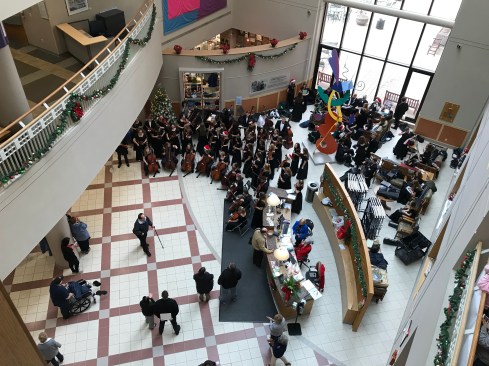
Winter concert in the Roswell Park atrium taken while I waited for Dona to finish a CAT scan
By in large, the bell rings for patients that have Stage 1-3 cancers. Dona was Stage 3 in 2014. In the words of Dona’s surgeon, “the horse was still in the barn.” Like others, she enjoyed the huge relief and encouragement that her cancer was quite possibly curable (see Dona’s post, The Bad News Ends Today ). But to survive, she endured a range of harsh treatments. With late-stage non-metastatic cancer, she got the full nine yards: surgery, uncomfortable surgical incision drains, subdermal medication port implant (actually quite a convenience), chemotherapy, hair loss (but she had a half-dozen great wigs), fatigue, infections (one landed her in the ICU), shingles, endless radiation which compromised my health from eating endless donuts while waiting for her in the hospitality suite. Yet, there was always an endpoint; a horizon to labor towards. At some point the bell in the atrium would toll and there would be the ‘victory dance’ of a person who has prevailed, with her team, over a great challenge.
Then there is the group for whom no bell tolls. This is the stage 4 group, or descriptively, people whose cancer has spread to distal organs. The horse is now out of the barn. We discovered shortly before Christmas 2018 that Dona was now in this group – the ‘new metastatic me’ as she now calls herself.
Although a full array of treatment options can be marshalled to fight the disease, the cancer is not curable. Simplistically speaking, medically, the treatment is whack-a-mole; like an endless fight against urban insurgency. Battles will be won but these folks must develop a new definition for victory over cancer.
Mission Objectives
Roswell Park’s vision is “to free our world from the fear, pain and loss due to cancer — one act of compassion, one breakthrough discovery, one life-changing therapy at a time — until cancer is gone.” I love that: big, vivid, energizing, inspiring. It holistically covers both the process and the objective. But it is the mission and vision of science and human endeavor. It is not complete for the incredible woman who is my wife that is now picking her way through the Stage 4 scree. (See: Nick, the barber, says, “Trust God, then your doctors.
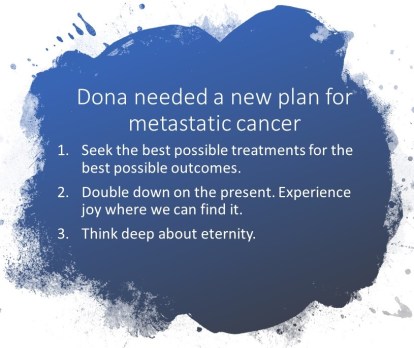
I am a retired military officer. The sailor in me loves well-crafted mission objectives. The man-child in me wants to tamp down anxiety by doing something, ANYTHING. So, shortly after Dona’s setback we worked together to draw up a plan of 3 parts:
1. Pursue the best possible treatments for the best possible outcomes.
We will stay informed and be our best advocates. But it is a relief that this mission is mostly in the hands of the excellent, caring, encouraging Roswell Park team. There are new therapies today that were not available when Dona was first treated in 2014. We are grateful. We are maintaining a positive outlook.
2. Double down on the present. Experience joy where we can find it.
Ordinary experiences are much more intense now.
Two weeks into a new treatment regimen, Dona developed incredibly painful mouth sores. That, coupled with a low blood cell count and worries about an infection kept her in bed and PJ’s most of the week; working on a blog piece titled, ‘Loneliness.’
Our daughter provided therapy and distraction when she asked me to pick up our two grandsons from school. Dona wanted in. She arrived at school armed with treats. She had purchased two bottles of flavored milk – chocolate and mint green. I told her not to present two different bottles of milk for the kids would argue over one in favor of the other. She said she knew which flavor each preferred. No problem. Once in the car kids began to argue, push and shove over the green milk. I smirked. I love being right. Dona demanded that we immediately return to Wegman’s to exchange the chocolate for another green. Though annoyed, I dutifully pulled into Wegman’s and Dona leaped from the car. The boys and I sat in the car for what seemed like less than a minute before she was back. We were startled at her speed. Each boy now had their own delicious bottle of green mint milk, or what the younger called booger-milk. The older boy, having more academic training, called it, mucous-milk. Much laughter. That was joy for us.
Not always, but sometimes suffering can make the little things, even silliness, seem so much more. At that moment joy was the vivid green of the ‘mucous-milk.’
I love my wife. Strong and courageous, longsuffering without being stoic. Looking for rays from a pale winter sun and finding them.
3. Think deep about eternity.
This, of course, is the endeavor of a lifetime. Much to think about and write here. Tim Keller has the jest it:
“Suffering takes away the loves, joys, and comforts we rely on to give our life meaning. How can we maintain our poise, and even our peace and joy, when that happens? The answer is that we can do that only if we locate our meaning in things that cannot be touched by death.”
Timothy Keller, Walking with God through Pain and Suffering, (Dutton, 2013), p. 36
What then is victory over cancer?
The Apostle Paul writes:
“Then what is written will come true. It says, “Death has been swallowed up. It has lost the battle.” (Isaiah 25:8) “Death, where is the victory you thought you had? Death, where is your sting?” (Hosea 13:14) The sting of death is sin. And the power of sin is the law. But let us give thanks to God! He gives us the victory because of what our Lord Jesus Christ has done.
– I Corinthians 15:54-56
‘Cancer can’t win’ is a frequently used banner for fundraisers. I Googled it. Most of the hits referenced Christian hope in the face of the disease. Many hits reproduced a poem written in the 1970’s by Robert Lynn for a friend. This poem was passed around pre-internet hand-to-hand as the words of an anonymous author and was eventually posted on line by people wanting to comfort friends and family. In the mid-2000’s, Lynn discovered his work had garnered over 160 million hits. It was time for a copyright!
CANCER IS SO LIMITED
Robert L. Lynn
Can cancer conquer you? I doubt it, for the strengths I see in you have nothing to do with cells and blood and muscle.
For cancer is so limited—
It cannot cripple love.
It cannot shatter hope.
It cannot corrode faith.
It cannot eat away peace.
It cannot destroy confidence.
It cannot kill friendship.
It cannot shut out memories.
It cannot silence courage.
It cannot invade the soul.
It cannot reduce eternal life.
It cannot quench the spirit.
It cannot cancel Resurrection.
Can cancer conquer you? I doubt it, for the strengths I see in you have nothing to do with cells and blood and muscle.
“At least you have somebody,” said the man leaving the cancer consultation room.
We were waiting our turn. This was one of several high anxiety medical appointments. We would be told the extent of the metastasis. Our daughter had offered to come with us and we gratefully accepted. To tap down the tension she was telling us the most recent knucklehead antic of one of our grandsons. We were laughing.
Shamefully, I didn’t notice the gentleman until those arresting words broke through the self-absorption and family comradery. I was speechless, literally. I said nothing to him. He walked by without receiving any personal acknowledgement. My husband and daughter felt it too; guilt for not offering some encouragement. David later told me that he thought of chasing the man down and saying something. But what was there to say?
“Sorry, man, that you don’t have a family or friend to be with you in a time like this?”
It was all so awkward, but my guilt was slightly assuaged by the justification that I was caught by surprise. But why surprised? Perhaps it was the surprise of a man’s spontaneous vulnerability to complete strangers. Or maybe it was the surprise of being shaken out of my consuming suffering to realize that I was part of a suffering humanity – no more or less special than anyone else; certainly not in the eyes of God.
Suffering is suffering for several reasons but one of its most devastating attributes is loneliness. “My God, my God why have you forsaken me;” the memorialized words of our Savior God who too experienced the human condition of loneliness as he hung on the cross suffering an agonized death of pain, shame and abandonment.
Hardly shocking are the numerous studies showing loneliness as adverse to physical health. More than depression or anxiety, loneliness predicts a lower mortality rate. People live longer who don’t report chronic feelings of loneliness. Consider the Roseto Effect; a 50-year study of the residents of Roseto, Pennsylvania, a community of Italian immigrants who lived sedentary lifestyles, were overweight, had high alcohol consumption, smoked stogies (whatever those are) and were exposed to toxic particles through their work at the quarries. Bottom line: they lived way longer than the average person in the US during the 1950’s. Being a descendent of Italian immigrants I was happily prepared to read that it was genetics that brought their good fortune of longevity. However, family members of the Roseto residents who lived in neighboring towns were not beneficiaries of the same great health. So, what was it? As it turned out no one in Roseto owned a TV and nightly group dinners were a common occurrence. Researchers, after controlling for about everything, concluded that these folks were dodging the bullets of loneliness’s bad health effects because they did use technology to entertain themselves in isolation. They just had each other and consequently lived longer for it.
Loneliness is awful on many levels. And just to be clear I’m talking about a distressful emotional condition; people that feel lonely, not people who live alone. Background: I was the only child of a career military father and a working mom. Loneliness was the constant background noise of my existence, but I compensated by developing people skills. Actually, I perfected very sophisticated kid skills. “Hey, you want to play with me at my house? My mom has candy in big dishes all through the house. (She really did. I didn’t care about candy, but I knew greedy, candy-starved children did.)
I told myself that I would never marry anyone in the military service, thus putting my kids through the never-establishing-roots-anywhere-lonely-existence that I had. But falling in love breaks a lot of promises made to one’s self.
I’m grateful for family and close friends. And I’m grateful for each of my adopted church families. Over the decades as an adult I have lived in ten communities spread over 11 time zones. In each I have enjoyed and loved the commitment each little band of Jesus followers had for me and me to them before I had to geographically move on.
“Family” is one of the most used metaphors in the New Testament for describing the church; a perk that has never been missed on this only child as she traipsed around the world. As David, my daughter and I sat waiting to learn the extent of my metastasis my adopted family sat in the wings, praying for us, bringing food, visiting, comforting, and laughing with us as appropriate.
I hope, I pray that the gentleman ‘with nobody’ but cancer will find his family. I pray that an adopted family, a church, will find him. It is our scared responsibility, as the church, to love our neighbor as we want to be loved. This challenges me, within my own little church, to make sure when someone is facing a health crisis to ask,
“Who is going with you to your appointment? How about me?”
In Flannery O’Connor’s controversial, dark short story, “A Good Man Is Hard to Find,” a petty, conniving, vain, selfish grandmother is accosted by escaped convicts while on a road trip with her son, daughter-in-law and 3 grandchildren. She and her family (spoiler alert) are shot and killed by the cons. Near the very end, the grandmother shows elements of humility and compassion as she reasons with and even tries to comfort the lead killer, named ‘The Misfit.’ It doesn’t work. But after he shoots her, the Misfit claims, in a moment of perverse remorse, that the grandmother “would have been a good woman, if there had been someone there to shoot her every minute of her life.”
I read it and immediately felt like I had been shot through (no pun) with a moment of painful clarity into human nature, or at least mine. I was just given a gift of insight and self-awareness. After all, Isn’t that what separates literary geniuses from the rest of the gifted writers. These geniuses give us images that expose us, enlighten us, humble us and, if we are lucky, transform us
Commentators believe O’Connor, a devout Catholic, makes two main points in this brutal short story.
One, the grandma and the Misfit are two sides of the same coin; deeply flawed sinners in need of the saving grace of Christ. O’Conner, a uniquely Southern writer, captures the essence of the ‘White Southern sinner’ of her time – full of pretense, false hospitality and graciousness that mask a deep suspiciousness and dislike of “the other,” and the willingness to use Jesus when convenient. The Misfit, more base in nature, lacks the pretense of the grandma. Neither measure up. All have sinned and fallen short.
Second, one traumatic event will not change your life necessarily for the better or forever.
I endured a great trial when I suffered through treatment in 2014 – mastectomy, chemotherapy, near-death infection, radiation. I was a better person through all that, or so I thought. I was gentler, less anxious and petty. I trusted God more and consequently enjoyed His presence more. In 2015, after treatment, I began to revert to my old self as i gained a false confidence that I was going to live mythically forever (to be explained). I don’t want to overstate this to make a point. I didn’t shoot a family along the roadside. I didn’t start manipulating and guilting my family, like the Grandma, to get my way. I hope I didn’t. But I did notice a subtle taking advantage of the grace of God and feeling a pressure to have my own way seeping its way back into my personality.
It is now 2019. I have Stage 4 cancer, which is not curable. In a sense I do have a gun to my head every minute of my life. And as a result, the petty vain things of this world are sloughing off faster than I can say Amazon Prime and faster than I can think up an endless list of what my husband should be doing for me or faster than I can complete a critical or judgmental thought of how someone has disappointed me. I like the new me, the metastatic me. Don’t get me wrong I’m not a masochist. I don’t want this disease. I don’t want this. I will say it again so I’m clear, I don’t want this! Nor would I have chosen it in order to get to the new improved version of me. And I am not sure that I will continue to like this new me. It could get ugly and so could my mood. But now, I am kind of feeling good about myself-my gentler personality . When I am not in pain that is. Methadone helps with that.
Here is what I’m learning
…you have to cherish the world at the same time that you struggle to endure it. Flannery O’Connor
Much of life is not cherished when we live in the “mythical state of immortality.” I am seeing how much of life is lived carelessly, vainly, judgmentally, critically, trivially, selfishly and proudful. ‘Mythical immortality’ (my term) is the belief that other people die, I don’t. The myth that I live forever, physically; a myth we can’t help but believe if our strongest desire is to live for ourselves and for our own happiness or at the least for the happiness of our own little tribe. When I live in this state, I find that my opinions and sentiments are imbedded deeply in the soil of self-righteous indignation. Everything matters; from the inanest to the most profound. There’s little wiggle room to separate out the important opinions from the trite. It’s all emotionally equal and meaningful because it originates with me and I am the master gardener of this creation – my life. Along the way of this mythical immortal self becomes the thin skinned, gossipy, greedy, worried, envious behaviors that are so common that I hardly notice them as being anything, but the way life is lived by all.
‘Mythical immortality’ is the belief that other people die, I don’t.
But then – Kapow! – the gun is at the head and the myth evaporates: a nice doctor gives me not very nice news. I am sick, really sick and not going to be allowed to live within the mythical boundaries of forever future plans. Within minutes of the news, however, I am given an invisible blank memory stick and I begin to upload two files. First file: a list of all that I am going to be “cheated” out of. Second file: what there is to be grateful for. It is easy to download what I might be cheated out of. Its not so easy to do the other bit.
But here is the catch, what is there to be grateful for if I don’t have someone to say, ‘thank you’ to? Thank you to my husband for the endless times as he serves me selflessly and generously. Thank you to medical scientists and doctors who show compassion within their expertise. Thank you to my daughters and their spouses for their support and love. Thank you to my many friends who show me extraordinary kindness and love. But unless there is a cosmic creator whose thumbprint is behind all the small and great wonders of existence then the thankfulness loses its mystery, awe and lifegiving power. I feel more alive when I am thanking God. God is eternal and somehow my thankfulness is linked to eternity and therefore takes on a more powerful life-giving meaning:
In everything give thanks; for this God’s will for you. – 1 Thessalonians 5:18
Postscript:
1. Giving ‘thanks in everything’ is not the same as ‘there is a reason for everything.’ I should blog about this sometime.
2. There is a better way to be better without having a gun held to your head every minute of your life or to have metastatic cancer. I should blog about this sometime.
On March 15, 2014, I posted a blog titled, “Fear of Dying.” It described my anxiety while undergoing a CT scan to determine whether my breast cancer had metastasized. It had not. My worst fear was not realized. The “horse was still in the barn,” to use my surgeon’s phrase.
That was then, this is now. Shortly before Christmas 2018 we discovered that the breast cancer of 2014 had metastasized to bone and liver. This begins a new journey. The horse is out of the barn, cannot be returned (it is not curable), but can be chased around the pasture (it is treatable). I have been started on a promising new drug that was not available in 2014. My doctors are encouraging me, I’m feeling God’s peace. That does not mean I don’t have a fear of death or more accurately a fear of dying. But I’m learned that my worst fear, then or now, is not metastatic cancer. I’m learning what I only got a glimpse of in March 2014, that my worst fear – to be abandoned by God – can never be realized.
Here is an insert from that post almost 5 years ago; a time when the horse was still in the barn. It holds true today with that darn horse out of the barn.
“I can’t say with confidence that the fear of dying will never find its way back to me again or that the way out of it will be to always quote scripture but there is a scripture verse I am taking to the bank of heaven. It’s a verse that doesn’t depend on me to muster up a no-fear-of-dying feeling in order for it to be operative.”
In Romans 8 verses 37-39 of the New Testament the Apostle Paul writes,
“No, in all these things we are more than conquerors through him who loved us. For I am convinced that neither death nor life, neither angels nor demons, neither the present nor the future, nor any powers, neither height nor depth, nor anything else in all creation, will be able to separate us from the love of God that is in Christ Jesus our Lord.”
Praise be to the God and Father of our Lord Jesus Christ, the Father of compassion and the God of all comfort, who comforts us in all our troubles, so that we can comfort those in any trouble with the comfort we ourselves receive from God. 2 Corinthians 2:3
Make no mistake – this world does not operate under a system of comfort but rather a system of survival of the fittest whether it is in the school playground or the board rooms of major corporations. Comfort and compassion in the midst of troubles come from God whether He is recognized as the author of it or not.
But how do we experience comfort in suffering? Doesn’t suffering, by definition, leave no room for comfort? Comfort and suffering (troubles) don’t co-exist but are strongly related as our biblical text attests. Comfort and suffering don’t co-exist but they can come in alternating waves. A person can be suffering from the loss of a loved one but moments of reprieve can come by way of a friend’s presence or an unexpected mercy and then later grief can hit again with a raging force and then later God’s comfort comes again to sustain.
He is the Father of compassion and the God of all comfort whether it comes as sustaining relief or in spurts of reprieve that give just enough hope to take the next breath.
We can experience comfort during periods of trouble and hardship. Let me suggest four reasons why we don’t feel God’s comfort or at least not get all the comfort available to us.
1: We don’t feel God’s comfort because we don’t ask for it
We will seek comfort from almost anybody or anything before we ask for it from God. Call it unbelief, pride, plain laziness or lack of imagination. Whatever it is, it does not depend upon or uphold the one who is called “the Father of compassion and all comfort.” Mercifully, He gives it out anyway to those who don’t even care much for Him. But how much more is our hope and faith enlarged when we ask for it, keeping our spiritual antennas pointing in all and any direction as we wait for his timing.
2: Comfort may not come immediately and so we are disappointed and distrustful
Waiting on the Lord is a frequent refrain in the Psalms and is fundamental to the meaning of faith and belief. “Now faith is confidence in what we hope for and assurance about what we do not see.” (Hebrews 11:1) Some of the great saints, preachers, missionaries, and hymn writers as well as many clients and friends of mine have been sufferers of depression and experienced great losses; but they were believers in the Father of compassion and the God of all comfort and were all the wiser and compassionate for it. Their experiences of waiting on God have given hope to innumerable sufferers.
3: Comfort does not always come to us in the way we expect.
We may be failing to recognize God’s comfort because it is not being delivered in a way we are used to or want. We must be alert for the subtle comforts of God.
Acts 17 of the New Testament reports a theological sermon Paul gave to some Greek intellectual philosophers who were being introduced to the Christ- way for the first time. At one point in his debate he says in reference to humankind “that they should seek God, and perhaps reach out for him and find him. Though he is not far from any one of us.”
He is close at hand but we miss Him because our antennas (if even up) are pointing only in certain common directions. God’s comfort is sometimes so close that it is missed. I have a friend who experienced disappointing career reversals and then had to leave her home. She was sitting in her car after clearing out the last vestiges of a life she loved. Sitting there alone she wondered where God’s care and comfort were for her and her family. At that moment she noticed a disabled refugee she had seen limping along the street many times before but paid little attention to. This time she watched him as he bent down to gaze at a small dandelion. He then looked up, turned towards her with a big toothless grin in what seemed to be a response to the beauty of a simple blooming weed. That was the moment my friend saw and felt the compassion and comfort of God. And it was through a man with far less material wealth and physical comfort than she. She drove off comforted by faith in a God who was there and whose compassion was shown to her in an unexpected, humbling way.
4: Suffering is not understood as having any value
A paraphrase of the last part of this verse goes something like this: “there will come a time when you will comfort others. The comfort you received from God when you were suffering will allow you to ‘pay it forward.’
When I was a young woman I suffered from a serious anxiety disorder. By today’s standard of mental health care I would likely have benefited from an SSRI and cognitive behavioral therapy. (A lot has changed in forty years.) Instead I received comfort through my Christian community even though it felt endlessly drawn out. I am pretty sure that if God had supernaturally spoken to me with a promise that someday I would be providing comfort to others because of the troubles I was having I would have said, “No thank you”. I would have still pleaded for the quickest and most permanent relief intervention possible. And there would have been nothing wrong with that reaction. He would have understood and expected it. But my life was to take a different course. In hindsight I can see that without that experience I would have missed out one of my life’s greatest privileges and satisfactions. I am a mental health clinician today because of my training and education. I am an empathic health clinician because of the “troubles” I went through in my early adult years and the benefits I received through the community of faith. God leveraged what happened in my life to later help me help others.
But, there is a caveat to all this. Proceed gingerly and prayerfully before telling a sufferer of how God is going to use their suffering. I just told my sad story but there are much, much sadder stories than mine being experienced. A bible verse like the one quoted above has truth but the messenger of that truth will more than likely be the Holy Spirit working through someone who has gone through a similar hardship to offer comfort to another.
In closing, I almost gave up this blog post several times. As I worked on it over the course of a week I had periods of discomfort and discouragement. I worried about a return of cancer and a host of other things. I felt like a hypocrite. But at the same time I had moments of insight and comfort so I stayed with it. And isn’t this an imitation of life? We have periods of discomfort, discouragement and trouble. We feel like giving up. But we persist, or rather God persists, comforting us, particularly if we ask Him for it, and then we wait and look for it in the ordinary and the extraordinary. And dare I suggest, when we come through it, it is time to pay it forward.
The list of 5 books that helped me grow up has to include Gary Haugen’s, “Good News about Injustice.” Reading this book deepened my prayers and convinced me that even I could play a small role as a justice advocate for the global poor.
When my first daughter was born David and I were over the moon as we would be for our second daughter’s birth. We received the typical comments of well-wishing and congratulations. One comment however surprised and alarmed me. “Maybe next time you will get that son.” From that moment forward I would be set on a course of paying attention to the worldwide preference of sons over daughters. The preference of sons over daughters I would learn was shared by women as much as by men. I grappled with the implications of such a bias and found it hard to understand. As the only child of Dom and Marie I never picked up that a son would have been their first choice. I was never sent a message that my gender precluded me from doing anything I wanted to do and that included staying single if I so desired. I enjoyed exceptional family acceptance. Listening to an NPR report a year after my daughter’s first birthday explained this preferential inequality. Interviews of women in the developing world described their desperate need to be validated as a human beings. Producing sons seemed to be their only ticket to enter the human race as worthwhile people. The voices of these women in conjunction with the sociological and economic narrative made sense to me, albeit tragically sad.
When Maria, my oldest daughter, was a freshman she heard Gary Haugen speak at her college. She recommended that I read his book, “Good News about Injustice.” I did and I knew I could no longer be just a whiner about the injustice meted out to girls and women.
I prolonged the impact of my response to the book by leading a women’s study. The book came with a study guide that included biblical justice verses that would build our biblical justice literacy. I downloaded and showed a dateline special that featured Gary Haugen’s social justice ministry, “International Justice Mission” doing what they do best: exposing the evils of sexual and indentured slavery and human trafficking. This particular dateline special would reveal a sting operation that virtually brought down a popular sexual deviant destination in Cambodia that preyed on children. The young girls who had either been kidnapped, sold or deceived into sexual slavery by a “Madam” and her minions validated the fear that in many places of the world being female was not only an undesirable gender preference but also a liability. They could and were commodities to be exploited.
I found that my prayers were more intentional for those caught in the web of poverty and sexual exploitation. And, for the first time I was involving myself in political advocacy work. I was taking baby steps. No, I was crawling. Off and on for the next decade I would meet with congressional staff members to get important anti-trafficking legislation passed, organize a seminar with an IJM staff worker to speak at my church, write letters to politicians, and work with other members in my church who wanted to push forward the cause.
In other words, “Good News about Injustice” helped me to grow up a little bit more into how one participates within the context of Micah 6:8. “What does God require of you, but to love mercy, do justice and walk humbly before your God.”
Let me be clear. I am far from being one of those at the forefront of justice movements. And I don’t know if my meager involvements in the US or Middle East have made a tangible difference. But I will say this: my conscience had been pricked and continues to be jolted. I take Christ’s example seriously and I am grateful for all those who work to end the terrible exploitation of the vulnerable for greed and lust. Especially, I am grateful for how God uses Gary Haugen and those he has inspired at the International Justice Mission to make a difference.
Gary Haugen recently gave a “Ted Talk”. He explains a new way of looking at poverty and its relationship to everyday violence. Believe it, this 22-minute video is a must-see. Once you watch it read Good News about Injustice and Haugen’s latest book, The Locus Effect.
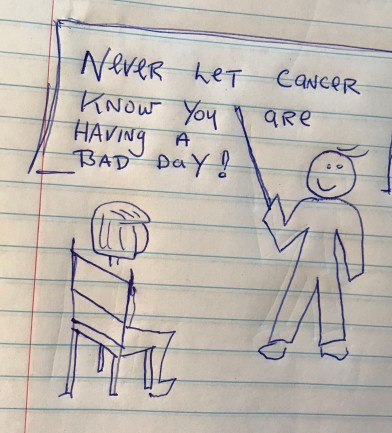
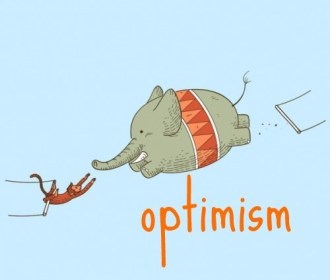
 Weird back story: when my first child was a toddler a good family friend died of lymphoma. I became obsessed with the fear of cancer. My neck was bruised from searching, prodding and poking for swollen lymph nodes. I went to the doctor pointing out some swollen bits. The doctor was annoyingly unimpressed. I went to another doctor. No satisfaction there either. I drove my poor husband crazy with the “what ifs.” (David lovingly refers to that period of our lives as the neurotic imaginary cancer scare of the 80’s). So, what was going on? The therapist in me analyzes that period of my life as a sort of coming of age process. Motherhood, with its great love for a vulnerable dependent human being, also came with great anxiety, realizing that life held little control. A little toddler needed her mother and I developed a neurotic need to reassure myself that we could never be separated. Time passed and more life happened (another child was born) there was less time to focus on the scary “what ifs” of this life. My neurosis took a rest. But I am not apologizing nor thinking its neurotic to hold to the view that there is something terribly wrong with a world that takes loving mothers or fathers from their vulnerable young children.
 Bowler is living out my younger self’s worst fear. Now, I have stage 4 metastatic breast cancer but I am long past being that young mother of a small child who lived in dreaded fear of cancer. I’m saddened and anxious about an unknown future but grateful that I saw my little children grow up to be amazing women. But before I come across as too ready to cross the finish line of motherhood, clarity is needed. I am pursuing the best medical treatment, staying as positive as possible, and praying for miraculous healing. I love my adult children and long to see them grow into their 40’s with all the self-awareness and maturity that awaits them. I adore my grandsons and long to live long enough for them to have memories of their Nona. I fret about my 93 year old mother being without her only child. I love, love my best friend and husband of almost 40 years and grieve as I think of his loneliness and aging beyond his 65 years without me. But the utter panic of leaving small children behind has thankfully been replaced with a swipe of my brow that a bullet has been dodged.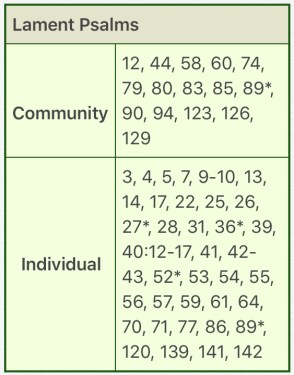
 We were waiting our turn. This was one of several high anxiety medical appointments. We would be told the extent of the metastasis. Our daughter had offered to come with us and we gratefully accepted. To tap down the tension she was telling us the most recent knucklehead antic of one of our grandsons. We were laughing.
 Hardly shocking are the numerous studies showing loneliness as adverse to physical health. More than depression or anxiety, loneliness predicts a lower mortality rate. People live longer who don’t report chronic feelings of loneliness. Consider the Roseto Effect; a 50-year study of the residents of Roseto, Pennsylvania, a community of Italian immigrants who lived sedentary lifestyles, were overweight, had high alcohol consumption, smoked stogies (whatever those are) and were exposed to toxic particles through their work at the quarries. Bottom line: they lived way longer than the average person in the US during the 1950’s. Being a descendent of Italian immigrants I was happily prepared to read that it was genetics that brought their good fortune of longevity. However, family members of the Roseto residents who lived in neighboring towns were not beneficiaries of the same great health. So, what was it? As it turned out no one in Roseto owned a TV and nightly group dinners were a common occurrence. Researchers, after controlling for about everything, concluded that these folks were dodging the bullets of loneliness’s bad health effects because they did use technology to entertain themselves in isolation. They just had each other and consequently lived longer for it.
 But here is the catch, what is there to be grateful for if I don’t have someone to say, ‘thank you’ to? Thank you to my husband for the endless times as he serves me selflessly and generously. Thank you to medical scientists and doctors who show compassion within their expertise. Thank you to my daughters and their spouses for their support and love. Thank you to my many friends who show me extraordinary kindness and love. But unless there is a cosmic creator whose thumbprint is behind all the small and great wonders of existence then the thankfulness loses its mystery, awe and lifegiving power. I feel more alive when I am thanking God. God is eternal and somehow my thankfulness is linked to eternity and therefore takes on a more powerful life-giving meaning:
 , I posted a blog titled, “Fear of Dying.” It described my anxiety while undergoing a CT scan to determine whether my breast cancer had metastasized. It had not. My worst fear was not realized. The “horse was still in the barn,” to use my surgeon’s phrase.
 Dona's Blog