Steroid Side Effects: New BFF’s’

‘Tis’ the privilege of friendship to talk nonsense, and have her nonsense respected.’     – Charles Lamb, 17th century poet and essayist


The last couple of infusions have required a total of 10 steroid pills to be taken during the 18 hours before the infusion. This only happens the day before the infusion and David is so thankful.  Here’s why.

After the first episode of steroid glut David asked if he could give me a signal while I was in the clinic that would indicate that I needed to take my enthusiasm and gregariousness down a notch. The signal would be a wink. I was all for this.  I certainly didn’t want to add embarrassment to him or myself due to a steroid over-exuberance. I agreed to the signal and thought that we had worked out something very appropriate.

Then came the day of my second infusion.  My system was flooded with steroids.  Yippee!  I knew I was walking the knife edge between friendly and inappropriate but I was having way too much fun yucking it up with everybody…….and I mean everybody.  Pity the stranger who just happened to look my way as I wanted them to become my new best friend.  I knew if I looked at David’s face it would be winking away so I made a conscious decision to not look at him.  What did he know?

Perhaps you are curious what my opening liners were to try to engage my new best friends?

“Hi there (lady sitting in waiting room), you have a really nice tan. I mean it; a really pretty tan.  But are you supposed to?  Aren’t we instructed to avoid the sun while on chemo?  Tip: start with a complement but end with a friendly helpful admonition or criticism.

Our conversation ended up being shorter than I would have liked.

Next attempt to make new best friends.

“Hi, I remember you guys from two weeks ago. You are the friendly volunteers who carry around the goody cart.”  (So far so good).

Then David said hi, too, but called one of them by the wrong name, or so I thought. Apparently steroids make one’s thoughts the rule of the land. I drew attention to the fact that David had called the woman by her wrong name. We argued about that in front of the volunteers.  I tried to enlist the volunteers to take my side.  They said they were instructed not to get in the middle of family disagreements.

The goodie cart rolled away sooner than I would have liked.

The infusion center at the cancer institute is huge with 36 infusion chairs or beds.  I decided I would visit all 35 of my chemo brothers and sisters.  I told David I was going to the bathroom and would take my IV pole with me and wouldn’t need his help getting there. I wandered the aisles to see if there was anybody I recognized from my previous visits.  Bingo! I quickly engaged a friendly and talkative 80 year old something patient that I had met the previous week.  Cruising and talking was great.  Eventually David and my infusion nurse found me and semi-dragged me back to my cubicle.

Friendly 80-year-old and I could have talked longer. She was probably on steroids too.

Back home and coming down from steroid exuberance I began to think about the awkward side of friendliness amongst strangers.  I searched the Net to read what not to say to people while seated next to them on a plane, clinic, or any other waiting area.  Here are some ‘pick-up or hi-ya’ questions I hope to avoid asking at my next infusion:

“What do you do about rectal itch?”

“Does this look malignant to you?”

“Want to see something really weird?”

All steroid frolics aside:

A little bit of steroids are great.  We all know of their anti-inflammability benefits.  A one-time mega dose of steroids is one thing but I hope that those of you that must take steroids long-term and experience the adverse side-effects read this blog post for what it is.

There is good research touting the health benefits of connecting with strangers “appropriately” (benefits for you and benefits for them). We just need to be willing to take a risk.  It is both spiritual (God created community), emotional/mental and organic. New human connections boost oxytocin and serotonin, which are biochemicals that build our immune system, improve mood and bond us with others.

So, I’ll see you out there making new best friends.  And don’t forget to smile (see blog post entitled, ‘Duchennes Smiles Only, Please’).
 

The Rumble of Panic beneath Everything

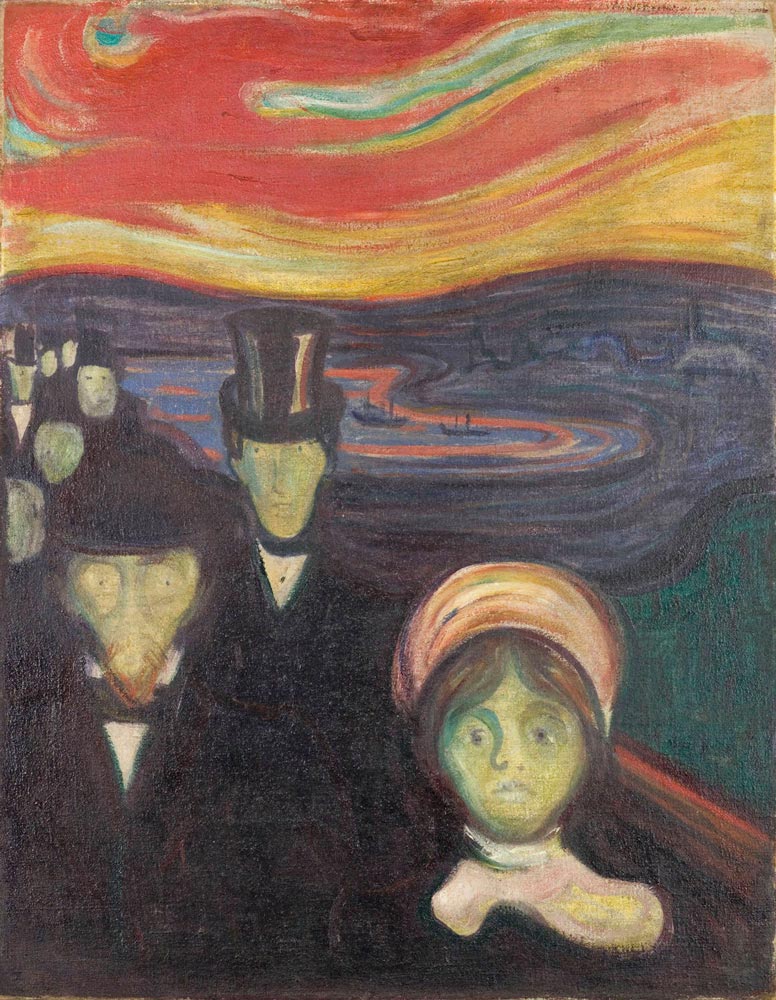
Anxiety (1894) by Edvard Munch

The counselor in me has always had a vulnerable side when the professional hat is not worn.

I’ve been an interested and emphatic listener of others’ stories since my twenties when the Jesus story first made its impact (coincidentally or consequentially, I’m not sure).  But I’ve not always been able to be a dispassionate empathetic listener. This vulnerability presents itself when I move from empathy to over-identification. The self-centered and self-protective side of my psyche hijacks the genuinely compassionate side and the fearfulness of “this sounds too close to home and could happen to me or a loved one” takes over and I am sorry I ever listened to that person’s story. I don’t know why but this does not happen when I am “clinical Dona” which is a good thing or I would have been admitted to a psych ward after my first year of practice.

I just spent three days in the hospital after getting an acute infection driven bya low white blood cell count due to chemotherapy.  I spent 24 hours in the ICU and two and a half days on a regular floor. In both situations I was in better health than the patients around me and because of this I had conversations with worried and distressed family members that I would meet in the hall or waiting room. I heard stories of protracted and acute suffering and misery in a very short period of time. The empathetic listener had not turned off while I was hospitalized.text for rumble_rev

But there were times during my hospital stay that I wanted it to turn off; like when the descriptions of misery were too raw and graphic. At that point cancer would interrupt the counselor – butt her out with one quick unexpected slam – reminding her that there could be much more misery in store down the road of cancer treatment.  So, after a while compassionate listening would give way to cowardly recoiling and shutdown. I would walk back to my room with more Dona-sadness than with Jack-sadness or Terri-sadness.  Not pretty or admirable.  Thankfully this overly anxious display of self-pity did not last long and did not keep me from praying for these folks and their distressed families.

My guess is that most of you readers are not going to be too hard on me.  In most of us there is that nagging feeling and suppressed thought that suffering and loss are not that far from any of us regardless of the many precautions we take to stay them off. They blindside even the most cautious and genetically hearty of us.

In the introduction of his book, Walking with God through Pain and Suffering, Timothy Keller quotes Ernest Becker:

 “I think that taking life seriously means something like this: that whatever man does on this planet has to be done in the lived truth of the terror of creation…… of the rumble of panic underneath everything.  Otherwise it is false.”

So how are we to live with peace, purpose, joy, love, and hope in light of this rumble of panic?  How are we to recognize a caring, loving God who is for us when at any time the shoe can drop or has already dropped?  I am a novice in this world of suffering but let me offer a couple of thoughts.

David my husband says that in times of crisis we are what we have been trained to be. My experience in watching others who have walked various kinds and degrees of suffering, ranging from tragic losses to debilitating and sometimes fatal illnesses, is that getting through it required leaning on spiritual resources previously learned or acquired.  I am not going to be so presumptuous as to imply that only those who rely on spiritual resources weather their tragedies well.  I have read or heard  inspiring stories of people who have weathered great hardship without apparently leaning on God.

But my experience in working in the US and the Middle East as well as meeting people from all over the world is that when push comes to shove it is spiritual resources that provide comfort and strength in times of critical helplessness; not perfectly or always heroically, but nonetheless “a leaning on” that brings comfort.  I heard similar disclosures last week in the hospital’s halls and waiting rooms.

So, what are these spiritual resources that I hear about from the sufferer?

  • Praying
  • Complaining to a God who is both there and not too thin skinned to take it.
  • Drawing on scripture for comfort
  •  Developing a Biblical awareness of the myriad of sufferings addressed in the biblical text with its various antidotes.
  • Receiving the practical and sacrificial helps and prayers of the church and friends that show the compassionate face of Christ, and finally,
  • Acknowledging that something supernatural is at work; ideally, a healing but certainly a feeling of the Holy Spirit’s presence. THEY ARE NOT ALONE.

I, too, have been relying on the above resources; not perfectly or even consistently . In a previous post called, Chipmunk Cheeks, I mentioned the futility of expecting God to give me the grace for my grim or fearful imaginings. He has not promised to do that. He has promised to be with me in the present and give grace for that present. If I lay hold of that truth once again I will be able to be fully present with those who tell me their woeful stories of pain and grief.  Only then can I be numbered as one of the spiritual resources on which they can rely. “Oh God let it be true about me.”