read this-its inspiring

In my last post I promised an article by Todd Billings which inspired the telling of my mild story in comparison.  The following is the article with the link.

Inhttp://www.christianitytoday.com/behemoth/2014/issue-10/deadly-healing-medicine.html?utm_source=gallireport&utm_medium=Newsletter&utm_term=13341127&utm_content=319474811&utm_campaign=2013

Incurable cancer.

I could hardly believe it when I heard the diagnosis. My wife and I had just celebrated our tenth anniversary, and our lives were spinning in joyful commotion with one- and three- year-olds at home. Initial testing brought back some worrying results. I had researched the possibilities, and I didn’t sound like a likely prospect for this cancer. The average diagnosis age is about 70; I had just turned 39. But here it was: an active cancer that had already been eroding the bones in my skull, arm, and hip.

With the Psalmist I cried out, “Heal me, Lord, for my bones are in agony. My soul is in deep anguish. How long, Lord, how long? Turn, Lord, and deliver me; save me because of your unfailing love” (Ps. 6:2b–4).

What was this “healing” for my bones and soul? The cancer has no cure, but it can be fought with special treatment. This treatment to extend my lifespan was not going to come through a gentle pill. Ready or not, I was in the midst of a battle. I needed strong medicine for healing to come. Within a week I was on a chemotherapy and steroid treatment as part of a five-month preparation for this strong medicine: a stem cell transplant.

I soon discovered this was not a regular transplant—replacing a sick organ with a healthy organ, or infusing health-filled medicines into my body. Quite the opposite. Receiving this “medicine” involved taking a lethal poison. First I had stem cells gathered from my blood. Next I received an intense form of chemotherapy derived from mustard gas, a World War I chemical weapon. These toxins attacked both healthy and cancerous cells in my bone marrow; they would definitely have killed me if there were not a way to revive me. My white blood count dropped close to zero, leaving me with virtually no resistance to infection. You can’t live like that. And yet, the only way to heal was to infuse this poison into my blood.

In the third step, the healthy stem cells taken earlier were infused back into my body. At first, they just float around, but the doctors hope that after a number of days, “engrafting” will take place: the healthy stem cells start helping the body produce an immune system again. Because this procedure so compromises the immune system, I would remain hospitalized for a month at a cancer lodge designed for avoiding infection, followed by several more months of quarantine.

The doctors referred to the final bottoming out of white cells as “the valley.”

During my transplant process, I was kept under close watch by doctors and nurses as my white blood cell count plummeted. The heavy toxins were infused into my body from dark bags labeled “hazardous drug” and “high risk med.” As my white counts fell, I experienced bouts of sharp pain, nausea, heavy fatigue, and discouragement. The doctors referred to the final bottoming out of white cells as “the valley.” During this time, I was walking through “the valley of the shadow of death” (Ps. 23:4, ESV). The doctors brought me down the path of death, for the path of death was the only way to healing.

Thankfully, engraftment eventually started to occur; slowly the healthy blood cells joined my body in recreating my immune system.

No Engraftment = No Life

Engraftment is a horticultural practice: uniting a branch to a plant in such a way that the branch is incorporated into the plant, becoming a part of the plant itself. In my case, before the stem cell transplant, I had to sign a consent form indicating my understanding that if engraftment did not occur, I could die. Because of the death-dealing powers of the chemo, the consent form probably could have used a simpler formula: no engraftment means no life.

Engraftment evokes biblical imagery, of course. In Romans 11:13–24, Paul uses rich horticultural imagery from the Old Testament to speak about how Gentile believers have been graciously grafted into the people of God. In the Gospel of John, Christ himself speaks about how he is the vine and his disciples are the branches, who can bear fruit only by abiding in him (15:1–8). For “apart from me you can do nothing” (15:5, ESV). No engraftment means no life.

As I lived through my ordeal, my eyes were opened anew to what it means for sinners like us to receive deep healing from God. We don’t just need a vitamin; we don’t just need a bandage to cover a flesh wound. We need strong medicine—we need death and new life united to Christ in order to be healed. Far too often, I have acted as if the gospel were a self-improvement plan to strengthen a muscle, to heal a small wound, to enhance my success. But the gospel is about losing our lives for the sake of Jesus Christ, tasting death to the old self in order to experience true life and healing. “Count yourselves dead to sin but alive to God in Christ Jesus” (Rom. 6:11). Our hope is not in ourselves, but in our engraftment—our union with Christ. “We were therefore buried with him through baptism into death in order that, just as Christ was raised from the dead through the glory of the Father, we too may live a new life” (Rom. 6:4).

There is no way to healing apart from death. This is a reality for all of us. God’s gospel medicine is not a light massage or an energizing pill. We cannot have only resurrection, skipping over our union with Christ in his death, our death to the old self. We desperately need healing. And the Great Physician provides this in mysterious ways.

As Martin Luther notes, even our “spiritual trials, sorrow, grief, and anguish of heart” are “the medicines with which God purges away sin.” This purging actually restores true human health. This medicine may feel like poison, and it does involve a kind of death, but it is actually coming to life in Christ. For when we cry out for “healing” we are crying out to a crucified and risen Lord who brings us life by uniting us to both his death and his life. That is strong medicine, indeed.

J. Todd Billings is Gordon H. Girod Research Professor of Reformed Theology at Western Theological Seminary in Holland, Michigan. This article has been adapted from his forthcoming book, Rejoicing in Lament (Brazos Press, February 2015), with permission.

Follow @BehemothMag on Twitter

Also in this Issue

Images and Infusions pointing to spiritual truths

An Image of hope in crisis:

My story:  Half way through chemotherapy I found myself in an acute medical state that would require a rapid response team in the hospital to revive me and three days in the hospital to stabilize me.  Monitoring and intravenous products were needed: antibiotics, hydrating fluids and 3 units of whole blood.

My husband’s story:  “When I brought you into the hospital because of a shocking 104 degree temperature, you were conscious, lucid and chatty.  But while the intake nurse took your vitals you suddenly became unresponsive.  The rapid response team was paged over the hospital PA and within a minute a seeming chaos of a dozen or more people gathered around you.  It was like one of those ER movie scenes where the door closes in the face of the panicked family member who is left in the lobby alone and fearing the worst.  Within those lonely powerless moments, I had a God given image: Christ was in the corner of the room with His arm stretched out over you and all those attending to you.  It was reassuring.”

“Lo, I am always with you even to the ends of the age.”  Matthew 28:20b

“I will never leave you nor forsake you.”  Hebrews 13:5b

“Even if it were possible a mother could forget her nursing child, I will never forget you.”    Isaiah 49:15b

An image of restoration:

Back to my story:  Later in the hospital room as I looked up at the IV pole with a unit bag of blood hooked in its place I thought of all the people who gave their blood for future needy unknown recipients. I was grateful.  Much later, I realized that the blessing of my medical emergency was those 3 units of whole blood.  I had not realized how bad I felt during the past two months of chemo.  That whole blood was a ‘miracle’ of rejuvenation.  I could now face the remaining two months of infusions.  And predictable to someone who thinks “Christian-ly”, my thoughts went to the One who gave His blood that we might have life. The New Testament makes it clear that like a blood donor, Christ’s blood was willingly given for life. In some transcendent and mysterious way that death and giving of blood was meant to secure forgiveness, life and hope.   Christ’s ‘blood shed for me’ was always a reality but it was not quite the obscure reality it once was for the ‘new fortified’ (3 units worth) Dona.

David needed an image for comfort in crisis; I got an image for restoration.  They both were God-given, but our knowledge of the promises of God in scripture provided the brush strokes for these pictures.

It’s not always a crisis that proves the reality of God’s love and presence.  But often an intense emotional experience can give us biblical insight into a reality that is bigger than ourselves.  Cosmic truths reach deep into our personal stories and transform them.

What about you?   Could you go back and revisit a crisis or ‘intense period’ in your life?  What biblical metaphor, image or teaching does the crisis highlight that makes the God of the universe relevant to your finite human dilemma?  And, if appropriate, could you share it in the comment section of this post?

Next week’s post will be someone else’s article, an excerpt from J.Todd Billings’ forthcoming book, Rejoicing in Lament (Brazos Press, copied with permission).  His cancer story will challenge us with the truth of God’s “engrafting.”  It is a seriously moving and insightful story.


Humor Makes the Serious more Serious

A pastor once told David that humor within a sermon makes the serious more serious. In other words it creates the emotional highs and lows that helps us remember the point of the sermon as well as create receptiveness that inspires change or endurance in doing well.

I have wondered as others have  whether Jesus had a sense of humor and said funny things. (Googling ‘Did Jesus have a sense of humor?’ yielded 10.6 million hits.)  As it turns out, many scholars think so.  Jesus’ use of hyperbole to make a point, the colorful descriptions in his parables, and the fact that he liked hanging out with “sketchy” people at dinner parties probably spoke to a winsome and intelligent humor as well as an appreciation for the delightful in some folks, especially the little ones.  And, we all know that Jesus would have laughed at the crazy viral YouTube, titled, “Charlie bit me.”  YouTube link here if you are one of the only three English speaking people in the world who have not seen this.  (Dave’s note:  Actually there is an Indian and Arabic remix.)

As an aside, my time over the last decade with Palestinian Bible Society staff in the West Bank and Gaza has taught me to expect a lot of laughing, hilarity, antics and teasing (without the booze) when they get together socially; in spite of being a group that has endured much hardship and tragedy.

My personal favorite “funny” from Jesus

log-in-eyeAbout two thirds through Jesus’ Sermon on the Mount he uses a ridiculous image to drive home his point about hyper criticalness.  David was reading Matthew 5-7 out loud to me the other day.  I laughed out-loud when David read Jesus’ famous ” get the log out of your own eye before trying to get the speck out of your brother’s eye” within the Sermon  (Matthew 7:1-5).  Scholars of Biblical studies and culture think I responded like Jesus’ Galilean listeners and it would have been by design.  Think about it for a minute. Jesus just told people to stop hating, lusting, divorcing, swearing and revenging. He tells his audience that they not only have to love their neighbor but also their enemy and do it with their actions. And He tells them that they should give to the needy but not  let anyone know about it, quit acting so religious, quit storing up wealth on earth, quit worrying and replace worrying with trust – all things we need to hear but when you pile them up all together they can seem a little overwhelming. Just when people were probably finding themselves emotionally and mentally flooded (a psych term) Jesus injected humor.  I like to think that Jesus thought something to the effect of, “hmm, let me break this up with a witty image that will last centuries and prepare these folks to hear even more challenges before I finish off ‘The Sermon’ that will inaugurate a new understanding of God’s ethical standard of living within the Kingdom of God. I know they will laugh but it will  only enhance the point that I have little patience with hypocritical judgmental-ism..

Jesus was no stand-up comic  but he used humor to drive home some tough sobering points that had barbs.

Some interesting facts about laughing from the Mayo Clinic.

In the short term:

Laughter doesn’t just lighten your load mentally, it actually induces physical changes in your body:

  • Stimulates many organs.Laughter enhances your intake of oxygen-rich air, stimulates your heart, lungs and muscles, and increases the endorphins that are released by your brain.
  • Activates and relieves your stress response.A rollicking laugh fires up and then cools down your stress response and increases your heart rate and blood pressure. The result? A good, relaxed feeling.
  • Soothes tension.Laughter can also stimulate circulation and aid muscle relaxation, both of which help reduce some of the physical symptoms of stress.

In the long term
Laughter isn’t just a quick pick-me-up, though. It’s also good for you over the long haul. Laughter may:

  • Improve your immune system.Negative thoughts manifest into chemical reactions that can affect your body by bringing more stress into your system and decreasing your immunity. In contrast, positive thoughts actually release neuropeptides that help fight stress and potentially more-serious illnesses.
  • Relieve pain.Laughter may ease pain by causing the body to produce its own natural painkillers. Laughter may also break the pain-spasm cycle common to some muscle disorders.
  • Increase personal satisfaction.Laughter can also make it easier to cope with difficult situations. It also helps you connect with other people.
  • Improve your mood.Many people experience depression, sometimes due to chronic illnesses. Laughter can help lessen your depression and anxiety and make you feel happier.

Spiritual application:

Laugh a lot.  Look for things to laugh about.  Be appropriate and sweet about it so watch out for superior sarcasm and passive aggressive teasing. Laughing with others increases our affection and emotional connection with them.  Above all, take yourself less seriously while taking God, very seriously – then you will be emotionally and spiritually ready to read the Sermon on the Mount. It’s no light read but then again we can handle it if we” first get the log out of our own eye.”


Radical touching

So it turns out according to a colossal amount of research that touching someone is good for health and mood; not just for the “touch-ee” but also for the “touch-er”.  Now, that is hardly earth shattering news. Being touched (APPROPRIATELY) whether in the form of a hug, gentle pat on the arm, holding a hand, back rub is shown to release neurotransmitters that positively affect the immune system, mood, self-esteem, blood pressure, and stress level.  It seems that there is nothing that even the slightest touch on the arm can’t bring about that is not positive.  Of course, there are caveats.  “Know your audience.”  Not all cultures will respond positively to an uninvited touch on the arm.  Nor, do all women necessarily want random men touching them on the arm or anywhere else. But the research is in:  touch activates skin receptors that send signals to the brain to release “feel-good” neurotransmitters and hormones that aid in boosting immune systems.  And, it does not take a scientist to know that touch, given in the right spirit and received in that same spirit, builds a healthy, uplifting psychological connection.

However, there is a “touching” that stuns with its radical compassion and fierceness.  And if we are honest we don’t quite know what to do with it.

The story

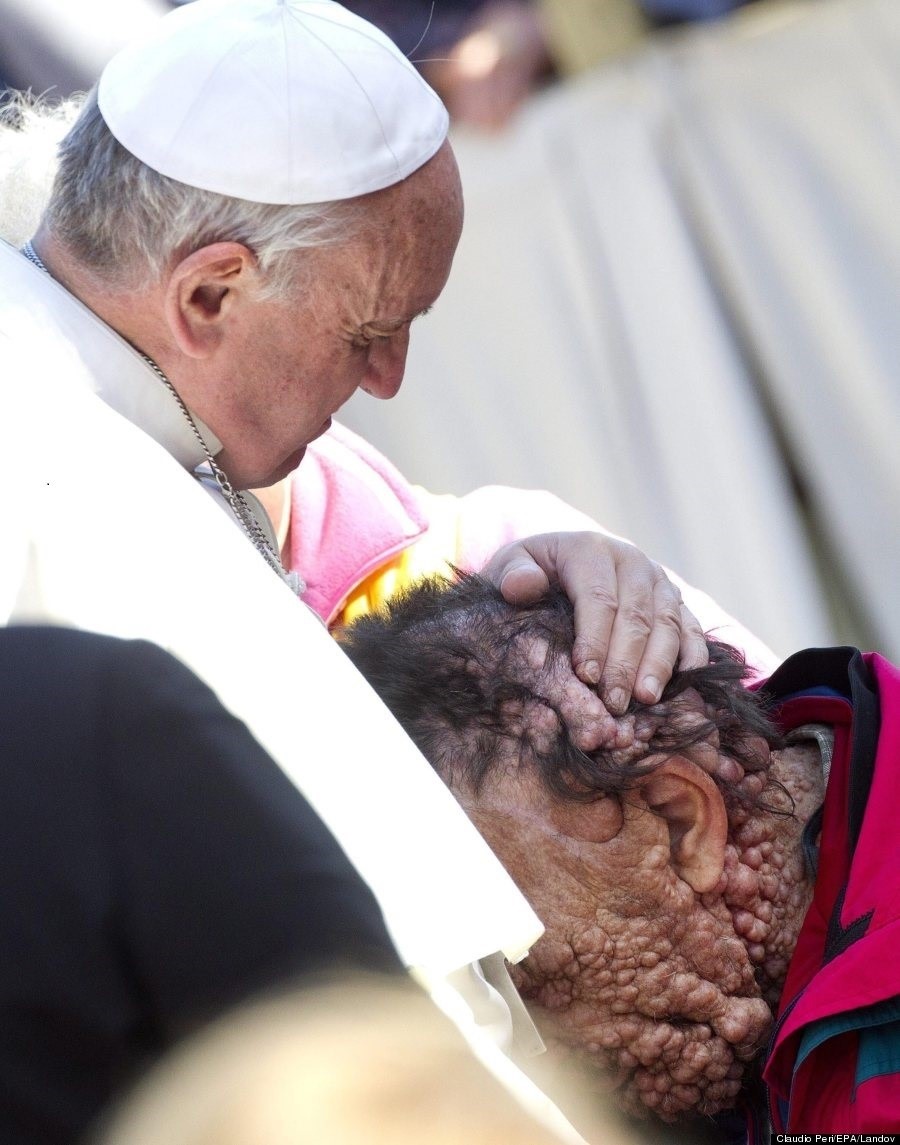
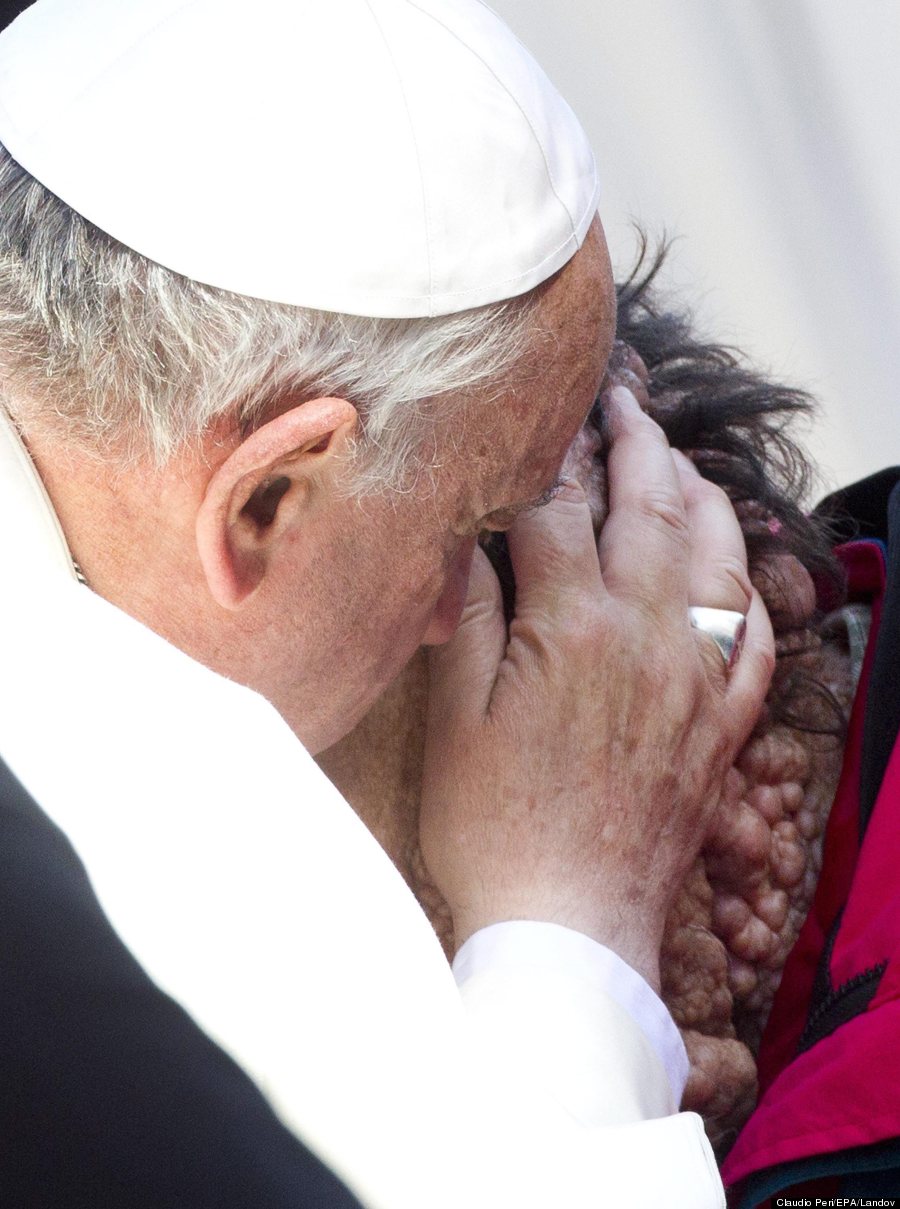
In early November of 2013, Vinicio Riva and others traveled by bus to Vatican City, where they attended a morning public audience held by Pope Francis. Vinicio Riva who was in a wheel chair pushed by his aunt was just hoping to see the Pope. Vinicia suffers from a rare skin disorder that has left him severely disfigured with tumors all over his face and body. Neurofibromatosis is not contagious.

The following was reported By CNN World.

“I didn’t think we would be so close to the Pope, but the Swiss Guard kept ushering us forward until we were in a corner in the front row,” recalled his aunt.  “When he came close to us, I thought he would give me his hand. Instead he went straight to Vinicio and embraced him tightly. I thought he wouldn’t give him back to me he held him so tightly.”

(There are pictures of this encounter at the end of this post.)

Vinicio, accustomed to stares of shock and fear, was initially confused by the pontiff’s lack of hesitation. “He didn’t have any fear of my illness,” he said. “He embraced me without speaking … I quivered. I felt a great warmth.”

The entire encounter lasted little over a minute, and soon Vinicio and his aunt were back on the bus; Vinicio in a state of combined shock and joy.

“He was almost not himself,” Lotto said. “He was shaking.’’

“I felt I was returning home ten years younger, as if a load had been lifted,” Vinicio said.

The Huffington Post reported Vinicio as saying, “I’m not contagious, but he [the Pope] didn’t know that.  But he did it, period.  He caressed my whole face and while he was doing it, I felt only love.”

No words were exchanged, just the healing comfort of touch. “I tried to speak to say something but I was unable to,” said Riva in a translation provided by Time. “The emotion was too strong. It lasted a little longer than a minute but it felt as if it were eternity.”

Gospel story

Pope Francis no doubt gets his cue from the gospels.  Another story reported in Matthew, Mark and Luke tells the story of Jesus healing a man “filled with leprosy.”  Jesus broke with centuries-old cleanliness laws by touching, no, “grabbing” a man who fell on his knees before Jesus saying, “If you are willing you can make me clean.”  Jesus, filled with compassion, grabs the man and says, “I am willing”.  The desperate man is cured from one of society’s most dreaded diseases – a disease leading to disfigurement and death but only after a life of misery, pain, isolation, shame and loneliness.

Many through the centuries have also taken their cue from Jesus to radically touch and bless the severely disfigured from dreaded skin diseases and disorders.  St. Francis Assisi, Dr. Paul and Mary Brandt, Mother Theresa and so many others that will never make the radical touch-ers hall of fame on this side of heaven.

I was curious what leprosy might have looked like in first century Palestine.  Surprisingly, Google images revealed something that did not look so different from Riva’s disorder.  Now, here is where it gets a little odd.  When I viewed several images of religious paintings of the encounter of Jesus with the leper they showed something quite different from what would have been the reality.  Jesus is portrayed as “ other worldly” taking his finger and pointing it towards the man as if he was dispelling fairy dust and the man with leprosy looks a little ashen or at most smudgy, something that hot soapy water could fix.  Why was the disease’s disfigurement played down and why is Jesus portrayed as someone who is beyond getting down and dirty with the lowly?  I don’t know but here are two theories.  One, the artist does not want us distracted by the terribleness of the diseased man so that we can keep our gaze on the beautiful ephemeral Jesus, or, two, a painting to be displayed in a church or in the palace of a wealthy benefactor needed to be lovely and stunning to look at showing the magnificence of Christ .  While I understand the reasons it is a disservice to the heart of Christ and to those suffering.

about me

So, would I do what Pope Francis did?  I need to honestly confront my limits and fears and ask sincerely what it means when Christ says, “When you do it to the least of these you are doing it to me.”  Wait a minute, I know what it means.  Compassion has no limits. It comes at a cost.  It certainly did for Christ, our Savior and Healer. I like to think of myself as a touch-er, hugg-er and kisser type of person.  I also like to think of myself as a follower of Christ, too. But, the call to be a radical touch-er?   Me? God help me. I mean it, Holy Spirit help me!

POPE FRANCIS' GENERAL AUDIENCEPOPE FRANCIS' GENERAL AUDIENCE


Living the New Normal

I finished cancer treatment over two weeks ago and have returned to my home in Juneau, Alaska.

I left Alaska in January of this year with a vision of myself as a healthy woman with exciting plans of seeing family and friends on the east coast and then a two month ministry in the Middle East; a routine that has gone uninterrupted for the last 8 years.  On February 26th those plans were profoundly interrupted with a sudden diagnosis of stage 3 breast cancer. For those of you who have walked this path or cared for someone who has, you know the common expressions: “Everything changed in a moment’s time.  The rug was suddenly pulled out from under me.  I went from living a life to surviving for a life, and etc…”

David, who likes the country western star Alan Jackson, shared the lyrics from the song Jackson wrote and recorded for Denise, his wife of 33 years, after she had completed her cancer treatment:

Ain’t it funny how one minute your whole life’s looking fine

And a short few words later it all just comes untied?

You can’t believe you’re looking at what was always someone else,

Now it’s staring right there at you, yesterday you couldn’t tell. (1) 

Once the shock was processed then came the emotions: some sadness, some anxiety and some frustration, guilt and worry.

Then the anger starts to surface, lookin’ up, askin’ why

Then you realize He (God) probably wants the best the same as I.

But there were two other emotions that couldn’t be laid to rest.  They would show up in unexpected ways and times.  Gratefulness and humbleness were two friends that would visit uninvited so I began looking for them in unexpected places and, seeing them often, would greet them by name.  Calling a thing by its name whether that thing is a person or abstraction carries its own blessing and power.  Why are we embarrassed when we can’t Grateful humble_revremember someone’s name when we see that person?  It’s because we intuitively know that saying the name out loud will validate that person as significant and valuable in relation to us. “Oh wow, you remembered my name!” Of course I did because you made an impression on me and I gave you enough care and consideration to file your name away.  Unspoken thoughts perhaps, but none the less operating to create meaningful relationship.  Well, it happens much the same way with abstractions.  You name an abstraction in relationship to yourself enough times you will begin to feel its connection and power in your life: love, kindness, endurance, thankfulness, to name a few. The New Testament has a list and refers to them as the fruits of the Spirit.  (Galatians 5: 22-23, Colossians 3:2-17)  If you have read even a few of my previous blog posts you will see these two not-so-now-abstract feelings pop up a lot.

More Alan Jackson:

And the seconds turn to minutes, and minutes wouldn’t last

And the hours, days, and weeks and months, seem endless and too fast

And the blessin’s poured from Heaven, like the rain on that first spring.

But now, there is a new challenge in my life.

The treatment protocol for my particular cancer is complete.  Now there are new thoughts, feelings and behaviors.  I’m learning to live “the new normal.”  I like to compare this state with how I felt when I had my first baby.  Lots of attention from medical staff during pregnancy, delivery, birth and the few days in hospital and then, “voila”, the release into the world with my new human responsibility to figure out how to do this thing of living with baby without the hand holding.

Now, I don’t want to overdo this analogy because in reality there is support after birth and there is support after cancer treatment.  After all, there are the checkups and the knowledge that if anything goes haywire I can pick up the phone and say, “help,” and I will get it.[2]

But since being home I have experienced some trepidation of my future health possibilities, some crankiness and anxiousness reserved for the person who deserves it the least.  (You husbands out there will be happy to know that he doesn’t take it lying down.  He emailed me one of my own past blog posts the other day as a reminder of, hmm… I am not sure but I think it was a clever way to say, “Hey, be nice” or “be true to your blog post”.  Fair enough.)   Now, all of the above reactions are not uncommon for cancer patients and survivors.  There are plenty of studies out there to point to an handholding revincrease of depression in cancer patients after treatment so it does not surprise me that I may be having a few ups and downs since being done with treatment and realizing my cancer care providers are a couple thousand miles away. But, I am now having to learn to live this “new normal” and start fine tuning my radar for gratefulness and humbleness in many different places and circumstances and when finding it, start naming it.  I need these and other “fruits of the spirit” to wash over, overwhelm and subdue the fearful musings and emotions about an unknown future.   The hand holding treatment days may have come to an end for now but the Spirit didn’t go away.  The Holy Spirit is with me reminding me that there is a boatload of gratefulness to be named out loud.

So, I’m going hunting in new territory and I won’t be alone.


(1) ‘When I Saw You Leaving’

Writer: Alan Jackson
Copyright: Tri-angels Music, Emi April Music Inc

[2] Help for those of us of the middle class, that is.  It should be like that for everyone but sadly we know it isn’t. And that is not because no one is willing to help. In many places there are those willing to lend a hand.  The problem many times is that the marginalized have a lack of confidence and trust in the system to get what is needed. But then again there are many places in this world where those willing to help are few and far apart. This is all grist for future postings.


The scales were tipped and I was feeling guilty

Party

I just got home from a party given by friends, Kyeonghi and Bernard, of the Buffalo church we attend.

Thirty-five people showed up, many wearing hilarious wigs in honor of my (still) hairless days. It was a blast. Most are young and full of “we are hard-wired for fun!”

Later

I sat in the dark of my apartment explaining to David that I was having some internal dissonance.  (Poor guy – he has to endure therapist phrases and he probably just wants to say, “Can we simply call it confused feelings?”)

“Maybe it wasn’t all so bad after all (my cancer treatment).  I’m kind of feeling that I may have made a big deal about nothing so terrible.”

David’s response was straightforward, “Yes, it was a big deal; trust me.”

Maybe I am going through something like the aftermath of child bearing. The relief of new life causes a kind of amnesia of the pain you thought you would never get over.

But then again, I wasn’t satisfied with that analogy. Something else was going on. I stared at the basket of cards from friends from Juneau and other places.  I looked at the books and gifts sent and reminded myself of the countless phone calls from family and friends and the many emails even from David’s clients and colleagues who had never met me but wanted to encourage me.  People read my blog and were unbelievably kind in their responses. Friends traveled to visit me or house me.

The kindnesses that I received from my health providers and just random folks I would meet in the hospital – all of these memories were flooding me with that “internal dissonance” thing. The level of kindness far exceeded the level of suffering.

Because I was feeling unworthy of this amount of kindness crazy thoughts were entering my head in an effort to make sense of it. “I must have communicated to everyone that it was worse than it was. Did I tell them I was dying?  Did I let on like I was bedridden and hospitalized most of the time?  Did I say that my head was in a bucket 24-7 during chemo?  Did I intimate that surgery had complications or that radiation could only be endured with drugs, prescription and recreational?  In short, did I exaggerate this whole thing in spite of the fact that my doctors were telling me I had a high risk disease and treatment would be intense?”

I thought of the support of my sweet daughters, their husbands and my grand boys and my courageous 88-year old mother who looks after my 91-year old father.  It was beginning to feel like too much.

Too much support.

Too much love.

Too much guilt from all that love and support.

Too much God – is that even possible?

The scale was tipped in favor of love – far outweighing the trials of cancer treatment.  I was overwhelmed with undeserved love.

Of course it was undeserved.  Christianity 101 tells me that.  None of us get what we deserve.  God help us if we do. It just can’t be about deserving. I don’t even want it to be.  It gets back to that fair thing I talked about in my last post.  After all, do I deserve all this support and some other person in a hostile dangerous place who is being horribly persecuted for their religious belief or ethnic heritage deserves being alone, feeling forgotten and wondering why God is silent.  Does she or he deserve that treatment while I am showered with love and support from friends and family?  Of course, not.

What to do with all this

There is something else going on.  What are we ultimately meant to be thankful for? Please don’t get me wrong, I’m very grateful for the support of friends, family, and health care providers who, in part, sustained me through this ordeal. But I know that right now at this moment countless people of Christian faith and other minorities in faraway places and prisons are suffering, even dying, alone and unnoticed.  What sustains them?  It can’t be, “God loves me this I know for I have so many friends and family telling me so!” Equating God’s grace and blessings to family and friends and medical support just do not cut it for the multitudes deprived of basic human rights.  I once read John Stott, the late theologian and vicar of All Soul’s Church in London, say something to the effect that he could not worship a God who had not suffered pain, abandonment humiliation and forsakenness. Thank God we have that God in Jesus Christ. His suffering appropriated something profound, cosmic and eternal for which anyone of us can be blessed, whomever and wherever we are. Now, I am venturing into territory that I cannot speak authoritatively.  But someone can and has.  His name is Ziya Merkal.  I read an article of his in Christianity Today back in 2008.  I printed off a copy, put in a manila folder and over the years have reread it many times.  Here are the links to two articles by Ziya Merkal , “Bearing the Silence of God” ( the one I carry around) and “Standing with the Desolate” (recently read this on line). Please read them.

After listening to my angst in the darkness of our apartment after the lovely party thrown in honor of my end-of-treatment.  My husband said, “Dona, just be thankful.”  Good words spoken by the champion of support, love and perspective during one of the toughest 9 months of my life.  But David was quick to point out that the apostle Paul said it better in I Thessalonians 5:18,

“For this is the will of God, that you be thankful.”

It’s not fair

My last post promised theological reflections on the article, “Are you too Good Looking to Get Sick?” This piece bothered me and I suspect that it bothered you as well if you read it.  In summary, a study indicates that the more attractive a person is the higher their good health quotient.  According to the research people considered to be very attractive are statistically shown to have better health, avoiding a host of diseases and disorders.

clothespin-nose-donaWhy does this bother me so much?  Well to put it simply: it just does not seem fair! Before I go any further and find myself accused of hypocrisy, I admit that I want to be considered an attractive 63 year old woman as much as the next woman or man but I don’t want it linked to better health.  Again, it just doesn’t seem fair but then who said life was fair? Right? I mean why do I get cancer and somebody else doesn’t?  Is it because I’m not attractive enough? Why am I being treated with stage 3 breast cancer and the woman sitting next to me has stage 4 (metastatic cancer).  That doesn’t seem fair to her, does it? Who knows? Maybe it’s because I have a small nose and she doesn’t (another positive physical characteristic listed in the article). Wait a minute, I don’t have a small nose.  In fact, when I was 13 years old I tried going to bed with a clothes pin on my nose to stop it from growing any further.  It hurt too much so I didn’t follow through. Maybe if I had followed through I wouldn’t have gotten cancer at 62.  I know that these musings are degenerating into absurdities but some scientific research topics can sometimes be “crazy making”. They can tempt you into believing that it all comes down to whether or not you dodged a bad gene bullet or got more than your share of good genes in the celestial line-up.  As it turns out Life appears not to operate like a functional family full of siblings; each one born into the belief that they have an inherent right to be treated equally.

Theological reflections:

First, the Gospel of Christ actually begins with an understanding that life is not fair. The world is damaged and people are damaged goods; that is why we need a Savior. Everything is out of kilter not “just our face symmetry” (another one of those hallmarks of attractiveness leading to better health). And there is a myriad of ways that that damage is reflected in our DNA, environment, intelligence, upbringing, life choices etc. etc. We are not wired to be perfect.  The Genesis account of our creation assumes our predisposition to mess things up, even though it was not God’s intent in making us that way.

Second, read the Gospels in the New Testament and you quickly meet a Jesus who has a preference for the poor, marginalized, vulnerable, abused and sick.  He says that he “came for the sick, not the well” which it turns out to be all of us in one way or another. Many would disagree with such a grim assessment of human nature but that is how I read the Gospels and the experience of history and the present realities of human affairs.

Third, there is no mention by the gospel writers of Jesus’ physical appearance in spite of the fact that we have had a feast for the eyes for centuries of a beautiful Jesus who is tall, Nordic, symmetrical, with eyes big and blue as the sky. (Thankfully, in recent decades we have had art and media depictions of Jesus with Middle Eastern good looks- not anymore helpful- but at least less racially biased.)   So, why no mention of Jesus’ appearance in the Gospels or the Epistles of the NT? There is a lot of speculation.  I’ll weigh in on this : it is irrelevant and a distraction to the gospel message.  God in Christ has come to be with us, all of us.  And  maybe those in the world who don’t have good health, good looks or good standing and prosperity are better positioned to the kind of humility that brings souls to the fact that they are in desperate need of the Jesus who says,

“I am the bread of life” (the one who wants to feed the emptiness in souls)

“I am the Good Shepherd” who is willing to leave the flock to look for the one lost sheep. The one who is always with us through whatever circumstances we encounter.

“I am the light of the world” whose light exposes the darkness around us and within us and then shines hope and forgiveness, revealing the way back home to Himself.

The Gospel of John is the place in the New Testament that Jesus pronounces the “I am” statements like the three mentioned above. There are others. At different times in my life at least one of the “I am” statements have met a need; each one profound, personal, hopeful and able to penetrate the walls of resistance to His love, healing and grace. Not always but enough over the years to build a relationship of trust that is not dependent on beauty, health, admiration or even fairness.

Comic postscript:  My husband, David, wonders when there is going to be a study on the health of people like himself who think they are good looking but really are not; but then again that would have to be a study that would take in a lot of the world’s male population. Ah, if we women could only have the confidence of boys!

“Darling, it’s better to look good than to feel good”

Sitting in the radiation therapy waiting room, a woman waiting for treatment complained about things people have said to her since her diagnosis. “You don’t look like you are in cancer treatment, you look so good.”  She went on to explain that she did not feel like she was doing well.  She was filled with  anxiety because of a return of breast cancer and two tumors recently found on her lung.  She went on to say, “I have always tried to look my best…..but that certainly doesn’t change what is going on inside of me.”  My heart went out to her.

In an old Saturday night live skit Billy Crystal made the following comment famous, “Darling, it is always better to look good than to feel good.”  So silly and shallow, but funny.  Yet, since 1989 the American Cancer Society has sponsored a free program called, Look Good, Feel Better.  Any cancer patient can sign up for a consult with a cosmetician and receive a free bag of cosmetics suited to skin type.

I am struggling a bit here. Read my post called “The New 60?” to understand why. But actually, I appreciate what the American Cancer Society is doing with this kind of program.  You only need to read a couple of testimonies from women who participated in Look Good, Feel Better to get teary-eyed and grateful for such a thoughtful program. As one woman explained, “I was pale, hairless with dark patches on my face and feeing terribly self-conscious. During the beauty consultation I felt uplifted and normal and more confident to meet the public.”  I found the program a boost to my self-esteem as well.  And I could do it without feeling so vain. After all, I am being treated for cancer. I get a free pass for a lot of things.

If this was my last word on the topic I would have given a nice advert and thumbs up to a good program and left it at that.  But I did a little research on the scientific studies associated with looking good and feeling good and found a study that left me disturbed and prompted theological reflection.  If you are curious about that study read the article, “Are You Too Good Looking to Get Sick?” at:  http://www.dailymail.co.uk/health/article-2675563/high-blood-pressure-asthma-research-says-looks-affect-risk-illness.html

If you are curious about my theological reflections read next weeks post.


Roswell Park Cancer Institute: Playground for grandchild and me

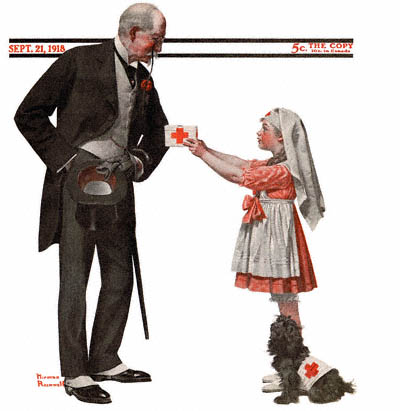
Happy-volunteer-fist-pump-kid1Today like every day except weekends I had radiation treatment at Buffalo’s Roswell Park Cancer Institute (RPCI). Desmond, our 15-month old grandson, came along for the ride. David watched him in the lobby of this huge sensory-filled place while I got my 20 minute treatment from my new best friends, my radiation therapists. After the 20-minute treatment David, Desi and I just hung out for an hour. I know it sounds weird to be hanging out in a cancer hospital with a child. What is wrong with a playground? But this bright expansive atrium with its Dunkin Donuts café, live music, gift shop, therapy dogs (one says hello in Spanish) and most importantly, a squadron of volunteers made Desi’s time special. Special for him and special for me since the end of February when I was diagnosed. I have yet to come back home immediately after a radiation treatment. I like visiting, snacking and socializing at RPIC. Those of you who know me are going to chalk this up to my sociability. Fair enough, I am social with or without steroids but that is not the whole story. There is an upbeat spirit about this place that goes way beyond my personality. And it is not just me who feels this way. Just ask anyone who has ever received treatment here. The army of volunteers and caring staff make the difference.

Those that can do, doI have been conducting my own informal poll; asking volunteers how long they have been volunteers, what they get out of it, and what motivates them to volunteer. As you might expect many are cancer survivors that have received treatment at Roswell and found the experience tolerable because of the way they were lovingly treated. Some have been caretakers of loved ones who received good care and warm receptions. And amazingly some are still currently in treatment for cancer. Their motivation is not too surprising, “I simply want to give back in some tangible way.” Other responses include enjoying the volunteers (lots of laughing among these folks) and the caring professional staff that appreciate them. Ryan, a paragon of upbeat-ness and coordinator of volunteers, describes going to a conference about volunteerism in the Western New York health care system. He learned that the average retention period for volunteers at health care institutions was less than a year; for RPCI it was 4.8 years. Hands down they outscored the others.

Shirley, a volunteer of 8 years coming from Canada, (no small sacrifice…Canada is just across the river but still a ½ hour to one hour border crossing each way) told a story of being part of a team that gave tours to CEOs from cancer hospitals all over the world. At the end of the Roswell tour, the CEO’s agreed, according to Shirley, that to two things that distinguished RPCI from other top cancer hospitals was the art work displayed and the Roswell volunteers.

But why is that? I am sure other hospitals have volunteers that are wanting to give back for the care they received. So, I went to another source to discover what the reason might be for the warm aura in this place and the long retention of its volunteers – over 500 strong, age range 14 to 98. Again, it feels a little weird to be talking about a cancer hospital like it is some kind of spa. But then again maybe it’s the element of unlikely expectations that provokes such appreciation. If I went to a spa I would expect to be pampered and warmly received. I don’t think I would ever have expected that going to a cancer institute would be anything but tedious and terrifying.

rockwellI asked the director of volunteer services, “Why do you think this place attracts happy volunteers?” I explained that I was a patient and was numbered with many who felt cared for. I told her my story. “I could not face leaving the hospital after hearing the news of the pathology report after my surgery. I had to stay, sit, pray and walk around as I soaked in the ambiance – a nurturing kind of ambiance that I had no words for but knew I needed for a while before I was ready to leave and face life “on the outside”.

But my story doesn’t even come close to the heart rendering story I heard from the director’s assistant. A 20-year old boy was diagnosed with cancer and in 6 weeks he died. The family of the young man was so grateful for the care and attention that everyone showed (staff and volunteers) that over a hundred flower bouquets were bought and hand delivered to each person who interacted with their son and family in that short period of time. Their son liked flowers and the family could think of no better way to show their appreciation. There were other touching stories but the director also wanted to sing the praises of the administration who was consistently supportive of volunteers, making them feel needed and welcomed. “I feel a need to thank them (admin) almost every day.”

So here is what I have learned about volunteer competency, happiness and retention through personal experience and internet research. And by the way I have seen this happen at the Palestinian Bible Society with their volunteers and with Love INC – a charitable service for people in need in Juneau, Alaska.

  • Volunteers have a need to feel like they are part of a mission bigger than themselves.
  • Volunteers have a need to feel like they are giving back blessings because they know they have been recipients of blessing.
  • Volunteers need to get along with each other and enjoy each other.
  • Volunteers need to feel appreciated and needed by those in authority.
  • Volunteers need to be part of a well-organized system that knows what to do with them.

But there is something else going on amongst these volunteers that is special but intangible. It cannot be reduced to bullet points. Throughout this “Dona study” of RPCI staff and volunteers, I have repeatedly sounded like a three year old who wants to understand something that is eludes my ability. “But why do you think this is so,” has been a common refrain as my therapist-mind wants to reduce ‘whys’ to their most indivisible core. I have concluded that I am not going to get my ultimate answer. Once again I must go to my default since this entire cancer treatment journey began: what is clear in the mind of God is a mystery to me. And not having my answer will not stop me from enjoying His benefits.

The Storyteller

It is gratifying to tell a story to a sensitive 4-year old. The stories don’t have to be particularly interesting with complicated plots, characters or climaxes. They sometimes don’t even have to be stories at all – just mere observations told with some real or feigned flair. But nonetheless they are received with appreciation and interest.
“Oh, look Marlon (my grandson), there’s a guy smoking a pipe. You don’t see that much anymore.” “Why,” said Marlon. “I don’t know. But my dad used to smoke a pipe but then he stopped smoking it when he learned from the doctor that it was bad for his health.” Health and/or moral lessons can be sneakily introduced this way. That story got retold to his parents later on when I wasn’t there. Too bad, because Marlon got the story understandably mixed up as he thought that I said his dad had smoked a pipe. My son-in-law had to tell him that ” Nonna was mistaken”. Shucks! I had to retell the story with emphasis on my dad, not his. By that time, Marlon was hardly interested in the retelling of a story that only included a change in proper names.

Sometimes my stories generate sympathy and compassion for almost nothing. “Hey Marlon, yesterday, I saw a guy carelessly throw trash out of his car onto the street. Boy, that wasn’t nice, was it?” “Why”, said Marlon. “Well, because we all need to work together to make our roads and communities clean and nice places to live.” Later, Marlon said, “Nonna, I’m sorry that you had to see someone litter from their car.” I was impressed that my non-story had such an impact even while feeling a tad guilty that my litter story had not nearly the emotional impact on me as my grandson assumed it had. Shame on me.

Storytelling is hot at the moment
There are books, seminars and workshops on Storytelling. It appears that we are all desperately in need of hearing a good story or, better yet, to be able to tell one. The goal is to create stories that are interesting, arresting, and even life changing. Libraries, clubs and shows advertise upcoming storytelling events. Good communication and sermons must include stories to hold the interests of its audience. That audience can sometimes be just one person like your spouse or child. This current trend has a way of making Storytelling sound like it’s the newest tool for good communication. It is almost as if before now, we were only communicating in treatises and legalese or worst yet, in grunts, texts and tweets. But Storytelling is hardly new. We have been telling stories ever since we humans have been sitting around camp fires rotisseriz-ing our wild drumsticks. We are hardwired for stories. Oral storytelling has been the ancient way of entertaining and efficiently teaching the younger generation of what was important for group cohesiveness and how to stay alive in a world rife with dangers.

We still do it.

I unfortunately got the “tell scary life stories gene” in spades as my daughters can testify. They are able to retell every, “once there was this person, and they did something and then something really horrible happened to them so watch out” story I ever told them. I am working on suppressing this anxious gene expression for the sake of my grandchildren. In fact, I am hoping to be able to tell them some of Jesus’ stories in winsome and engaging ways. And hopefully, like Jesus, I won’t do my Aesop’s fable-lesson- type-thing at the end of the story to make sure they get the point. Rather I hope to let Jesus’ parables do their own mysterious workings in my grandchildren’s hearts and minds; informing their understanding of God’s love and what He wants of them.

I have been attending to the parables of Jesus for several decades. I am often surprised how freshly they communicate God’s ways and wisdom. ” The prodigal son” (Luke 15) is a personal  favorite  when I am tempted to feel that God  doles out love and acceptance based on performance rather than faith in His love and sacrifice. My latest appreciation of this parable follows, thanks to Kenneth Bailey.

A very incomplete recap of Jesus’ story of the “Prodigal Son”
The story begins with a young adult son or teen who asks for his share of the family inheritance – a request that was unheard of in first century Palestine. The request amounts to a “you are taking too long to die so give me my inheritance now.” Jesus’ audience would have perked up immediately with this story’s beginning as it would have belied the cultural norms right from the get- go. A son behaving in such a way would have been punished but surprisingly the father grants his request and off the son goes to a “faraway place where he proceeds to squander his inheritance on wild riotous living.” Jesus then describes the son’s descent into self-inflicted poverty. Alone and starving the son remembers the stability and comforts of home and decides to take a chance and return. He, too, knows his culture’s expectations of how to treat such a flagrantly disobedient son. But he is desperate.

Jesus’ first century listeners would have assumed the ending to this morality drama. The father who is also a wealthy landowner and by implication a leader and one of the guardians of the community’s stability  would have the son killed, banished or, if inclined to show mercy, treated as an hired servant with no claim to a son’s status or affection. The latter is what the son is hoping for as we listen to his internal dialogue being practiced on his journey back home.: “Father, I have sinned against heaven and against you. I am no longer worthy to be called your son: make me like one of your hired servants.” (Luke 15:18-19)

And why not? There needed to be an ending that would help keep the community intact. After all, youth listening to a story like this would need to know that if you break the community’s rules , you could expect to be an outcast. How else would the long held traditions of elder respect and compliance be upheld? How else was a community going to be protected from chaos, corruption, and possible extinction unless the father or community elder did not exact the rules of tribal community survival?  Bringing the erring son to justice was certainly what the Jesus-listeners would have expected.. But no, this is not how this story would end. Jesus, no doubt, surprised his listeners with an ending of unimaginable love, forgiveness, and humility. “But while the son was still a long way off, his father saw him and was filled with compassion for him. He ran to his son, threw his arms around him and kissed him.” (Luke 15:20)

I like imagining the father hiking up his long robe to run ( older men in the Middle East don’t run. it is beneath them and invites shame) all the while thinking, “Who cares what the village thinks of me. Let the community be disgusted with my disregard to the village’s rules and let them think I am no longer worthy of their esteemed opinion and respect. I only care that I have my son back and I am going to throw a party!” To add more intrigue to this story, Jesus introduces a third character. The self-righteous follow-the-rules older brother who upon hearing of his loser brother returning and being thrown a party by their father is abhorred and resentful. He complains bitterly to his father for what he sees as an injustice of indulgence and favoritism. The father tries to woo the older son with love, as well. “Don’t you see? You had the benefit of always being with me and enjoying the comforts of home, while your brother was playing the fool and ended up almost starving to death, you had a stable life with friends and beef steak anytime you wanted it.”

Bailey, a theologian and Middle Eastern scholar who I credit for elucidating Jesus’ parables with exciting insights, calls this parable and other parables, metaphoric and deeply theological representations of God’s, “costly demonstration of extravagant and unexpected love.” He states says that this kind of love that only God can offer is for “the law breaker (younger son) as well as for the law keeper (older son in the story).” They both need it and so do we regardless of which brother we identify with.

Read, ”Jesus through Middle Eastern Eyes,” by Kenneth Bailey.

Personal application
Is a story told to first century Palestine relevant for us? Well, it depends if you feel a need to be accepted and loved beyond your capacity to be deserving of such love. And it depends on whether or not you believe in a God whom you have let down no matter how little or hard you have tried to be good and self-justified. If you feel such a need as I do then this parable is a tear jerk-er of good news. And for sure it is much better and has more emotional impact than stories of people smoking pipes or even of litter bugs.