The upside (I mean it!) of being bald


In this post I want to  speak to the pluses and minuses of being bald. I’m serious….not tongue-in-cheek, or just funny or sarcastic. I have come to see some real advantages about being bald.

The positives:

1. You feel squeaky clean after a quick shower.

2. Your head dries within seconds – no blow drying, no nothing – just you and your natural born head.

3. You never have a bad hair day.

4. If you ever get head lice it will be easy to get rid of.

5. You get to reinvent yourself with the many wigs that you have conned from the American Cancer Society.  (Not really a con; it is just a matter of going to all the different ACS sites and asking for your one free wig.  They don’t care that you got one at another location.  Thank you, ACS.)

6. Friends give you gifts.  Some are beautiful scarves that you can wrap your head in different styles: African, Gypsy, Egyptian.   Again you’re reinventing yourself.

Aside:

You know how our mothers always told us to make sure we had clean underwear on in case we were in an accident and had to be taken to the hospital?   Well I’ve got another one for you ladies:  always make sure you have on 24-hour stay lipstick and earrings..

True story: In an earlier post I mentioned that I passed out at the oncology clinic due to fever and infection; an episode that required the hospital’s  rapid response team to be summoned.  Once they were reassured  I was no longer in crisis  they started talking to me.  Let me rephrase that. They started talking about me.  At that point I was slowing regaining consciousness.  I could hear and understand but I just could not summon the strength to open my eyes.. I heard one responder say, “Look at her she still has her lipstick on!”  At that moment I knew something critical had to be said whether my eyes were open or not. So I said, “By the time I have my eyes open I expect all of you that are surrounding me to have your lipstick on.”  (I desrved that.)  They laughed and said that Ralph only wore his at night.  (Ralph had to have been a medical student.) See ladies, clean underwear won’t generate admiration or laughs.  Wearing clean underwear is just doing your duty.  Wearing 24-hour lipstick is above and beyond.

Positives of baldness continued……

6. When you want your husband to feel sorrier for you than you deserve you can  walk around the house bald or with an unflattering scalp cap; looking very pitiful without your lipstick or earrings. It might get you a back rub or yet another glass of lemonade. But don’t overdo  this, it will backfire. One time after being particularly demanding my husband looked at me in my scalp cap and said, “You look and act like you are in the mujahedeen!”

7. When you finally decide to spruce it up a bit you get more than your share of compliments from your husband. He really means it because he’s really relieved!

The downside:

Did you notice that I didn’t mention a single negative? There is one big one:

You cannot ride in a convertible.  If you ride in a convertible you wig will invariably fly off once the car attains a speed of 45 miles an hour. It is likely your friends will be videotaping you when this happens. The video will be uploaded and go viral within minutes. This is subject to YouTube embarrassment and notoriety worldwide. I know this to be true because I know of it happening to at least one other woman.

So I’ll close with a link to the  Church Lady’s Wig Flies Off. I have watched this YouTube a dozen times.  I love this woman and I love her family and you’ll see why.  Listen carefully for some few  keywords. She explains what a “Treacher” is.  Listen for the word, “road kill”.  Watch the  the expression on her daughter’s (the driver’s) face.  Listen to the teasing of the other daughters that are on and off-camera.   And finally listen for the expression that I could have said, “at least you wearing your lip stick!”


Please weigh in on this topic of plusses of baldness in the comment section. No negatives please.

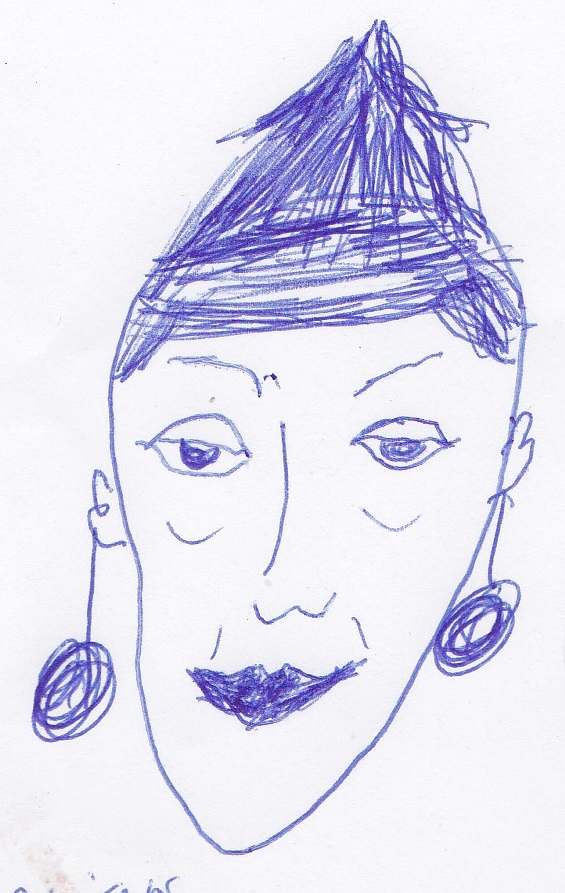
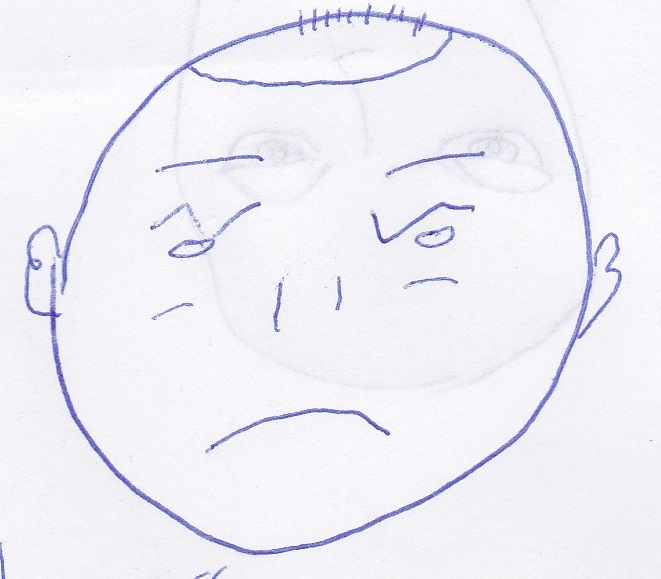
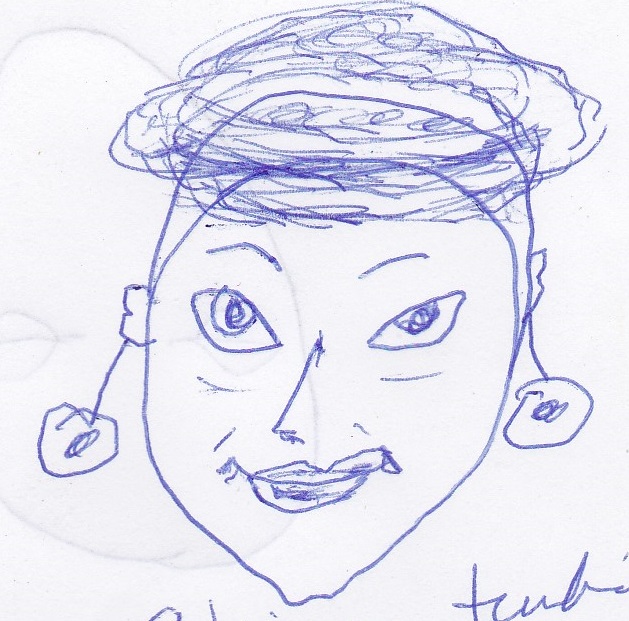
Some illustrations from my own creative hand to amuse and educate: remember you are reinventing yourself.

Lipstick, earrings, wig and looking twelve


Egyptian scarf with lipstick and cool earrings
No lipstick, no nothing but grumpiness
Short curly wig. Too much lipstick but cool earrings.
Gypsy scarf with lipstick and earrings but looking 10-years old.
African turban, lipstick, earrings

The Rumble of Panic beneath Everything

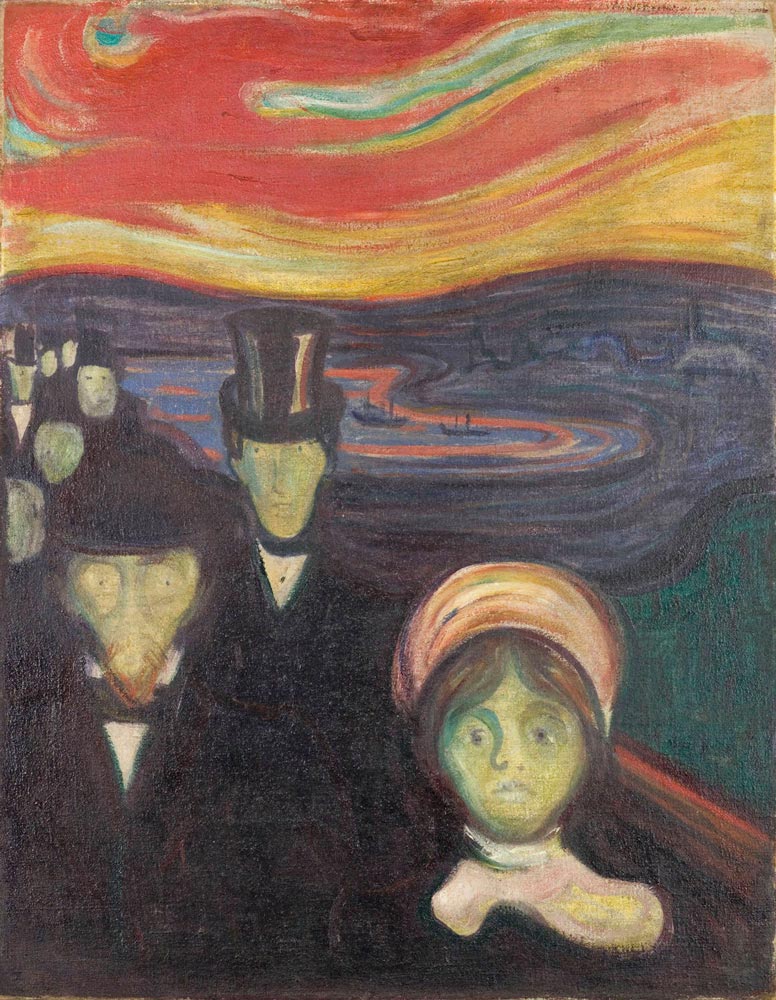
Anxiety (1894) by Edvard Munch

The counselor in me has always had a vulnerable side when the professional hat is not worn.

I’ve been an interested and emphatic listener of others’ stories since my twenties when the Jesus story first made its impact (coincidentally or consequentially, I’m not sure).  But I’ve not always been able to be a dispassionate empathetic listener. This vulnerability presents itself when I move from empathy to over-identification. The self-centered and self-protective side of my psyche hijacks the genuinely compassionate side and the fearfulness of “this sounds too close to home and could happen to me or a loved one” takes over and I am sorry I ever listened to that person’s story. I don’t know why but this does not happen when I am “clinical Dona” which is a good thing or I would have been admitted to a psych ward after my first year of practice.

I just spent three days in the hospital after getting an acute infection driven bya low white blood cell count due to chemotherapy.  I spent 24 hours in the ICU and two and a half days on a regular floor. In both situations I was in better health than the patients around me and because of this I had conversations with worried and distressed family members that I would meet in the hall or waiting room. I heard stories of protracted and acute suffering and misery in a very short period of time. The empathetic listener had not turned off while I was hospitalized.text for rumble_rev

But there were times during my hospital stay that I wanted it to turn off; like when the descriptions of misery were too raw and graphic. At that point cancer would interrupt the counselor – butt her out with one quick unexpected slam – reminding her that there could be much more misery in store down the road of cancer treatment.  So, after a while compassionate listening would give way to cowardly recoiling and shutdown. I would walk back to my room with more Dona-sadness than with Jack-sadness or Terri-sadness.  Not pretty or admirable.  Thankfully this overly anxious display of self-pity did not last long and did not keep me from praying for these folks and their distressed families.

My guess is that most of you readers are not going to be too hard on me.  In most of us there is that nagging feeling and suppressed thought that suffering and loss are not that far from any of us regardless of the many precautions we take to stay them off. They blindside even the most cautious and genetically hearty of us.

In the introduction of his book, Walking with God through Pain and Suffering, Timothy Keller quotes Ernest Becker:

 “I think that taking life seriously means something like this: that whatever man does on this planet has to be done in the lived truth of the terror of creation…… of the rumble of panic underneath everything.  Otherwise it is false.”

So how are we to live with peace, purpose, joy, love, and hope in light of this rumble of panic?  How are we to recognize a caring, loving God who is for us when at any time the shoe can drop or has already dropped?  I am a novice in this world of suffering but let me offer a couple of thoughts.

David my husband says that in times of crisis we are what we have been trained to be. My experience in watching others who have walked various kinds and degrees of suffering, ranging from tragic losses to debilitating and sometimes fatal illnesses, is that getting through it required leaning on spiritual resources previously learned or acquired.  I am not going to be so presumptuous as to imply that only those who rely on spiritual resources weather their tragedies well.  I have read or heard  inspiring stories of people who have weathered great hardship without apparently leaning on God.

But my experience in working in the US and the Middle East as well as meeting people from all over the world is that when push comes to shove it is spiritual resources that provide comfort and strength in times of critical helplessness; not perfectly or always heroically, but nonetheless “a leaning on” that brings comfort.  I heard similar disclosures last week in the hospital’s halls and waiting rooms.

So, what are these spiritual resources that I hear about from the sufferer?

  • Praying
  • Complaining to a God who is both there and not too thin skinned to take it.
  • Drawing on scripture for comfort
  •  Developing a Biblical awareness of the myriad of sufferings addressed in the biblical text with its various antidotes.
  • Receiving the practical and sacrificial helps and prayers of the church and friends that show the compassionate face of Christ, and finally,
  • Acknowledging that something supernatural is at work; ideally, a healing but certainly a feeling of the Holy Spirit’s presence. THEY ARE NOT ALONE.

I, too, have been relying on the above resources; not perfectly or even consistently . In a previous post called, Chipmunk Cheeks, I mentioned the futility of expecting God to give me the grace for my grim or fearful imaginings. He has not promised to do that. He has promised to be with me in the present and give grace for that present. If I lay hold of that truth once again I will be able to be fully present with those who tell me their woeful stories of pain and grief.  Only then can I be numbered as one of the spiritual resources on which they can rely. “Oh God let it be true about me.”

The Friendly Chanter

I Corinthians 15:19:  If Christ is our hope in this life only, we deserve more pity than any other people.

Without fail chemo infusion days bring encounters with people that go beyond the friendly chit chat.  I hear stories that cause me to think, pray and wonder on a deeper level.  Thursday was no exception.

The story:

While waiting for the pre-infusion check-in with my oncologist I was approached by an engaging woman. She had just finished her routine mammogram.  Cancer free since 1999!

As an aside; it is refreshing news to hear such a thing because typically I meet people who are dealing with reoccurrences which tend to unnerve me. David helps me put these encounters in perspective. “Dona, you are in a cancer institute where people are here for cancer treatment of all varieties and reoccurrences. The others who have been cured or in long term remission are in Starbucks having lattés with friends”. (Fair enough).

Back to the story:

The stranger approached me smiling and said, “I noticed you because you seem to be so upbeat and light filled and I just had to meet you.”  I returned the compliment genuinely and she told me her excitement to be cancer-free for so long and then surprised me with a discussion of hope.  She handed me a pamphlet and card with her name on it. It wasn’t what I expected because as she gave me the pamphlet she said, “I am not a proselytizer but I have experienced the benefits of chanting through a particular Buddhist sect’s practice. It is all explained in the brochure and if you have any questions please feel free to call me.”  She went on to explain that chanting in this way can even change things on a cellular level.  I thanked her because I realized this came out of a genuine liking and concern of me. But I told her that I was receiving therapeutic benefits from blogging through the lens of my Christian faith and gave her the address of my blog and invited her to read it.  I hope she does and I hope she’s in no way offended in reading this post.

Another aside: David wanted to weigh in on this discussion so offered his experience of “chanting” to our new acquaintance.  I quote him, “I did something like chanting when my wife was being diagnosed and I felt helpless and too anxious to even pray. All I could manage was to say, aloud when alone or silently to myself when in public, ‘God is my refuge and strength, a very present help in trouble.’  I said it over and over again and it helped.”

I am not sure this was the kind of “ chanting”  she  was referencing but I admired David’s transparency and humility as he described the importance of quoting a piece of scripture over and over again as a way of drawing comfort.

Spiritual insight on the nature of Hope:

It seemed that hope for my new friendly acquaintance was related to the benefits that her spiritual practice could give her in this life. To quote the pamphlet, “we believe that happiness is being able to experience profound joy that comes from never being defeated by any problems in life,” and “We have the power to take charge of our own destiny.”  Perhaps she also believes as many Buddhists do that there is the hope of a progressive awareness of reaching nirvana where all desire, and attachment is absorbed into the universal life force of all things absent of any individuality. “This kind of chanting practice gives hope”, she reiterated.

It struck me that the Christian hope has a lot to do with this life but ultimately because it is part and parcel of a tangible, transformative, redemptive eternal life.  Distinct personal beings like a “real distinct you” and a “real distinct me” are transformed and in communion with a tangible God in His trinity with absolutely no loss of our distinctive selves. I want this kind of hope- A hope that goes beyond this life. Because whatever spiritual practice we do or whatever medical intervention helps us we will all eventually die. We do not possess ultimate power to stop certain forces at work that threaten to undo us. But we can rely with hope on the One who holds all things in his Hand and whose purposes though inscrutable at times are at the same time meant for our good.  So, why not really hope big. Hope with a capital H that carries us into an eternal glorious future while we wait out patiently the infinite glory of God to be revealed in us and in this world and the world to come.

1 Peter 1:3-4

Praise be to the God and Father of our Lord Jesus Christ! In his great mercy he has given us new birth into a living hope through the resurrection of Jesus Christ from the dead, and into an inheritance that can never perish, spoil or fade-kept in heaven for you

Postscript:  Goldie Eley, David’s 90 year old mother, departed this life on May 21st. She collapsed from congested heart failure walking back to her home from a bible study a 100 yards from her home. Her Glorious Hope is now being realized.


I am a “6” and my husband is a “7”

I am a “6” and David is a “7” on the enneagram personality inventory.

Who cares and so what?

I enjoy this popular personality inventory stuff.  Bear with me.  Later, I will lead you to some of the most inspiring thoughts.   Not mine (be gone chemo-brain hubris!) but quotes from recently published, must-read book.

A ‘six’ personality type is a natural doubter and questioner. So, I did not have to have cancer to wonder why God allows suffering.  I have questioned others within theological circles and read numerous publications in an attempt to make peace with suffering from a Christian faith perspective. Caring about suffering did not just happen when I found myself enduring some of it because of cancer treatment. I have questioned smarter people than me and I have, I admit, questioned God on this matter. Theodicy (defense of God’s goodness and omnipotence in view of the existence of pain  and suffering) has been topic of theological and practical struggle for me for the past 4 decades.  But like Peter one of Christ’s followers, when asked whether he too would leave Jesus like many following Him did because of the hard teaching Jesus had just laid out, Peter’s (Dona’s) response was “where else would I go as you have the words of eternal life.”  (John 6:68)

But occasionally the doubt and unease woven throughout my ‘six’ personality type rears its worried head like a watchful seal in the Juneau harbor – casting about looking for potential threats until soothed and reassured only then to slowly submerge beneath the surface.  I trust in the goodness of God afresh.

The ‘Six’ personality type is also the loyalist with strong convictions.  So, being a Six is not all bad.  However it gets funky when the six’s spouse is a ‘seven’ personality type.  ‘Sevens’ are the adventurers and enthusiasts. They naturally trust that everything is going to work out in the end. David’s personality though 90 percent perfect for me, has not generally made for long, long philosophical discussions.  Manna from Heaven for me but more like prison food for David.   Ironically, David will tell you that what caused him to leave the faith as a teenager – the problem of pain, evil, suffering and injustice in the world- would be what brought him back in his early 20’s.  In David’s view, some worldviews logically account for suffering, but only one, Christianity, addresses the problem while offering hope.  (See John 6:68, again).  He’s a man with a vision who wants to do something, shake it out on the fly.  In the classic words of President Arnold Schwarzenegger in ‘The Simpsons Movie,’ he ‘wants to lead not read.’   I am not suggesting that David does not have his own private devotionals but long, long discussions with me has not been his forte.  This is just the nature of a ‘seven’ on the enneagram which is incongruent with the ‘six” which naturally wrings her hands on many issues, philosophical or not.

But along came cancer carrying a book by Timothy Keller, Walking with God in the Midst of Pain and Suffering (Dutton 2013).  Now, almost every morning David and I get our coffee and he reads out loud to me from this book and we discuss and discuss and it has become manna from Heaven for both of us.  I’ll never have all my answers but I’m grateful to Keller and others who without pat answers or arrogance towards those of a different view, honestly and competently engage with the issues.  I highly commend this most-readable book.  I’ll conclude this post with a few Keller quotes:

“Part of the genius of the Bible as a resource for sufferers is its rich multidimensional approach. It recognizes a great diversity of forms, reasons for, and right responses to suffering.” (9)

“In the secular view, suffering is never seen as a meaningful part of life but only as an interruption.” (26)

“Christianity teaches that, contra fatalism, suffering is overwhelming; contra Buddhism, suffering is real; contra karma, suffering is often unfair; but contra secularism, suffering is meaningful. There is a purpose to it, and if faced rightly, it can drive us like a nail deep into the love of God and into more stability and spiritual power than you can imagine.” (30)

“While Christianity was able to agree with pagan writers that inordinate attachment to earthly goods can lead to unnecessary pain and grief, it also taught that the answer to this was not to love things less but to love God more than anything else. Only when our greatest love is God, a love that we cannot lose even in death, can we face all things with peace. Grief was not to be eliminated but seasoned and buoyed up with love and hope.” (44)

“But resurrection is not just consolation — it is restoration. We get it all back — the love, the loved ones, the goods, the beauties of this life — but in new, unimaginable degrees of glory and joy and strength.” (59)

“Suffering is actually at the heart of the Christian story.” (77)

“The best people often have terrible lives. Job is one example, and Jesus—the ultimate ‘Job,’ the only truly, fully innocent sufferer — is another.” (133)

“The only love that won’t disappoint you is one that can’t change, that can’t be lost, that is not based on the ups and downs of life or of how well you live. It is something that not even death can take away from you. God’s love is the only thing like that.” (304)

Mother’s Day 2014

dona and maria 32-years ago: Maria (the one without hair) and me

I didn’t think I could take another poignant sweet anniversary or holiday.  David’s and mine 35th anniversary (I had my chest port inserted) was poignant enough without Mother’s day coming in a close second.  But here I was the day before mother’s day with an unexpected text from my oldest daughter, wanting to shave her own head in mother/daughter solidarity for my cancer treatment.  My initial and steadfast response was NO. But that was after I just swallowed a big lump of sweetness that still sticks in my heart from such an offer. The other daughter didn’t know of this as she was too busy texting me every 30 minutes from Syracuse to remind me to take my anti-nausea meds and eat anything I want, get plenty of rest, etc. and all the while entertaining in-laws from all over to celebrate her husband’s graduation festivities having earned a PhD in Business Administration (well done, Rob).

Hair was falling out in clumps.  So mother’s day was the day that we felt that the shaving of the head ceremony would occur with Maria, oldest daughter, assisting her dad.

It’s now the day after mother’s day and I couldn’t go through with it.  It couldn’t be mother’s day – not the day that 32 years ago this child made my first mother’s day a reality.  Toting her around on my hip with her little bald head was not the image I could escape as I realized that 32 years later on Mother’s day that bald baby was a grown women with children of her own  helping her mother weather a challenge.   Not on mother’s day; the poignancy was too much for even me who adores poignant moments, not just mine, but anyone’s. Deeply moving moments enrich my life – probably another reason that psychotherapy has been my career and passion for years.

Doing a minimal amount of research on the psychology of poignancy did not yield the wealth of readymade quotes to inspire but there were simple descriptions worth mentioning.

  • Poignancy is cognizance of happy-sad emotions related to meaningful endings:  parents watching their child marry or wave goodbye from her new freshman dorm room.
  • Poignant moments increase as we get older because we are more aware of the passing of time. We are more aware of the limits of time here on earth and therefore transitions are more bittersweet.
  • It is not that the young cannot experience poignant or bittersweet moments.  Look no further than high school graduations and all other graduations after that to see the tears in some eyes and the feelings of sadness of an era ended, never to return, but still the satisfaction, even joy, of a necessary milestone achieved.

Anticipating Maria shaving my head on mother’s day showcased an era ended and another begun – a daughter competently trading places with her mom.  Poignant for me but more utilitarian for her.  She can do something for me, her Mom, which I can’t do for myself – pure and simple for her but bittersweet for me; not soon to be forgotten.

I’ve learned that people will forget what you said,
people will forget what you did,
but people will never forget how you made them feel.
– Maya Angelou

 All of this makes me wonder if Christ had bittersweet experiences or moments of poignancy.  I don’t believe the word is used in the Bible but I can’t help but think that as Christ buddied around with his followers and friends at dinner parties that there were not moments when He knew this would end, and His to approach the bitter cross would begin.  The meaningful end of fellowship with friends was at hand. And perhaps He felt an emotion akin to poignancy. Bitter but sweet because He also knew that the resurrection would follow that separation and usher in something infinitely better and new in the future of all concerned.  Including you and me.


An exclusive moment within diversity

blessedThere was only one black man in the phlebotomy waiting room. Unusual because the waiting room was crowded and usually representative of ethnic origins and different races living in this city. One of the many reasons I love Buffalo.

I came in first and was seated. I noticed him because he was also the only one of us wearing a mouth mask, not an uncommon sight in a cancer institute but noticeable. He sat across the room from me and I smiled at him.  His eyes told me he had smiled back.  I had not had much luck with anyone else (smiles are important to me; see my post, Duchene’s Smiles, Please).  Everyone seemed wrapped in their world of worry or boredom with yet another routine to follow for the care they need.

He pulled down his mask so I could see him smile and said, “Are you having a nice day?”

I answered back, “I have no complaints.”

As if talking to himself he said, “You trust in God and leave everything up to him” to which I answered “amen.”

He then directed his comments back at me as if returning from a place of prayer. “I am a blessed man, a very blessed man”.

Since we were talking across the room from each other I wondered what people were thinking.But it was like the two of us were there alone.  I continued, “I can tell you are a blessed man because of your ball cap.”

He seemed momentarily confused until he took it off, exposing his baldness, and read the words on the cap, “I AM A BLESSED MAN.” He laughed as he explained he forgot that he had that particular ball cap on but agreed with it wholeheartedly.  At this point I was called in to have blood drawn.  I left the waiting room feeling the exclusivity of a tender moment with a man who openly and unabashedly shared my hope.

“Always be ready to give account for the hope you have……”

–          I Peter 3:16

Nick, the barber, says, “Trust God, then your doctors.”

Since my cancer diagnosis a year ago my husband’s barber, Nick, has given him two pieces of advice.

“You tell Dona like I told my wife. You stay aliveyou stay healthyyou stay upbeat!  Not just for yourselfnot just for the people who love you, but for the people who hate youWhen they see you walking down the sidewalkthey say, ‘that woman still around?!’  And when they see you look-in good it will give themclinch in the gut.”

And….tell Dona

“Trust God, and then your doctors.”

Although left speechless after hearing the first bit of advice I appreciated the second. But how can I trust God for my well-being and trust doctors at the same time for my cure?  I think about this all the time.  I say that I trust God but yet I find myself hanging on every word of a medical provider as if I’m hearing from ancient oracles pronouncing my destiny.  I don’t like the feeling of smallness that happens when I talk to a provider at the cancer institute.  The little girl inside me is saying, “Please be nice to me because you are bigger and I am small right now so you can hurt or help me.”

It’s not quite that pathetic but exaggeration serves the point.  I defer to medical providers as if they hold the balance of my life in their hands.  But this flies in the face of everything I believe about who truly holds my fate in His hands.

I have said all these things to you so that in me you may have peace. In the world you have trouble: but take heart! I have overcome the world. (Jesus quoted in John 16:33)

I am not disabusing modern medicine in light of faith.  I am grateful for the medical advances in the care of those with illnesses.  I thank God for those who use their intelligence, ingenuity and compassion to develop treatments and cures for the myriad of diseases that plague humanity.

But what is the role of God in a person’s life when the material world offers so many empirical, concrete procedures and assurances?

My husband said that we treat science as God, technology as the Holy Spirit, and I’ll complete this false trinity by noting that the mental health profession is seen as Christ.

“Trust God first and then trust the doctors.”  But as a person who worships the Creator of the material world rather than the material world itself, how is this to look?  How is this played out in a way that moves me away from spiritual platitudes to words that reflect my deepest convictions and hope?  Well, for starters I must believe that God exists and that He can be trusted.  I don’t get there easily and I don’t get there by hard work.  I get there by being inspired, or more to the point, something is opened up to me and I enter in.  At the same time there is work, some soul work, involving curiosity and study.  For God knows that this world is not going to hand God’s trust to me on a platter.

Ultimately, there will come a point where the pursuing, studying, questioning and reflecting demand a leap of faith.  But it won’t be a blind leap. It will be a wide eyed here I go, for better for worse, for richer or poorer kind of leap.  Do these words remind me of another leap?  Yes, belief in God is like the decision to say ‘I do’ at the altar of marriage – not blind but certainly not a 100 percent certain. But there is enough information, time, dialogue and togetherness invested to make the leap seem more than reasonable – almost compulsive or desperate!  It is an I-have-to-have-this-person-in-my-life kind of leap.

So what is it to trust in God? It’s knowing we belong together; pure and simple.  He is mine and I am his, no matter what happens. Medical science and its allies are created to lighten a burden but we are not on intimate terms.  I am not their “darling” but I am God’s and so it goes for each one of us that trust Him.

Dona Eley is a cancer survivor and a mental health therapist for the Community Christian Counseling Center in Juneau.  She blogs at donaeley.wordpress.com

In this world you have trouble: but take heart! I have overcome the world.

(Jesus quoted in John 16:33)

The would-ofs, could-ofs, should-ofs

Post-Traumatic Stress and the Blame Game

As a trained critical incident stress management debrief-er, I know something of “the could-of’s, would- of’s, should- of’s” that are recited, ruminated, or replayed by victims of trauma (a natural response after a traumatic incident).  Being diagnosed with a life threatening disease is considered a traumatic incident as is a host of others.  Very few of us will escape this world without experiencing or witnessing a trauma.  Helplessness and fear will come uninvited and we will be unhinged for a period of time.  Although experiencing or witnessing trauma is all too common in our world, the severity or duration of the symptoms is very individualistic.

I was in the chemo infusion reception area with call beeper in hand when I struck up a conversation with a young woman.  The young are a particularly disconcerting sight in this area of the hospital so I was drawn to her.  Without probing she volunteered that starting 5 years ago she was diagnosed and treated for thyroid cancer, then breast cancer and now lymphoma.  She talked for a while and just as my beeper went off she said,

“I can’t stop blaming myself because I smoked. I quit 7 years before being diagnosed with thyroid cancer but I can’t stop thinking how I should have never smoked at all.” 

In other words, she shouldn’t have done something but she did it anyway. If she had only known what the ramifications would be she would have done something differently to keep herself from this situation.  She believed that she could have prevented her illness.  So, she has herself to blame and that torments her.

I had only moments as I was preparing to leave for my first infusion.  I essentially told her what I just told you in the first paragraph.  She thanked me.  Who knows what relief, if any, was given.  I would have liked to have talked to her more.

Having received a life threatening diagnosis myself I am no stranger to the “would of, could of, should of’s”.  I unscientifically ruled out a genetic cause of my cancer. My 88-year old mother and care giver to my 91-year old father is as sturdy and illness-free a woman as you will meet.  So, having ruled out genetics, I thought of ways to blame myself for my diagnosis.  I began to think of all the things I should have done differently or would have done instead. The internal dialogue went like this:

“Maybe I should have eaten more organic foods or at least done a better job of washing the vegetables before consuming them. I should have not had a glass of red wine with dinner (some links to breast cancer in recent studies) or maybe I could have managed my life better so there would have been less stress from worrying about the family from which I lived so far away. Oh, and let me not forget the insomnia that I tried to manage on my own for 8 years before getting help. or the virtually forgotten phrase, “taking a vacation”. I should have, could have, or would have done something differently if I had only known that stress “might” tip my cancer fighting properties to exhaustion and make its break through.”

 “The would-of, could-of, should-of’s” are Useless……….or are they???????

….after all there are some very definite links to cancer from our behaviors. Smoking leads to lung cancer. Alcohol abuse can lead to liver cancer and there are other harmful consequences to our behaviors that are not directly linked to cancer but to other human ailments.  We are warned about these woes because the science is clear but many of us take our chances, especially when young and our mortality is irrelevant in eking out the best and happiest existence we can for ourselves.  I personally may not have done those particular abuses but I have done other things along the way that I thought little of.  My faith teaches me that there is an operating function in my soul that demands gratification or at least having it my way without the restriction of healthy boundaries or unwanted consequences.

Galatians 5:17 in the New Testament says.  “What my corrupt nature wants is contrary to what my spiritual nature wants, and what my spiritual nature wants is contrary to what my corrupt nature wants. They are opposed to each other. As a result, I don’t always do what I intend to do.”

Copyright © 1995 by God’s Word to the Nations. Used by permission of Baker Publishing

My Christian faith not only gives me the diagnosis of the human condition but also insights and helps to deal with “the would-of, could-of, should-of’s”, when they come to accuse me after a trauma or bad news

First:   I need to admit the possibility that some of my suffering (I am not only speaking of cancer when I reference suffering or trauma) may be my fault.   As one friend said long ago, “there ought to be a support group for people who have no one to blame but themselves.”  If we are honest all of us would be right at home in one of those support groups from time to time.  But thankfully I am not left waddling in the miry clay of self-blame. No, in this grand cosmic meaning of life that I cling to accepting blame is not so demoralizing and debilitating if I accept the truth of God’s ready and willing forgiveness held out to me even when I don’t deserve it.  This is the heart of God for me and for you.

Two:    I try not to let the blame game distract me from a possible more important issue for which God is attempting to get my attention. Hyper-focusing on the current dilemma can be too narrowing a view of myself, creating a tunnel vision that precludes more expansive, reflective soul searching – reflection that could lead to depth of understanding that actually strengthens and enriches the fabric of life.

Three:  Sometimes there is no personal fault in suffering or even deeper meaning to be found.  We live in a broken world and that brokenness sometimes sweeps us up. My infinite God has not chosen to reveal all there is about himself and his purposes to my finite reasoning. But one thing I lay hold of is that I worship a suffering God.  The late John Stott wrote in his book “Evangelical Essentials” that he could not worship a God who had not suffered in the midst of all the suffering to which humanity is subjected.

So what is my take home? 

When the “would-of’s, could-of’s, should-of’s” accompany pain and suffering I will rely (I hope, I hope!) on trusting God for forgiveness and grace when it my fault.  When personal fault is not found then I will trust (please Lord make this so!) in the inexplicable mystery of Jesus for redemption now and forever and trust Him for healing, maybe now, but definitely forever.


A witnessed life

For the last 20 years David and I test each other on remembering what we did to celebrate each and every one of our anniversaries.  We run into confusion and memory loss for about 15 of them as we are not a couple that has intentionally made anniversaries much more than a short excursion or a dinner out.

Yesterday we celebrated our 35th and unless we both end up with dementia we won’t forget it.  No special excursion unless a day at the cancer institute counts and no special jewelry to commemorate our 35th unless a med port ring surgically placed in the chest wall counts.  David will remember our 35th because of the added bonus of suffering through a cracked rib from a fall a several days before in Florida (one day into a 5-day trip meant to give us a break before chemo therapy started).

The traditional wedding symbol for the 35th anniversary is coral.   According to Wikipedia, “This is because coral organisms grow close together just like a good marriage, built and developed over many years.”

Is it simply the passing of time that builds a good marriage – ticking off years until you reach 25, 30, or 35 then “voila”, there you have it, a good marriage?  Or, is it something else that can’t be measured in years?

David and I have a good marriage so far.  I don’t think you can rest on your yearly laurels. “For better or worse and in sickness and in health,” a promise we made 35 years ago is currently being played out by a serious disease.  How it all ends – not just this sickness part but other parts as well – are still to be tested. We have had other sicknesses and a few heart aches and disappointments thrown to connect us to the rest of the married world.  The union of two becoming one certainly doesn’t negate the two unique personalities brought to the union each with there weaknesses and strengths. Marriage uncovers personality traits neither partner were aware of prior to the promised commitment to faithfulness, cheerleading, and fun.   For example, and I will mention only my foibles, I did not know that I could be critical, defensive, or even irritable until I was married for a while.  Now, it’s not all bad as certain character strengths have had a chance to express themselves to my surprise as well.    All in all, marriage has provided many blessings – but especially a journey into humility (having children is the other road to humility).

I am married to my best friend as it turns out and the following lines from the 2004 movie, “Shall We Dance” spoken by Susan Sarandon, the wife character, expresses this sentiment:

“We need a witness to our lives. There’s a billion people on the planet… I mean, what does anyone’s life really mean?[1]  But in a marriage, you’re promising to care about everything. The good things, the bad things, the terrible things, the mundane things… all of it, all of the time, every day. You’re saying ‘Your life will not go unnoticed because I will notice it. Your life will not go un-witnessed because I will be your witness’.”

Timothy Keller writes in his book, The Meaning of Marriage, “To be loved but not known is comforting but superficial. To be known and not loved is our greatest fear. But to be fully known and truly loved is, well, a lot like being loved by God.  It is what we need more than anything.  It liberates us from pretense, humbles us out of our self-righteousness, and fortifies us for any difficulty life can throw at us.”

So, about two weeks from now I will ask the person I trust the most to do me the honor of shaving my head.  It was my hair that David says that initially attracted him to me over 35 years ago and it will be shaving that hair off that will make the decision I made 35 years ago to marry him the best one of my life.

Footnote 1: The quote by the character played by Susan Sarandon, “what does anyone’s life really mean?” is a rhetorical question that compels me to comment. Each individual life, married or not, means a lot to the One who is the ultimate witness to our lives.  He witnesses and marvels at every aspect of our short mundane lives with all its suffering and joys. I know that everyone does not share this belief and certainly not a secular world that sees Christianity as a crutch for “the infantile” (Richard Dawkins). Yes, a crutch indeed.  A crutch that someday will be thrown away at the restoration of all things.

Quirky Advice

Some of you dear readers are now at risk of being offended. You will recognize yourself in this post. But remember “teasing can be a sign of affection.”  I heard this somewhere years ago and found it comforting as I am married to someone who teases his wife as a life calling. There have been times he has regretted that calling.

Since my cancer diagnosis I have received encouragement from all of you.  How do I know it is ALL of you? Simple…you are reading my blog at this moment and you have gotten this far without clicking away.

There are some however, who are incapable of reading my blog but have greatly encouraged me.  I am a grandmother. (“Uh-Oh”, you are thinking.)

If you tire of “granny gush” skip this part.  I am afraid if you don’t then I will be accused of the following:

boring cat

Ok, where was I? Oh yes, grandchildren:  there is 4 year old Marlon who when he  first time he saw me after the mastectomy asked straight away, “Are Your lymph nodes recovered yet, Nonna?” rather prophetic if you ask me as it had not been yet explained to me that the real discomfort was not going to be the mastectomy, per se, but the lymph node removal surgical part. How did he know that?  Gifted? Of course!

And then there is 10 month old Desmond who said to me just yesterday, and I quote, “Nonna, I love you so much and I am hoping that you will not only have a full recovery from this battle with cancer but that you will come out of it a stronger and better person!” 10 months old! Amazing, right?  No, just gifted.

Ok, I’m done with grandma references.

Now for some of the quirkiest encouragements I have gotten so far:

Let’s start with Nick, David’s Sicilian barber for the last several years. I don’t know what was funnier, David setting up the scene with the accent in tow or the actual “sort of” encouraging advice.  Apparently Nick was so moved by what he was hearing about me (his wife had cancer several years ago, as well) that he put the clippers down so he could put his hands on David’s shoulders.  Looking at David through the mirror he said passionately (try to imagine a Don Corleone accent).

“You-uh tell-uh Dona like I-uh told-uh my wife. You-uh stay-uh alive, You-uh stay-uh healthy, You-uh stay-uh upbeatNot-uh just-uh for yourself, not-uh just-uh for the people who-uh love-uh you, but for the people who-uh hate-uh you. When they-uh see you walking-uh down the side-uh-walk-uh, they-uh say, ‘That-uh woman still around’?!! And when they-uh see you lookin-uh good it will give-uh them-uh a clinch-uh in the gut.”

David, having grown up in the South where niceties are spoken of everyone, sincere or not, was speechless.  Being 100 percent Italian and 50 percent of that being Sicilian I have the right to poke fun and reassure David that as strange as that advice was, it was meant to encourage him and me. This encouragement was validated as very good advice by one of my mother’s Italian friends.

I have received numerous cards, gifts, flowers, emails, texts, books and phone calls to reassure and encourage.  I even had a friend that I had not seen in 10 years from North Carolina that flew in and stayed with me a few days this week (David had to go back to Alaska for a week of work). Nothing but loveliness and sweetness with all the above encouragements. But….

barbee sauceThere have been some quirky gifts.  After confronting my friends with “what in the world were you thinking?” They were appalled at the suggestion that they were poking fun at my future chemo haute coiffure but rather remembered how much I loved this particular barbecue sauce at one of the restaurants they recommended in one of their favorite cities in Oregon.  Uh…Huh… Sure.

Another couple sent me some viewing material that I am sure they found in the Wall Mart 1-dollar bin or else quickly became a re-gifted item. What were they thinking?

sonny and cher

Then there is the couple that had food therapy suggestions for David to do for me, starting with David learning to prepare cheese cauliflower and hosing me down with an olive oil mist hooked up to the shower nozzle. Again what were they thinking?!?

olive oil shower

What is my point?  Encouragements are appreciated in whatever manner they come because they reflect the uniqueness of friends and family empathizing within the universal experience of suffering.  Somehow it makes the suffering less and the gratefulness more. God’s love shines ever more brightly because of all of you.