We saw the sunrise (in Mosul) and we said, ‘Oh God you are good!’

I believe in Christianity as I believe that the sun has risen: not only because I see it, but because by it I see everything else.”

― C.S. Lewis

This post will not be a cancer-related one unless cancer is used here metaphorically as we take time to consider the malignancy of some suffering in this world.

Have you ever heard a story that left you in awe or perhaps confused as to how to make sense of it?  You knew that what you were hearing was swelling with profound meaning but because you had never experienced anything close to such a thing you felt inadequate to try to give words of meaning to what you heard; as if you might risk exposing a small-mindedness or an arrogant superfluous-ness.

I am about to share a story with you but it will be the last thing I will write for fear that I will be tempted to comment or explain. Some stories are stand alone and they work their meaning for each individual in unique emotional or spiritual ways. And that meaning can be transformative in some way. Offering a commentary can perhaps rob the story of its mystery of inspiration for a particular individual in a particular way.

I have been a subscriber to two different websites that track and follow the persecution of Christians in areas of government repression or radical Islamic insurgency.  Release International (a UK-based organization) and World Monitor Watch (a ministry of Open Doors) inform of persecution of individuals or whole communities. Their information is based on sources that are close to the situation and are supported by a few secular media organizations.  These stories of persecution have become so numerous, common place and seemingly intractable that unless you are looking for them they are not reaching your typical news source.

Recent news coverage of the fall of Mosul, Iraq to radical Islamist insurgency forces has made all the major news sources. What may or may not be explained in the telling of the takeover of the city by ISIS (the Islamist insurgents ) is the terror that 3000 Christians are experiencing as they desperately try to escape a possible death, abduction, or worse as they become a target of hostilities. We are aware that this is happening in Syria as thousands upon thousands of refugees flee to Jordan, Lebanon or any place that they can get to. And yes, these terrorized refugees are Muslim as well as Christian. Civil war is no respecter of religion, age or defenselessness. However, in both countries (Syria and now Iraq) thousand year old enclaves of Christians are being targeted for extinction, extortion or forced conversion.  Entire communities, towns and cities of Christians who have lived peacefully for centuries as minorities in Syria and now in Iraq, have fled.

Typically the web sites I go to for updates don’t share personal human interest stories. They typically tell the facts and ask for prayer or some form of advocacy.  I pay special attention, however, when a personal story is reported.  The following is part of the full story of the Christian flight from Mosul as reported in World Monitor Watch and it left me so humbled and in awe of God’s work in the hearts of Christians in the midst of great adversity.

“A family with four small children, three to nine-years-old, living in the most dangerous area of Mosul – similar to the Green Zone in Baghdad – said after ISIS reached Mosul on June 6 they planned to leave early Tuesday morning around 7 am. But on Monday evening – while they ate dinner – two homes next to them were hit with RPGs and set on fire.

“We left the food and ran,” the wife said. “We didn’t even stop for our shoes, we fled in our sandals! We just made sure to take our I.D.s and important papers. The children were very scared.”

An older woman spoke of the long trip leaving Mosul:  “We saw many people crying, and very angry. But we were singing praise songs in our car. We saw the sunrise, and we were saying, ‘O God, You are good.  Thank you for this peace we have, we didn’t sleep all night, and still until now, but we are not angry. When we are rich in God, it is very special in these kinds of hard times.”

At one place where they were stopped waiting to pass, she saw some young men who were very angry. She went over and said to them, “Do you believe in God?” When they said yes, she asked, “Can I pray for you?” So they said ‘yes, please pray for us’. So she prayed with them there. “And I’m still praying for them now,” she added.

The church leader joined in: “Pray that we can return quickly to Mosul, because the future is unknown for us all. What kind of jobs we can get here is limited, and of course students missed their final exams, which are now postponed. How can we live, find work for an income? The church is helping us temporarily with living expenses, but we can’t stay here forever.  If we cannot return, we will apply for residency here in Ankawa. We believe God will care for us, as Jesus said He does for the birds of the air!”

“God is good, all the time!” he added, with a big smile, gesturing to the children tumbling over each other and playing in the tiny hallway. “We pray things will get better, so we can go back to Mosul.”

Upon leaving, the church leader gave a final plea: “Pray for peace in Iraq.  We have had enough of wars. Nowhere is safe here.”

Lord we join our fellow believers as we pray for peace for everyone and the end of terror.  (Psalm 10:17-18)  Amen

(Sorry dear readers, I did just leave a commentary.  I couldn’t help it.)
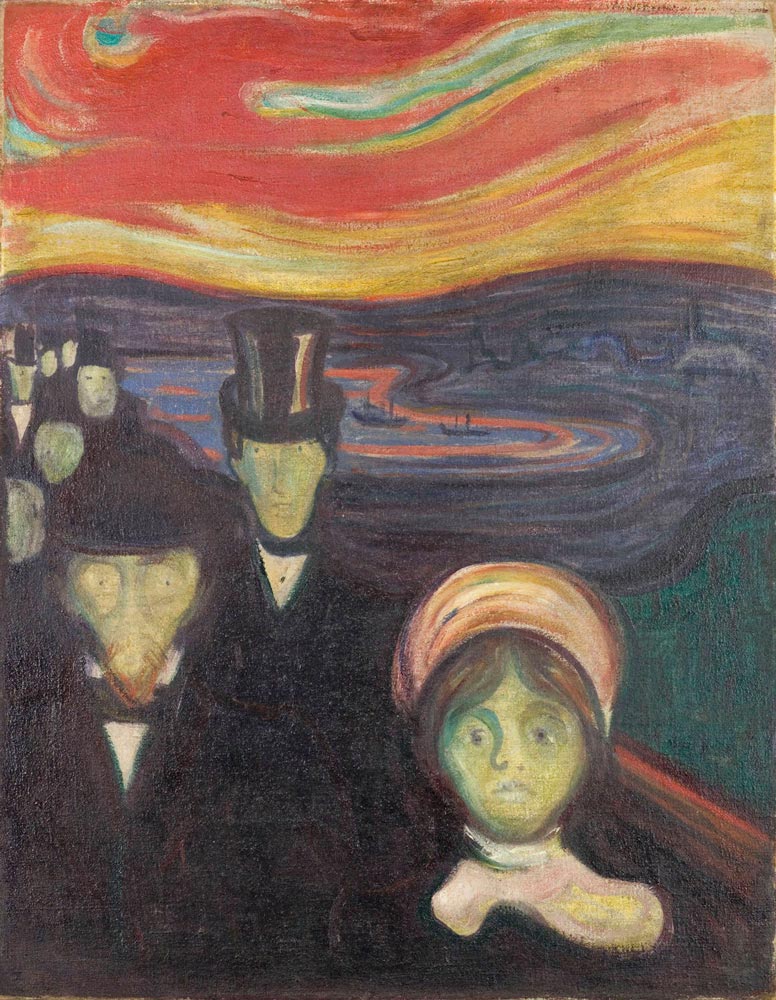


The Rumble of Panic beneath Everything

Anxiety (1894) by Edvard Munch

The counselor in me has always had a vulnerable side when the professional hat is not worn.

I’ve been an interested and emphatic listener of others’ stories since my twenties when the Jesus story first made its impact (coincidentally or consequentially, I’m not sure).  But I’ve not always been able to be a dispassionate empathetic listener. This vulnerability presents itself when I move from empathy to over-identification. The self-centered and self-protective side of my psyche hijacks the genuinely compassionate side and the fearfulness of “this sounds too close to home and could happen to me or a loved one” takes over and I am sorry I ever listened to that person’s story. I don’t know why but this does not happen when I am “clinical Dona” which is a good thing or I would have been admitted to a psych ward after my first year of practice.

I just spent three days in the hospital after getting an acute infection driven bya low white blood cell count due to chemotherapy.  I spent 24 hours in the ICU and two and a half days on a regular floor. In both situations I was in better health than the patients around me and because of this I had conversations with worried and distressed family members that I would meet in the hall or waiting room. I heard stories of protracted and acute suffering and misery in a very short period of time. The empathetic listener had not turned off while I was hospitalized.text for rumble_rev

But there were times during my hospital stay that I wanted it to turn off; like when the descriptions of misery were too raw and graphic. At that point cancer would interrupt the counselor – butt her out with one quick unexpected slam – reminding her that there could be much more misery in store down the road of cancer treatment.  So, after a while compassionate listening would give way to cowardly recoiling and shutdown. I would walk back to my room with more Dona-sadness than with Jack-sadness or Terri-sadness.  Not pretty or admirable.  Thankfully this overly anxious display of self-pity did not last long and did not keep me from praying for these folks and their distressed families.

My guess is that most of you readers are not going to be too hard on me.  In most of us there is that nagging feeling and suppressed thought that suffering and loss are not that far from any of us regardless of the many precautions we take to stay them off. They blindside even the most cautious and genetically hearty of us.

In the introduction of his book, Walking with God through Pain and Suffering, Timothy Keller quotes Ernest Becker:

 “I think that taking life seriously means something like this: that whatever man does on this planet has to be done in the lived truth of the terror of creation…… of the rumble of panic underneath everything.  Otherwise it is false.”

So how are we to live with peace, purpose, joy, love, and hope in light of this rumble of panic?  How are we to recognize a caring, loving God who is for us when at any time the shoe can drop or has already dropped?  I am a novice in this world of suffering but let me offer a couple of thoughts.

David my husband says that in times of crisis we are what we have been trained to be. My experience in watching others who have walked various kinds and degrees of suffering, ranging from tragic losses to debilitating and sometimes fatal illnesses, is that getting through it required leaning on spiritual resources previously learned or acquired.  I am not going to be so presumptuous as to imply that only those who rely on spiritual resources weather their tragedies well.  I have read or heard  inspiring stories of people who have weathered great hardship without apparently leaning on God.

But my experience in working in the US and the Middle East as well as meeting people from all over the world is that when push comes to shove it is spiritual resources that provide comfort and strength in times of critical helplessness; not perfectly or always heroically, but nonetheless “a leaning on” that brings comfort.  I heard similar disclosures last week in the hospital’s halls and waiting rooms.

So, what are these spiritual resources that I hear about from the sufferer?

  • Praying
  • Complaining to a God who is both there and not too thin skinned to take it.
  • Drawing on scripture for comfort
  •  Developing a Biblical awareness of the myriad of sufferings addressed in the biblical text with its various antidotes.
  • Receiving the practical and sacrificial helps and prayers of the church and friends that show the compassionate face of Christ, and finally,
  • Acknowledging that something supernatural is at work; ideally, a healing but certainly a feeling of the Holy Spirit’s presence. THEY ARE NOT ALONE.

I, too, have been relying on the above resources; not perfectly or even consistently . In a previous post called, Chipmunk Cheeks, I mentioned the futility of expecting God to give me the grace for my grim or fearful imaginings. He has not promised to do that. He has promised to be with me in the present and give grace for that present. If I lay hold of that truth once again I will be able to be fully present with those who tell me their woeful stories of pain and grief.  Only then can I be numbered as one of the spiritual resources on which they can rely. “Oh God let it be true about me.”

I am a “6” and my husband is a “7”

I am a “6” and David is a “7” on the enneagram personality inventory.

Who cares and so what?

I enjoy this popular personality inventory stuff.  Bear with me.  Later, I will lead you to some of the most inspiring thoughts.   Not mine (be gone chemo-brain hubris!) but quotes from recently published, must-read book.

A ‘six’ personality type is a natural doubter and questioner. So, I did not have to have cancer to wonder why God allows suffering.  I have questioned others within theological circles and read numerous publications in an attempt to make peace with suffering from a Christian faith perspective. Caring about suffering did not just happen when I found myself enduring some of it because of cancer treatment. I have questioned smarter people than me and I have, I admit, questioned God on this matter. Theodicy (defense of God’s goodness and omnipotence in view of the existence of pain  and suffering) has been topic of theological and practical struggle for me for the past 4 decades.  But like Peter one of Christ’s followers, when asked whether he too would leave Jesus like many following Him did because of the hard teaching Jesus had just laid out, Peter’s (Dona’s) response was “where else would I go as you have the words of eternal life.”  (John 6:68)

But occasionally the doubt and unease woven throughout my ‘six’ personality type rears its worried head like a watchful seal in the Juneau harbor – casting about looking for potential threats until soothed and reassured only then to slowly submerge beneath the surface.  I trust in the goodness of God afresh.

The ‘Six’ personality type is also the loyalist with strong convictions.  So, being a Six is not all bad.  However it gets funky when the six’s spouse is a ‘seven’ personality type.  ‘Sevens’ are the adventurers and enthusiasts. They naturally trust that everything is going to work out in the end. David’s personality though 90 percent perfect for me, has not generally made for long, long philosophical discussions.  Manna from Heaven for me but more like prison food for David.   Ironically, David will tell you that what caused him to leave the faith as a teenager – the problem of pain, evil, suffering and injustice in the world- would be what brought him back in his early 20’s.  In David’s view, some worldviews logically account for suffering, but only one, Christianity, addresses the problem while offering hope.  (See John 6:68, again).  He’s a man with a vision who wants to do something, shake it out on the fly.  In the classic words of President Arnold Schwarzenegger in ‘The Simpsons Movie,’ he ‘wants to lead not read.’   I am not suggesting that David does not have his own private devotionals but long, long discussions with me has not been his forte.  This is just the nature of a ‘seven’ on the enneagram which is incongruent with the ‘six” which naturally wrings her hands on many issues, philosophical or not.

But along came cancer carrying a book by Timothy Keller, Walking with God in the Midst of Pain and Suffering (Dutton 2013).  Now, almost every morning David and I get our coffee and he reads out loud to me from this book and we discuss and discuss and it has become manna from Heaven for both of us.  I’ll never have all my answers but I’m grateful to Keller and others who without pat answers or arrogance towards those of a different view, honestly and competently engage with the issues.  I highly commend this most-readable book.  I’ll conclude this post with a few Keller quotes:

“Part of the genius of the Bible as a resource for sufferers is its rich multidimensional approach. It recognizes a great diversity of forms, reasons for, and right responses to suffering.” (9)

“In the secular view, suffering is never seen as a meaningful part of life but only as an interruption.” (26)

“Christianity teaches that, contra fatalism, suffering is overwhelming; contra Buddhism, suffering is real; contra karma, suffering is often unfair; but contra secularism, suffering is meaningful. There is a purpose to it, and if faced rightly, it can drive us like a nail deep into the love of God and into more stability and spiritual power than you can imagine.” (30)

“While Christianity was able to agree with pagan writers that inordinate attachment to earthly goods can lead to unnecessary pain and grief, it also taught that the answer to this was not to love things less but to love God more than anything else. Only when our greatest love is God, a love that we cannot lose even in death, can we face all things with peace. Grief was not to be eliminated but seasoned and buoyed up with love and hope.” (44)

“But resurrection is not just consolation — it is restoration. We get it all back — the love, the loved ones, the goods, the beauties of this life — but in new, unimaginable degrees of glory and joy and strength.” (59)

“Suffering is actually at the heart of the Christian story.” (77)

“The best people often have terrible lives. Job is one example, and Jesus—the ultimate ‘Job,’ the only truly, fully innocent sufferer — is another.” (133)

“The only love that won’t disappoint you is one that can’t change, that can’t be lost, that is not based on the ups and downs of life or of how well you live. It is something that not even death can take away from you. God’s love is the only thing like that.” (304)

Mother’s Day 2014

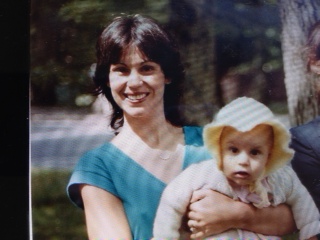
dona and maria 32-years ago: Maria (the one without hair) and me

I didn’t think I could take another poignant sweet anniversary or holiday.  David’s and mine 35th anniversary (I had my chest port inserted) was poignant enough without Mother’s day coming in a close second.  But here I was the day before mother’s day with an unexpected text from my oldest daughter, wanting to shave her own head in mother/daughter solidarity for my cancer treatment.  My initial and steadfast response was NO. But that was after I just swallowed a big lump of sweetness that still sticks in my heart from such an offer. The other daughter didn’t know of this as she was too busy texting me every 30 minutes from Syracuse to remind me to take my anti-nausea meds and eat anything I want, get plenty of rest, etc. and all the while entertaining in-laws from all over to celebrate her husband’s graduation festivities having earned a PhD in Business Administration (well done, Rob).

Hair was falling out in clumps.  So mother’s day was the day that we felt that the shaving of the head ceremony would occur with Maria, oldest daughter, assisting her dad.

It’s now the day after mother’s day and I couldn’t go through with it.  It couldn’t be mother’s day – not the day that 32 years ago this child made my first mother’s day a reality.  Toting her around on my hip with her little bald head was not the image I could escape as I realized that 32 years later on Mother’s day that bald baby was a grown women with children of her own  helping her mother weather a challenge.   Not on mother’s day; the poignancy was too much for even me who adores poignant moments, not just mine, but anyone’s. Deeply moving moments enrich my life – probably another reason that psychotherapy has been my career and passion for years.

Doing a minimal amount of research on the psychology of poignancy did not yield the wealth of readymade quotes to inspire but there were simple descriptions worth mentioning.

  • Poignancy is cognizance of happy-sad emotions related to meaningful endings:  parents watching their child marry or wave goodbye from her new freshman dorm room.
  • Poignant moments increase as we get older because we are more aware of the passing of time. We are more aware of the limits of time here on earth and therefore transitions are more bittersweet.
  • It is not that the young cannot experience poignant or bittersweet moments.  Look no further than high school graduations and all other graduations after that to see the tears in some eyes and the feelings of sadness of an era ended, never to return, but still the satisfaction, even joy, of a necessary milestone achieved.

Anticipating Maria shaving my head on mother’s day showcased an era ended and another begun – a daughter competently trading places with her mom.  Poignant for me but more utilitarian for her.  She can do something for me, her Mom, which I can’t do for myself – pure and simple for her but bittersweet for me; not soon to be forgotten.

I’ve learned that people will forget what you said,
people will forget what you did,
but people will never forget how you made them feel.
– Maya Angelou

 All of this makes me wonder if Christ had bittersweet experiences or moments of poignancy.  I don’t believe the word is used in the Bible but I can’t help but think that as Christ buddied around with his followers and friends at dinner parties that there were not moments when He knew this would end, and His to approach the bitter cross would begin.  The meaningful end of fellowship with friends was at hand. And perhaps He felt an emotion akin to poignancy. Bitter but sweet because He also knew that the resurrection would follow that separation and usher in something infinitely better and new in the future of all concerned.  Including you and me.


An exclusive moment within diversity

blessedThere was only one black man in the phlebotomy waiting room. Unusual because the waiting room was crowded and usually representative of ethnic origins and different races living in this city. One of the many reasons I love Buffalo.

I came in first and was seated. I noticed him because he was also the only one of us wearing a mouth mask, not an uncommon sight in a cancer institute but noticeable. He sat across the room from me and I smiled at him.  His eyes told me he had smiled back.  I had not had much luck with anyone else (smiles are important to me; see my post, Duchene’s Smiles, Please).  Everyone seemed wrapped in their world of worry or boredom with yet another routine to follow for the care they need.

He pulled down his mask so I could see him smile and said, “Are you having a nice day?”

I answered back, “I have no complaints.”

As if talking to himself he said, “You trust in God and leave everything up to him” to which I answered “amen.”

He then directed his comments back at me as if returning from a place of prayer. “I am a blessed man, a very blessed man”.

Since we were talking across the room from each other I wondered what people were thinking.But it was like the two of us were there alone.  I continued, “I can tell you are a blessed man because of your ball cap.”

He seemed momentarily confused until he took it off, exposing his baldness, and read the words on the cap, “I AM A BLESSED MAN.” He laughed as he explained he forgot that he had that particular ball cap on but agreed with it wholeheartedly.  At this point I was called in to have blood drawn.  I left the waiting room feeling the exclusivity of a tender moment with a man who openly and unabashedly shared my hope.

“Always be ready to give account for the hope you have……”

–          I Peter 3:16

Nick, the barber, says, “Trust God, then your doctors.”

Since my cancer diagnosis a year ago my husband’s barber, Nick, has given him two pieces of advice.

“You tell Dona like I told my wife. You stay aliveyou stay healthyyou stay upbeat!  Not just for yourselfnot just for the people who love you, but for the people who hate youWhen they see you walking down the sidewalkthey say, ‘that woman still around?!’  And when they see you look-in good it will give themclinch in the gut.”

And….tell Dona

“Trust God, and then your doctors.”

Although left speechless after hearing the first bit of advice I appreciated the second. But how can I trust God for my well-being and trust doctors at the same time for my cure?  I think about this all the time.  I say that I trust God but yet I find myself hanging on every word of a medical provider as if I’m hearing from ancient oracles pronouncing my destiny.  I don’t like the feeling of smallness that happens when I talk to a provider at the cancer institute.  The little girl inside me is saying, “Please be nice to me because you are bigger and I am small right now so you can hurt or help me.”

It’s not quite that pathetic but exaggeration serves the point.  I defer to medical providers as if they hold the balance of my life in their hands.  But this flies in the face of everything I believe about who truly holds my fate in His hands.

I have said all these things to you so that in me you may have peace. In the world you have trouble: but take heart! I have overcome the world. (Jesus quoted in John 16:33)

I am not disabusing modern medicine in light of faith.  I am grateful for the medical advances in the care of those with illnesses.  I thank God for those who use their intelligence, ingenuity and compassion to develop treatments and cures for the myriad of diseases that plague humanity.

But what is the role of God in a person’s life when the material world offers so many empirical, concrete procedures and assurances?

My husband said that we treat science as God, technology as the Holy Spirit, and I’ll complete this false trinity by noting that the mental health profession is seen as Christ.

“Trust God first and then trust the doctors.”  But as a person who worships the Creator of the material world rather than the material world itself, how is this to look?  How is this played out in a way that moves me away from spiritual platitudes to words that reflect my deepest convictions and hope?  Well, for starters I must believe that God exists and that He can be trusted.  I don’t get there easily and I don’t get there by hard work.  I get there by being inspired, or more to the point, something is opened up to me and I enter in.  At the same time there is work, some soul work, involving curiosity and study.  For God knows that this world is not going to hand God’s trust to me on a platter.

Ultimately, there will come a point where the pursuing, studying, questioning and reflecting demand a leap of faith.  But it won’t be a blind leap. It will be a wide eyed here I go, for better for worse, for richer or poorer kind of leap.  Do these words remind me of another leap?  Yes, belief in God is like the decision to say ‘I do’ at the altar of marriage – not blind but certainly not a 100 percent certain. But there is enough information, time, dialogue and togetherness invested to make the leap seem more than reasonable – almost compulsive or desperate!  It is an I-have-to-have-this-person-in-my-life kind of leap.

So what is it to trust in God? It’s knowing we belong together; pure and simple.  He is mine and I am his, no matter what happens. Medical science and its allies are created to lighten a burden but we are not on intimate terms.  I am not their “darling” but I am God’s and so it goes for each one of us that trust Him.

Dona Eley is a cancer survivor and a mental health therapist for the Community Christian Counseling Center in Juneau.  She blogs at donaeley.wordpress.com

In this world you have trouble: but take heart! I have overcome the world.

(Jesus quoted in John 16:33)

Fear of Dying

The atmosphere was tense in the CT scan waiting room.  Nothing seemed particularly different at first blush – several men and women waiting their turn to have a machine tell them something about their tumors.  Like me, many were being accompanied by a family member or friend.  By this time, I had been in the breast cancer waiting room several times.  The atmosphere in the BC waiting room I now see as qualitatively different.  A friend referred to it as, “You and your sisters waiting together.”  None of that filial bonding in the CT scan waiting room.  We were a mixed gender and we were there representing a variety of different malignancies.  No one likes the word “cancer” but I imagined you flinched a bit when you read “malignancies.”  But that is how it felt.  I think that it had more to do with fear than anything else.  I wasn’t seated long before I heard the frustration and anger of one man directed at the two receptionists.  He and his wife had been waiting a long time and he was upset, “this place is incompetent and needs more accountability” was one of his many comments.  His disgust and self-righteousness was difficult to hear.  But later his gait to the CAT scan room told the story of great pain and a life threatening condition.  Another woman was angrily defending her cell phone’s dependability with one of the CT scan techs. “I have my phone with me all the time so there was no way you tried to call me to change the appointment.”  She pleaded, “I need this to happen today so that my oncologist can start my meds again for my liver and pancreas.”  I wanted to cry for her.

Things calmed down for me a bit until the two mega TV screens came on with a feature story on the plight of Syrian refugee children.  The shocking statistics of children who had already died in the Syrian war and the continuing health crisis of children in the refugee camps including an outbreak of polio only served to increase the malignant atmosphere of the waiting room.  By the time I was ushered into the CT scan room I was praying, “Come Lord Jesus, Come.  There is too much pain and fear of dying in this world so just come and set everything right.”

Laying on the CT machine’s gurney, I thought I was doing well emotionally considering my experience in the waiting room.  But I was suddenly betrayed by my limbic system.  Out of nowhere, my heart was racing and my breathing was rapid and shallow.  Where did this come from?  Within a nana-second I knew why.  My body was picking up the physical sensations of fear before a rational thought was registered.  The classic case of the amygdala beating the frontal cortex to the punch.  “Oh no, the test is over so why is the tech taking so long to come back to me?  They must be seeing something that is of concern.  The horse is out of the barn!  Metastasis!”

The fear of dying had just made itself known.  So, I did what a few friends had suggested in fearful situations.  I started quietly quoting relevant bible verses audibly. Verses that I had memorized in my twenties, the time in life to memorize as the young brain seals the deal.  It helped. I can’t say with confidence that the fear of dying will never find its way back to me again or that the way out of it will be to always quote scripture but there is a scripture verse I am taking to the bank of heaven.  It’s a verse that doesn’t depend on me to muster up a no-fear-of-dying feeling in order for it to be operative.  In Romans 8 verses 37-39 of the New Testament the Apostle Paul writes,

“No, in all these things we are more than conquerors through him who loved us. For I am convinced that neither death nor life, neither angels nor demons, neither the present nor the future, nor any powers, neither height nor depth, nor anything else in all creation, will be able to separate us from the love of God that is in Christ Jesus our Lord.”

By the way, I found out two days ago and now, four days before my surgery that the CT, bone and MRI scans were clear.  The horse is still in the barn.

It’s not the Sword of Damocles

There are so many moments that I forget that I have cancer- not totally surprising since I haven’t had anything done yet except for the 3 biopsies on the right breast. But I am pleased to say that I am able to forget that this is hanging over me especially when I am with my daughters and their families, laughing at the antics of my grandsons.  The lively conversations and activity make me feel so normal and vibrant. Then there are other times when I am counseling someone and able to be fully present with their pain and confusion. Or the times when my husband, David says something outrageously funny and the laughing and joking makes me feel lighthearted without a care in the world.  I really do forget at moments like these that I have cancer.  I am so grateful that this can happen. But then unease sets in and I can’t shake the feeling of a Damocles who ate dinner at the court of Dionysius with a sword hanging over his head by the single hair of a horse’s tail.  The thought ominously glistens above my head, “you have cancer”. Wow that’s scary”. “I could have gone longer without that realization to sober me up” or worse yet, “why? After all I am (was) a healthy woman who had regular mammograms and no family history”.

But then I am reminded that we live in a fallen world where sickness and tragedy hit so many with far more intense and terrifying force than anything I will ever experience. And many, many will experience that hardship with far less support and love than I am receiving.  And if it has anything to do with who is deserving of good fortune well count me out for I have already had more than my share.  So, here is what I believe from the scriptures which life seems to accurately validate: “The rain falls on the just and the unjust” (Matthew 5:45) and so does the drought.  The promise we have is that Jesus is with us through it all. I don’t want to come across super spiritual or strong because I am not naive. This will be a journey with pain and discouragement that will possibly provoke reactions that I will be less than proud of. But for today I am going to go with gratefulness for the prayers and love from others and “God’s peace that transcends all understanding” (Phil. 4:7).