This may sound trite and irreverent: ‘Great Reads’ for a devastating loss. When a ‘Great Reads’ list pops up on my Kindle it lists books selected to amuse and entertain. But ‘great’ is defined as “remarkable in magnitude, degree, or effectiveness.” (Merrium-Webster) And that what is great can comfort, enlighten and even transform. I have groped about for all those in my year of grief.
So here is my list of books and articles, great reads I have turned to again and again for comfort and reassurance. I would be grateful if you could share what has helped you.
Top choice:
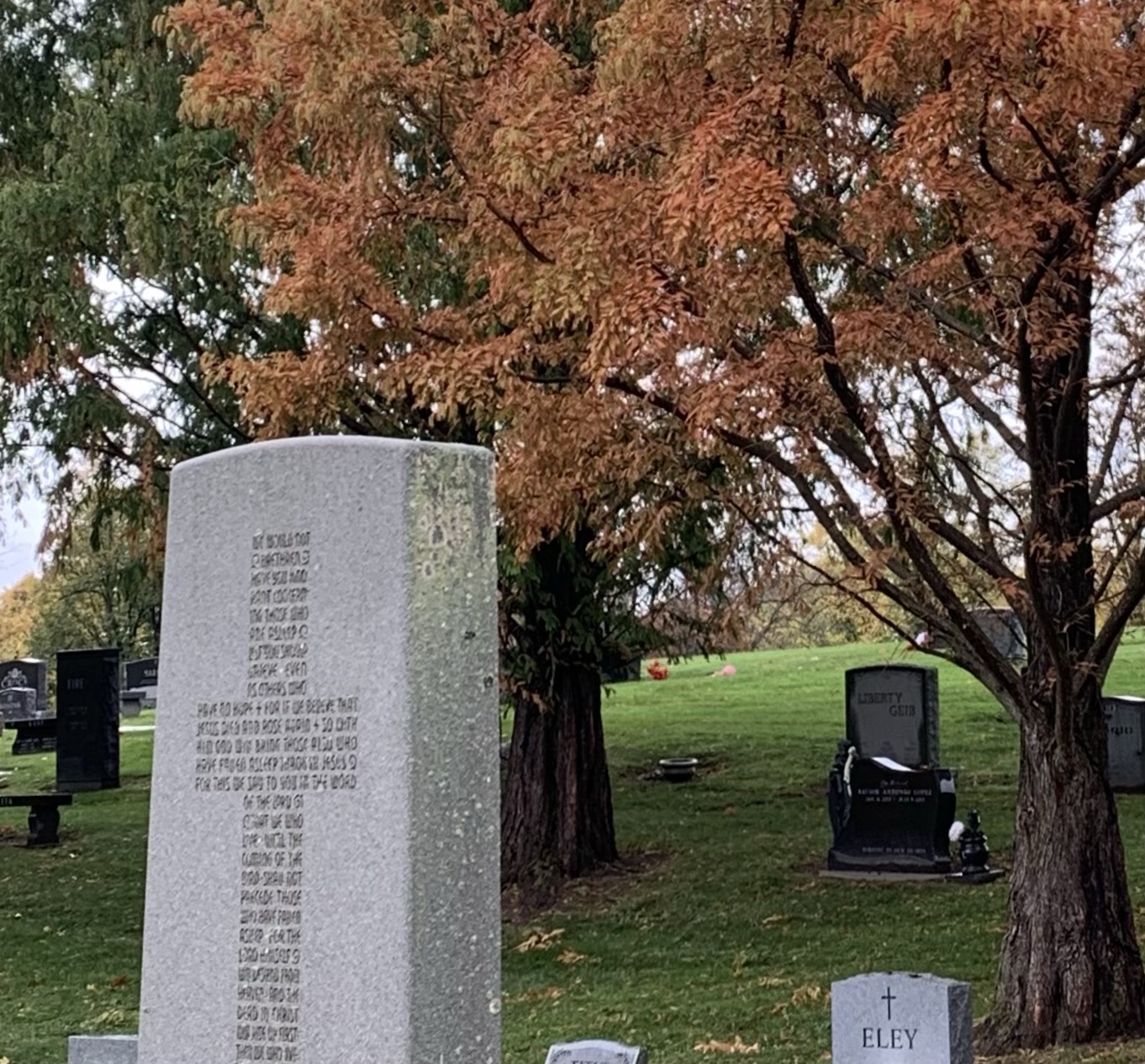
1 Thessalonians 4:13-18 inscribed on a memorial adjacent Dona’s grave.
1 Corinthians 15 – simply the best encouragement
Paul reminds us, “if only in this life we have hope in Christ we of all people are to be most pitied.”
(I also read 1 Thessalonians 4:13-18 every time I visit my wife’s grave. The entire passage is inscribed on a family tombstone a few feet from Dona’s gravesite.) “Therefore, comfort each other with these words.”
Close second:
Things Unseen, Mark Buchanan
A book about the “hope of heaven that inspires and sustains passion and purpose in this life and on earth. It’s about learning how to bring heaven near – fixing our hearts and minds on things unseen.” (2 Cor 4:18)
This Canadian pastor has not written a dense theology book. Quite readable with tons of touching stories and even help from scenes in one of my favorite movies, The Karate Kid. I have a friend who lost a child at 18 months. He read Things Unseen in two days.
Third choice:
Walking with God Through Pain and Suffering, Tim Keller
Theology, but explained in a way that only Keller could. (He died of pancreatic cancer in 2023.) I read a chapter a day to my wife when she was going through chemo.
Fourth Place: Three short reads
What Will Heaven Be Like? Thirty-five frequently asked questions about eternity.
See CS Lewis’s chapter on Heaven in his book, The Problem of Pain. Also, Lewis’ journal account, A Grief Observed, about the death of his wife is quite helpful. Initially, he refused to publish it, given that the first third was so raw and despairing. (He called it a ‘yell’.) But, like many of the Psalmists, he works through his anger, grief, and fear towards gratitude for Christ.
An old man loses his cherished wife and has only hand-wringing daughters for comfort. (I note that my daughters are anything but.) Then a mysterious white dog shows up.
Six months after Dona died, I got a new primary care doctor. During the initial intake exam and interview – that time when the doc gathers your medical history with head down keying in info – I told him, when prompted about ‘relational status’, that my wife had died. He stopped typing and looked at me for a full 10 seconds, saying nothing but with a face that showed such compassion and empathy that even now I have a lump in my throat just remembering that ‘connection’.
Two
“You are right, you have told that before, but that is such a sweet story about Dona that I was quite happy to hear it again.”
– Greg McClain
We, the bereaved, want to talk about our spouse. But we worry that we are repeating ourselves and boring our listeners. After talking about Dona, I asked Greg whether he had heard that story before. What a sensitive, affirming response from my daughter’s father-in-law.
Three
“When two people fall in love at least one will have their heart broken. It may be from separation or death, but it is what we sign up for. Love is life.”
– David Eley
Pardon the self-promotion. I said this to Dona when she knew death was near and worried about me. It both saddened and comforted her. She often repeated this right up to the end.
Four
“You were robbed.”
– Gail Schlosser
It was helpful for this pastor and close friend of Dona’s to tell me, “Although I appreciate that you can believe that other people have lost more, and that you are grateful for the life you had with Dona, you were still robbed. Robbed of many more years together, serving together, and experiencing life together.”
Am I grateful for the life I had with Dona? Of course. Gail helped me see that I was over-emphasizing gratitude at the cost of not fully facing my pain. It was time to scale back the “stiff upper lip” and perhaps even complain to God. (For helpful advice on lament, see Carolyn Madanat’s reflections in a previous post.)
Five
Making offers that require a ‘yes’ or a ‘no’.
In the days before and after Dona’s death, friends would tell me, “Let me know if you need anything.” These were sincere offers. They would have given me the shirt off their back if I asked. I appreciated their concern. However, like most guys, maybe even gals, I didn’t know what I needed and likely would not ask if I knew. What I needed was yes or no offers:
“I am bringing chicken parm over at 4 pm. Yes, or no?”
“We have dinner reservations for Tuesday at 6 pm. Please join us. Yes, or no?”
The week after Dona passed my brother-in-law told me he had booked an October hiking trip for us in the canyons of Utah.
At the reception after Dona’s memorial service a friend approached me and said,
“David, I’m so sorry……..now, would you be able to be my partner in the Thursday men’s golf league?”
Too fast? Not for me. Suddenly I had a vision of my future. Well, at least what my Thursdays and the upcoming October would look like.
When my wife learned that her cancer had metastasized, she picked up the pen again. Realizing the difficulties ahead she wrote:
Talking is necessary as the means of vital human connection but talking is not a discipline; not for me anyway. Writing is the spiritual discipline that keeps me grounded. And it has good science to back its claims to stress reduction and trauma healing. Writing forcibly imposes boundaries on thinking. It reins in anxious thoughts that would run off down numberless rabbit trails; causing untold feelings of misery, fear and confusion.
Three days after Dona’s funeral, an empty journal was left on my doorstep with following note:
Dear Dave,
Your text the other day has stuck with me – that you wished you could call Dona or write her a letter to tell her about Saturday….. It got me thinking: what if you did just that? What if you wrote to Dona and told her about all the things that were happening around you and inside you? Mundane events. Profound thoughts. Intense emotions.
Who knows, it might be a good way to process. And will provide a record for you of this hard road you’re on now…
This journal is for you in case you want to write to Dona. And if you think this is a completely daft idea; well, you got yourself a new journal! Or you can set it aside and regift it when you need a present in an emergency.
Peace I leave with you; my peace I give you. I do not give to you as the world gives. Do not let your hearts be troubled and do not be afraid.
– John 14:27
And so, I started writing. I filled that journal, then my son-in-law gave me another, and a friend gave me another. Sometimes I write to Dona, sometimes to God, sometimes using journal prompts suggested in my bereavement group’s workbook, sometimes I just write. Nearly all of what I write would not be useful to anyone else. But I read and re-read them. In a house fire, I would grab my journals before I fled….along with my golf clubs.
Three
Writing is like driving at night in the fog. You can only see as far as your headlights, but you can make the whole trip that way. – E.L. Doctorow
Four
The act of writing is drawing a fence around something wild and untamable, and suddenly it is linear and coherent. The people that write their stories are some of the calmest people that you will ever meet. It might be chaos in your mind, but it will be orderly on the page. Suddenly, all those things banging around in your skull will be put in order as you tell your story. It is going to have a beginning, middle, and end. It will be right. And that creates a sense of calm. I have tamed the chaos, and now I can do whatever it is next.
– Dave Eggers interviewed on TED Radio Hour, May 11, 2023 TED.npr.org
Five
I can shake off everything as I write; my sorrows disappear, my courage is reborn. – Anne Frank
That short sentence, written by a teenage Jewish girl hiding from the Nazi’s, succinctly states the benefits of lament, a practice so often employed by her ancient ancestors in the Psalms of the Old Testament. More on that in another post.
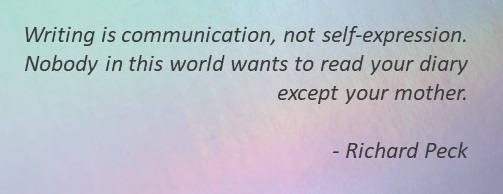
Dona passed away a year ago this month. Many times, I have opened the laptop to write a blog entry, hoping to honor her memory, not to mention the effort she put into this blog, and to share something that might help the bereaved. But all my reflections seemed like way too much navel gazing, self-centered self-expression too personal to be used by others. So, I’m taking another approach. I intend to capture what other people have said, or written, that helped me these past 12 months of grief. For the next several posts, I list my top five quotes about various aspects of the grief journey that were in some ways healing. Please share your own in the comment section.
One
Is there any phrase more useless than, ‘If only?’
– Anonymous
Two
It is what it is.
The dozen members of my bereavement group all agreed that this was a helpful statement. What does it mean for the widowed? Face the circumstances and your loss head on.
Three
Unlike some faith traditions, or the Greek Stoics, Christianity finds nothing particularly noble about suffering – it should not be welcomed. Yet, unlike secularism, Christianity teaches that suffering can be meaningful…… Keller (1)
Difficult times loosen my tie to this world and bring me closer to the Lord. Only suffering can pry me from this world and its pleasures. Moo (2)
However, and………………..
Four
It struck me that the Christian hope has a lot to do with this life but ultimately because it is part and parcel of a tangible, transformative, redemptive eternal life. Distinct personal beings like a “real distinct you” and a “real distinct me” are transformed and in communion with a tangible God in His trinity with absolutely no loss of our distinctive selves. I want this kind of hope- A hope that goes beyond this life. Because whatever spiritual practice we do or whatever medical intervention helps us we will all eventually die. We do not possess ultimate power to stop certain forces at work that threaten to undo us. But we can rely with hope on the One who holds all things in his Hand and whose purposes though inscrutable at times are at the same time meant for our good. So, why not really hope big. Hope with a capital H that carries us into an eternal glorious future while we wait out patiently the infinite glory of God to be revealed in us and in this world and the world to come.
I am reminded that we live in a fallen world where sickness and tragedy hit so many with far more intense and terrifying force than anything I will ever experience. And many, many will experience that hardship with far less support and love than I am receiving. And if it has anything to do with who is deserving of good fortune well count me out for I have already had more than my share. So, here is what I believe from the scriptures which life seems to accurately validate: “The rain falls on the just and the unjust” (Matthew 5:45) and so does the drought. The promise we have is that Jesus is with us through it all. I don’t want to come across super spiritual or strong because I am not naive. This will be a journey with pain and discouragement that will possibly provoke reactions that I will be less than proud of. But for today I am going to go with gratefulness for the prayers and love from others and “God’s peace that transcends all understanding” (Phil. 4:7).
For 8 long years of aggressive cancer treatment Dona clung to this great truth and this great Hope; a hope in a particular truth that has sustained so many in this tough, beautiful world.
(1) Keller, Timothy (2016) Making Sense of God, p.74
(2) Moo, Douglas (2000) The NIV Application Commentary: Romans (see commentary on Romans 5:3-5)
Pain is the most individualizing thing on earth. It is true that it is the great common bond as well, but that realization comes only when it is over. To suffer is to be alone. To watch another suffer is to know the barrier that shuts each of us away by himself. Only individuals can suffer.
Edith Hamilton
How long must I wrestle with my thoughts and day after day have sorrow in my heart?”
Psalm 13:2
About three in the afternoon Jesus cried out in a loud voice, “Eli, Eli, lema sabachthani?” (which means “My God, my God, why have you forsaken me?”).
Matthew 27:46
In our sleep, pain which cannot forget falls drop by drop upon the heart until, in our own despair, against our will, comes wisdom through the awful grace of God.
Aeschylus from Agamemnon
Blessed are those that mourn, for they will be comforted.
Jesus quoted in Matthew 5:4
I’m anticipating venturing into unknown territory. Thankfully Christ came, died and rose from the dead, and in doing so leads us out of death into a new kind of life. But the reality of living this Christian life is that I live it in community; dying is facing God alone. That can be a terrifying thought. If it isn’t, it should be. So, by looking at creation, particularly infinite creation (cosmos), I’m looking at the character, in part, of the Creator. And I am comforted by what I’m seeing.
But I trust in your unfailing love; my heart rejoices in your salvation. I will sing the Lord’s praise, for he has been good to me.
Psalm 13:5-6
It has been three weeks since Dona died, my constant companion for 43 years. No one said it would be easy to endure this loss, I didn’t expect it to be easy, and it isn’t easy. But I am comforted and lifted up by memories; memories of how she breathed life into me over and over again. I am thankful as I think of her unfailing belief in her creator and savior. It was infectious.
And, of course, I am comforted by the support and concern of family and friends. I am thankful for their memories of Dona. Two days ago, I got a text from a friend:
“I’m acutely missing Dona today. There’s something I really want to talk to her about — she would have been my first call:)”
She went on to add:
“I’m sure you’re madly missing her!!”
Yes, I am madly missing her, but that acknowledgement of my loss somehow lifts my spirits.
Grief and loneliness joined with thanksgiving and comfort.
So, we move forward with the knowledge that those that mourn are somehow and someway blessed and will be comforted. Thank God.
This vantage point for the Mendenhall Glacier in Juneau is one of the most photographed views in Alaska. This spot, which I could see from my office when I served in the Coast Guard, offered insight and reassurances as I watched my wife deal with metastatic cancer.
In the foreground is the muskeg meadow; wet, nutrient-rich, verdant, home to vast clumps of fireweed, Alaska’s state flower. In the background, framed by the glacier, are the Mendenhall Towers; mountain peaks rising 1.3 miles straight up from near sea level. These are young mountains, exposed as the vast icefield encasing them began to recede in the 1700’s. First scraped clean by the ice field and continuously swept clean by snow, ice and wind, these peaks have little of the life of the fireweed meadow they preside over.
So different – the fireweed meadow and the rock pinnacles – yet no one would argue successfully that the meadow is more beautiful than the peaks, or vice versa.
The meadow produces; the peaks stand in testimony. The fireweed meadow shows Alaska’s nurturing hand; the peaks show signs of Alaska’s harshest nature: hurricane force winds, snow and ice.
Like fireweed, many of us bloom because we happened to take root in the most accommodating and nurturing of soils. Like the Mendenhall Towers, some of us are scraped clean by the harshness of life, whether it be our environment, disease, or tragedy.
Turning the comparison of the meadow and the peaks slightly in another direction, I can write that nearly all of us start in the bloom of youth and over time evolve to a form more pronounced, bearing the marks of the ice and wind of this world, still beautiful as God’s image bearers, but deeper, more complex, weathered and polished.
I watched Dona deal with a serious cancer since early 2014. Most cancer sufferers are described as ‘fighting cancer’ or ‘enduring a long struggle with cancer.’ I appreciate the spirit and determination those descriptions signal. But Dona did not fight her cancer, she let her oncologist do that. Dona seemed to maneuver her cancer, somehow positioning the disease at a place where she could learn, grow, even flourish. With each setback – a disappointing scan or lab report, a quality-of-life diminishing side-effect – I saw Dona maneuvering, adjusting, and finding a way to grow a little higher, like the Mendenhall Towers of Juneau; perhaps scraped and scoured a bit, but nonetheless ultimately towering over her disease.
Where does this come from?
As much as I would like to give her full credit I cannot. I was with Dona for 43 years. This is a new spirit. She has always had many attractive traits: thoughtful, kind, empathic but, also, a relentless planner, troubleshooter; dedicated to seeing peril around the corner and making big plans to counter the threat. Once she stored $2000 in a box after reading a report that cyber-terrorists could easily shutdown the electric power grid, making banks and ATM’s inoperable. But once she faced her worst and most real crisis, she became less anxious, more relaxed, less out to prove something to herself. When scan reports were not good, Dona took the news with courage, dignity, grace, humility; always encouraging and thanking her health care providers.
And she liked her ‘new metastatic self’. She wrote about it on more than one occasion.
I would not call this new outlook serenity. A more serene person would have done less on-line shopping. It was not stoicism either. We were still quite anxious during each visit to the hospital. As we waited for our oncologist to enter the treatment room, I would read her dumb jokes from the internet as a disruption.
I am still struggling to define and understand the change.
Recently, I have described this change as Dona’s confidence in God’s big plans for her future. Fear revolves around our thoughts about the unknown future and our imagining the worst of that which is unknown. But she was convinced that she had a future, and it was a good one. We prayed for a miracle of healing, for longevity. That is not granted, but no matter, we still have a future, and it is glorious.
Tim Keller writes, “We are future-oriented beings, and so we must understand ourselves as being in a story that leads somewhere. We cannot live without at least an implicit set of beliefs that our lives are building toward some end, some hope, to which our actions are contributing. We must imagine some end to life that transcends.”[1]
But that is not the whole story. Hope and faith are essential, but we need some external help. If it depends only on our personal resolve or insight we are back where we started – some of us succeed through a gift of temperament or fortitude, some not.
And we boast in the hope of the glory of God. Not only so, but we also glory in our sufferings, because we know that suffering produces perseverance; perseverance, character; and character, hope. And hope does not put us to shame, because God’s love has been poured out into our hearts through the Holy Spirit, who has been given to us. Who shall separate us from the love of Christ? Shall trouble or hardship or persecution or famine or nakedness or danger or sword? No, in all these things we are more than conquerors through him who loved us. For I am convinced that neither death nor life, neither angels nor demons, neither the present nor the future, nor any powers, neither height nor depth, nor anything else in all creation, will be able to separate us from the love of God that is in Christ Jesus our Lord.
Romans 5:2b-5; 8:35, 37-39
It can only be the Spirit of God that vitalizes life, communicates God’s truth, and reassures of his eternal plan for us through the grace of Christ.
What was great about this external strength was that when hardship came, I did not worry that Dona would not be able to endure it because it did not depend solely on her. I trust I will be able to draw on that same strength.
I so deeply miss her.
Dave Eley
[1] “Making Sense of God: An Invitation to the Skeptical” by Timothy Keller.
On December 22, 2022, the day before the Great Buffalo Blizzard, we agreed with the oncologist to stop Dona’s cancer treatment and enroll her with Hospice. Focus will be on comfort at home. We feel okay about it. She will likely live longer on Hospice than on aggressive treatment.
Dona sleeps most of the day but is in no pain. Praise God. Although a bit confused at times and very weak, there is a calm and focus that must only come from the “peace of God that surpasses all understanding….guarding her heart and mind in Christ Jesus.”
Medical science and technology have given us 8 great years and, according to Dona, some of her best years. (Seriously, see ‘I Like the New Metastatic Me. ) We are grateful to have been the recipient of a dozen or more cutting edge or proven treatments, (which worked well until wily cancer cells morphed and found a workaround) developed by the best researchers and engineers the world has to offer, and delivered by compassionate surgeons, doctors, technicians, and nurses. But over time treatment has taken a toll. Modern medicine has its limits.
When the best efforts of our medical clinicians are overwhelmed and consumed by disease what is left? For the Christian, it is the hope of the resurrection. What does that look like? Perhaps it is like the discovery of a masterpiece that was hidden when painted over with an inferior work of art. As the later work flakes away due to time and the elements the earlier original is revealed, something beautiful and totally different. Or, perhaps it is as simple as Jesus’ parable of the house built on a rock that leaves the home intact when the winds and rains come. (Matthew 7)
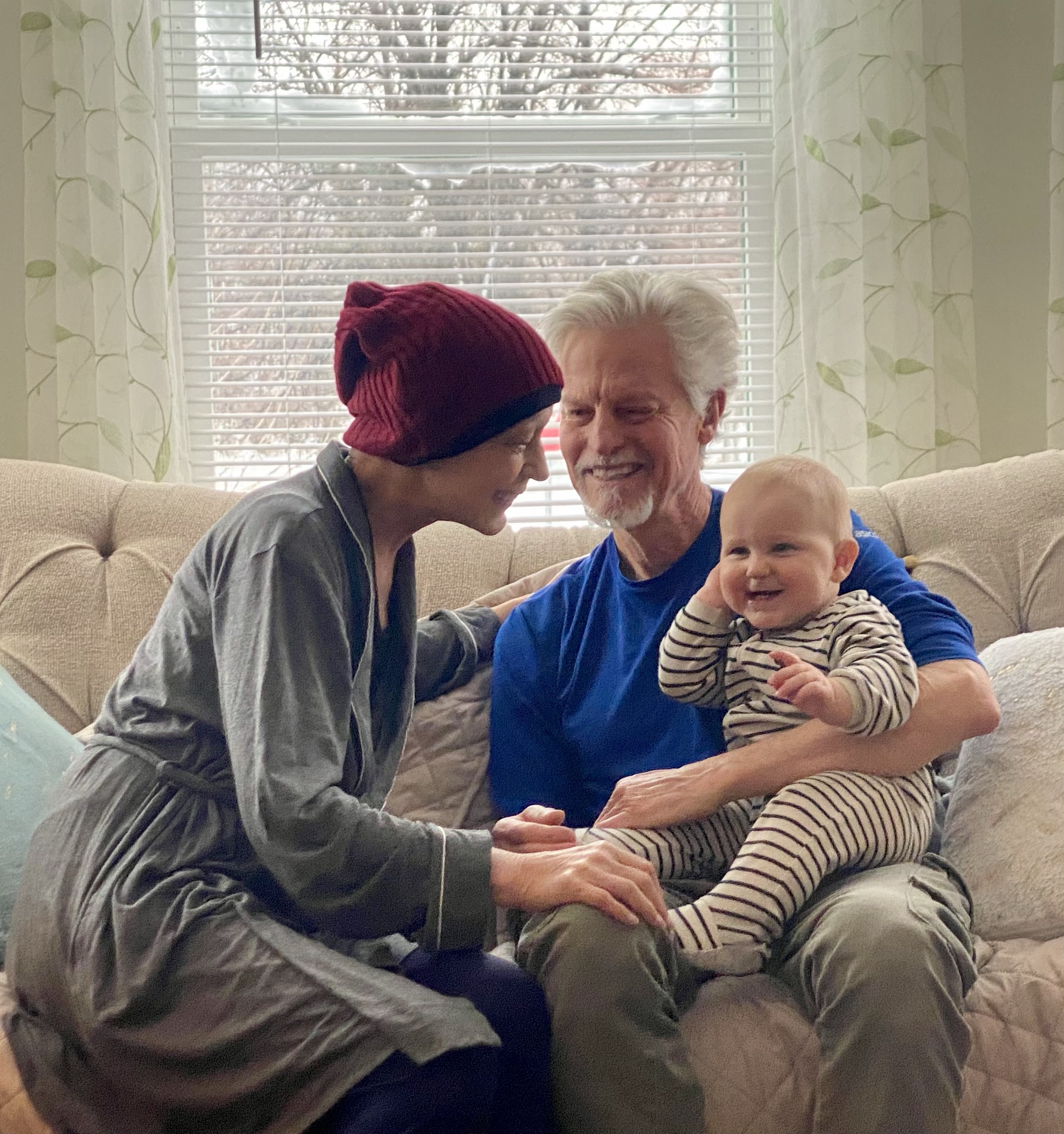
Dona with grandson #4 on Christmas Day 2022 after the Great Buffalo Blizzard
It is that underlying beauty, strength, and solid foundation that is now so evident in my wife. Yesterday, I told Dona, “When my time comes, I hope I can also face my mortality directly, look it square in the face without flinching. But I think I will be frightened.”
She gazed at me for a minute, I was beginning to think she had drifted off, and then she said, “When your time comes God will give you grace and strength. But for now, you need to quit with the chipmunk cheeks.”
She was alluding to two posts she wrote early in her cancer journey. The chipmunk cheek image is from John Piper, who writes:
Behold, I am about to rain bread from heaven for you, and the people shall go out and gather a day’s portion every day (Exodus 16:4).
God’s grace is like manna. God gives us “a day’s portion every day.” This is why Jesus taught us to pray for our “daily” bread, not “next week’s” bread.
We need to quit being chipmunks. We don’t need to try and stuff our cheeks with today’s manna, anxiously storing up fuel for the nasty winter we imagine around the corner. God doesn’t give us grace for our imaginations, he doesn’t give us grace for our chipmunk approach to life. (Emphasis mine.)
The hardcore truth is that this habitual way of viewing the big scary world can quickly become faith-numbing insanity. “Dona,” I say to myself, “where is God in all this worry about the future? What are you fretting about? Who do you believe is really in charge?”
Me, apparently…….God waits for us to wave our white flags and allow his grace to attend to our present needs and not for those imagined future troubles. And that grace is sufficient to carry us through the day.”
So, as Dona says, I’m going to quit (try to quit) being a chipmunk and train myself through repetition, reminding myself of eternal truths, look for joy each day, and trust tomorrow, both for my life and especially for by wife’s, to the hand of God, who transcends our mortal limitations.
Suffering has allowed me to empathize with the suffering of others more deeply. This new level of compassion is both heart-breaking and life-giving in equal measure. I am grateful.
I occasionally get questions that at first glance may seem impertinent or insensitive when posed to a person with Stage 4 cancer. But I am not startled or offended. Afterall, I write unreservedly in my blog about my mortality, and, most gratifyingly, my friends ask questions out of genuine concern and a desire to understand more fully what I am going through.
Recently, a close friend asked:
“Dona, you ever wish that you had died suddenly from an accident or heart attack instead of going through these years of suffering, not knowing when the medical team has no more resources to keep you alive?”
An insightful question I have been pondering ever since.
There was a time when I would have said absolutely, I would rather die suddenly than go through cancer treatments. After all, what other illness fills us with dread as we wonder about lumps, difficulty swallowing, or unrelenting back pain?
Another friend, a physician, told me about a patient that showed up at his medical practice with grave concerns about a skin condition. The doctor’s diagnosis was chronic, severe psoriasis. He told his patient the condition would cause pain, discomfort, interfere with sleep, and make it difficult to concentrate. There would be no cure. The patient relied, “Thank God it’s not cancer!”
We do not walk around fearing heart attacks, gallbladder attacks, car accidents, lupus, or sundry illnesses that can be very devastating and even fatal. It is cancer that fills us with fear. Within literature or human discourse there is no other disease used as a personifier of something malignant, evil, or spreading. (“Bitterness grew like a cancer until it consumed her.” “His hunger for power was a cancer that could not be stopped until he destroyed everyone in his way.”) We use the word cancer because it is a word loaded with all kinds of imagined suffering and dread of when and how it will take our lives. And unlike the animal kingdom we humans have existential angst and future awareness, realizing we are mortal and will leave behind loved ones, future dreams and plans and meaningful work.
Getting back to my friend’s question……
Early on when I discovered I had metastatic breast cancer I wrote a blog post titled “I like the new metastatic me.” It had nothing to do with being masochistic or pathological. It had all to do with welcoming the change of perspective on what was, and what was not, important in life. Consequently, I found a greater peace of mind because I had less things that I was holding onto and less to become anxious about. The new metastatic me simplified life and found me focusing on joy and gratefulness.
Although my cancer had progressed from Stage 3 to Stage 4, I was happy to find that my character development had moved from stage 1 to stage 2. Well, maybe Stage 0.5 to Stage 1.
That was then, this is now. In the last four years there certainly has been more suffering than I would have anticipated when I was first diagnosed with metastatic cancer. But I can say with confidence that after 4-5 years of living with this awful disease that I’m thankful I was not taken suddenly.
I am more others-centered now than 4 years ago. My character development has moved from stage 2 to stage 3. Well, maybe 1 to 2. You get my intent. I am trying to walk the line between braggadocios and false humility. The point is that I have more empathy and heart sickness when I hear of others suffering, whether from the terror-stricken children of Ukraine, the starving children of Somalia, or the grieving parent of a loss child or husband. I used to avoid reading BBC international news (I have an app). Too much tragedy. Now, I read and pray because it disrupts my own suffering and allows, what Mother Theresa called, “my heart to be broken with what breaks the heart of Christ.”
And this suffering somehow reminds me of the Great Hope.
“Not only so, but we also glory in our sufferings, because we know that suffering produces perseverance; perseverance, character; and character, hope.”
Romans 5:3-4
Before unpacking this, I must reiterate that the grace of God has been apparent every step away. He deserves the credit and glory.
Suffering can breed empathy:
When people are faced with a terrible diagnosis there is a choice that must be made. Will the rest of life be driven by bitterness and anger; resenting the unfairness? As I have heard on more than one occasion, “I took good care of myself: ate healthy, exercised frequently, managed stress, and even served God so how did this happen to me?”
As I noted above, there is an aspect of my chronic suffering that has bred empathy and compassion for those who suffer, whether from cancer, other ailments, heartbreaks, betrayals, extreme losses. My prayer life has been richer and more spontaneous as I read the news or talk with people who are hurting. And for those times I forget I have cancer as I focus on them.
I do not know why suffering has produced empathy, but I have a couple of theories.
The God of the cross
We have a God that suffers with us. The late John Stott, theologian and pastor of All Souls Church in London often said he could not worship a God who had not experienced extreme suffering.
“The fact of suffering undoubtedly constitutes the single greatest challenge to the Christian faith and has been in every generation. Its distribution and degree appear to be entirely random and, therefore, unfair. Sensitive spirits ask if it can possibly be reconciled with God’s justice and love.”
I could never myself believe in God if it were not for the cross. The only God I believe in is the One Nietzsche ridiculed as ‘God on the cross’. In the real world of pain, how could one worship a God who was immune to it?
John Stott, The Cross of Christ, pp. 335-336
In summary, my metastatic cancer first gave me a new perspective on what, and what was not, important in life. Consequently, I found a greater peace of mind because I had less things that I was holding onto and less to become anxious about. The new metastatic me simplified life and found me focusing on joy and gratefulness.
Second, suffering has allowed me to empathize with the suffering of others more deeply. This new level of compassion is both heart-breaking and life-giving in equal measure. I am grateful.
My character development has moved from Stage 1 to Stage 3! Will I ever get to Stage 4? Not in this earthly tent!
And this brings me, finally, to the point of all this. The end result of suffering is not character development but hope. (Romans 5:3-4) Hope in what? Eternal life and that time when Christ will “make all sad things untrue.”1 A cold, pitiless universe, full of random disease and tragedy, without God provides little or no incentive to develop character or hope.
If only for this life we have hope in Christ, we are of all people most to be pitied.
1 Corinthians 15:19
Yes, oh yes, I am thankful, suffering or no suffering, for every moment the Lord had graced me with!
1Originally spoken by Sam to Gandalf in J.R.R. Tolkien’s, The Return of the King. Often quoted by Tim Keller and NT Wright in their reflections on the resurrection.





 Dona's Blog